
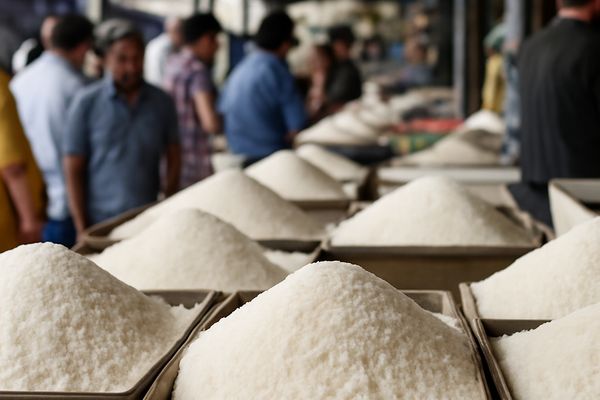
Fine rice prices in India are under clear downward pressure, with weak buying across key segments preventing any meaningful recovery. Despite prices holding at current levels, the overall tone is soft and directionless, and the short‑term balance of risks still leans to the downside unless demand improves.
Demand from traders, bulk buyers and export channels has slowed noticeably, creating a dull market phase where sellers remain active but buyers are cautious. Comfortable supplies in mandis, combined with softer export interest, are reinforcing the bearish undertone. Recent export price moves in Asia and India’s ample rice availability suggest that external markets are unlikely to provide an immediate upside trigger.
Exclusive Offers on CMBroker

Rice
all golden, sella
FOB 0.97 €/kg
(from IN)

Rice
all steam, pr11
FOB 0.47 €/kg
(from IN)

Rice
al ısteam, sharbati
FOB 0.64 €/kg
(from IN)
📈 Prices & Market Tone
Domestic fine rice (barik chawal) is quoted around ₹7,300 per quintal, equivalent to roughly $88 per 100 kg. Using an approximate rate of $1 = €0.92, this translates to about €0.81 per kg at the wholesale level. Despite this, sentiment remains weak, with participants describing conditions as a “dull and weak market phase” rather than an outright collapse.
Export-oriented FOB offers also show a soft, but currently steady, picture. In New Delhi, recent offers for key rice types have been flat week‑on‑week, for example Indian 1121 steam around €0.81–0.82/kg and Sharbati steam around €0.59–0.60/kg on an FOB basis. Vietnamese long white 5% is near €0.43–0.44/kg FOB Hanoi after modest declines in recent weeks, underlining the broader downward drift in Asian export quotations.
| Origin / Type | Spec | Location / Terms | Latest Price (EUR/kg) | 1M Trend |
|---|---|---|---|---|
| India fine rice (barik) | domestic, non-basmati | Mandi (IN), ex‑market | ≈0.81 | Soft / under pressure |
| India 1121 steam | parboiled, export | New Delhi, FOB | 0.88 ≈ 0.81 | Sideways, slightly soft |
| India Sharbati steam | non‑basmati | New Delhi, FOB | 0.64 ≈ 0.59 | Stable |
| Vietnam long white 5% | white, 5% broken | Hanoi, FOB | 0.46 ≈ 0.43 | Slightly weaker |
🌍 Supply & Demand
Sluggish domestic demand is the main drag on the fine rice market. Traders, stockists and bulk buyers have cut back purchases, leading to thin daily volumes and limited willingness to chase offers higher. End‑user offtake appears adequately covered, which reduces any urgency to restock at current price levels.
On the supply side, mandi arrivals are comfortable, keeping spot availability ample. India has recently harvested record or near‑record rice crops, and official and trade projections point to a large exportable surplus through 2026, reinforcing the sense of no immediate tightness in physical supply. This combination of soft demand and smooth arrivals is preventing any upside, even as prices in some competing origins also ease.
Exports add a further layer of weakness. While India remains the dominant global exporter, recent months have seen slower incremental buying from some destination markets and logistical headwinds linked to geopolitical tensions. This has especially impacted premium and basmati segments, indirectly weighing on sentiment for fine non‑basmati rice by crowding more volumes back into the domestic channel.
📊 Fundamentals & External Drivers
Fundamentally, the fine rice market is caught between ample supply and lacklustre demand. The lifting of earlier export curbs has left India with strong participation in global trade, but global buyers are now facing plentiful options and softer prices across multiple Asian origins. OSIRIZ/Inter‑Rice export price indices show a broad easing bias into early 2026, consistent with reports of a global rice surplus and record Indian output.
Speculative and hedge‑fund interest is relatively limited in physical fine rice compared with other grains, so price discovery is being driven mainly by physical flows rather than paper market volatility. That makes the current weakness more fundamentally grounded: without a clear demand catalyst, there is little reason for buyers to front‑load purchases. Weather risks are, for now, less prominent than in past seasons; recent assessments point to broadly normal conditions in key Asian rice belts, supporting the expectation of continued comfortable supply.
📆 Short-Term Outlook
The immediate outlook for the fine rice market is weak to stable. In the base case, prices are expected to hover around current levels in euro terms, with a slight downward bias if buying remains as subdued as in recent weeks. Any sharper decline would likely require either a renewed slowdown in exports or a fresh wave of forced selling from stockists.
On the upside, the most realistic trigger is a pickup in demand from domestic bulk buyers or a rebound in export inquiries once logistical and geopolitical uncertainties ease. Until then, the market is likely to trade in a narrow range, with sellers active and buyers continuing to negotiate hard on prices and quality.
🧭 Trading Outlook & Recommendations
- Buyers (millers, bulk users): Consider staggered purchases rather than aggressive forward booking, as the current weak tone and ample supply argue against a near‑term price spike. Use any small dips in euro‑denominated prices to secure immediate requirements.
- Sellers (farmers, stockists): Avoid heavy distress selling where storage is available, but be realistic on offer levels. The market is soft and directionless; holding out for significantly higher prices in the very short term appears risky.
- Exporters: Focus on optimizing logistics and hedging currency exposure, as margins are thin in a soft price environment. Competitive pricing relative to Vietnam and Thailand remains crucial to defending market share.
📍 3‑Day Directional View (EUR Basis)
- India, fine rice ex‑mandi: Slight downward to sideways bias in euro terms, as local weakness offsets minor FX moves.
- India, FOB non‑basmati (New Delhi): Largely stable with a soft tone; small discounts possible to stimulate buying.
- Vietnam, FOB long white 5%: Sideways after recent easing; no major catalysts for a rebound within the next few days.
Related posts:
 Rice Market at a Crossroads: Flat Futures, Soft FOB, Rising Geopolitical Risk
 Rice Market under West Asia Shock: Basmati Pressure vs Domestic Grain Stability
 Rice under Pressure: Low Grain Prices, High Costs and Execution Risk
 Basmati Under Pressure: How Weak Exports Are Reshaping the Rice Market
 India Basmati Rice: Stable Exports Under West Asia Stress
 Rice Market Under Pressure: Vietnam’s Volumes Rise, Prices Soften
 Wheat under pressure: Indian mill slowdown meets global ample stocks