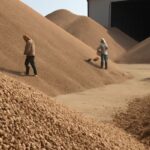
Desi chana prices in India are holding firm in a strong, well‑supported market, even as export-oriented chickpea offers from India and Mexico show a mild softening in recent weeks when expressed in EUR.
The domestic desi chana market is trading in a narrow and stable band, with no visible distress selling despite regular arrivals. Farmers are selling in a controlled manner and demand from traders and dal mills remains steady, keeping the market balanced with a slight positive bias. At the same time, FOB chickpea offers from India and Mexico have edged a few percent lower since late February, reflecting some easing in international values but without translating into pressure on the Indian desi chana segment.
Exclusive Offers on CMBroker

Chickpeas dried
count 42-44, 12 mm
FOB 1.28 €/kg
(from MX)

Chickpeas dried
count 75-80, 8 mm
FOB 0.81 €/kg
(from MX)

Chickpeas dried
count 60-62, 8 mm
FOB 0.83 €/kg
(from IN)
📈 Prices & Market Structure
Desi chana in Indian mandis is quoted around ₹5,650–₹5,700 per quintal, equivalent to roughly €0.63–€0.64 per kg (about €63–€64 per 100 kg), and has held these levels without meaningful fluctuation. The tone is described locally as a “strong and steady market”, with buyers active and no panic selling by farmers. Ongoing arrivals are being absorbed smoothly, indicating that current price levels are well accepted by both sides of the market.
| Product | Origin | Specification | Terms | Latest Price (EUR/kg) | Prev. Price (EUR/kg) | Trend (late Feb → mid Mar) |
|---|---|---|---|---|---|---|
| Chickpeas dried | IN | 42–44 count, 12 mm | FOB New Delhi | ≈€0.89 | ≈€0.93 | Modest easing |
| Chickpeas dried | IN | 44–46 count, 11 mm | FOB New Delhi | ≈€0.86 | ≈€0.90 | Modest easing |
| Chickpeas dried | MX | 42–44 count, 12 mm | FOB Mexico City | ≈€1.23 | ≈€1.26 | Slightly softer |
| Chickpeas dried | MX | 75–80 count, 8 mm | FOB Mexico City | ≈€0.79 | ≈€0.81 | Slightly softer |
(EUR conversions are indicative, assuming approx. ₹100 ≈ €1.00 and 1 USD ≈ 0.92 EUR.)
🌍 Supply & Demand Balance
On the supply side, arrivals into mandis are described as regular but not heavy, and there is no evidence of aggressive unloading. Farmers are deliberately pacing sales, which prevents inventory overhang and underpins the current price corridor. The absence of excess supply pressure is a key factor behind the present firmness.
Demand from traders and dal mills is steady rather than spectacular, but sufficiently consistent to clear the flow from the countryside. Buyers remain active, and the lack of panic selling suggests confidence that current levels are sustainable. Overall sentiment is firm and balanced, with the physical market behaving like a tightly held, fundamentally supported structure.
📊 Fundamentals & External Influences
The core fundamental picture for desi chana is one of equilibrium: supply is well managed at farm level, and domestic demand is resilient. This stands in mild contrast to export-oriented quotes in India and Mexico, where EUR-denominated FOB prices have edged down by a few cents per kg since late February. That softening signals a slight loosening on the global side but has not translated into visible weakness in Indian mandi prices.
The premium for larger calibres remains intact in FOB markets, with 12 mm material from both India and Mexico still commanding a noticeable mark-up over smaller sizes. For European buyers, the recent drift lower in offers means marginally better import purchase levels, but the underlying firmness in Indian desi chana limits the scope for a sharp downside. The market remains more vulnerable to incremental demand upside than to a sudden supply surge.
📆 Short-Term Outlook
In the near term, the desi chana market is expected to stay broadly stable with a slight positive bias. As long as farmers continue controlled selling and arrivals remain orderly, downside risk appears limited. Any incremental improvement in demand from dal mills or regional buyers could quickly translate into modest price appreciation from already firm levels.
Internationally, the recent softening in FOB chickpea values suggests that further downside in EUR terms is possible if sentiment weakens in pulses more broadly. However, the tight and steady situation in India’s domestic desi chana segment should act as a cushion against deep corrections. Weather in key producing regions will be watched, but at this stage it is not the dominant driver of price direction.
🧭 Trading Outlook & 3-Day View
- For importers/European buyers: Use the recent softening in FOB EUR prices from India and Mexico to secure partial cover, but avoid over-extending expectations for further discounts given firm Indian mandi conditions.
- For Indian traders: Maintain a balanced book; current levels look well supported, and limited downside suggests carry positions remain justifiable with prudent risk management.
- For dal mills/end-users: Consider staggering purchases; the market is stable, so chasing higher levels is not yet necessary, but low dips are likely to be shallow and short-lived.
3-day directional indications (EUR terms, indicative):
• India FOB New Delhi chickpeas: sideways to slightly firm, range-bound in the high €0.80s–low €0.90s/kg.
• Mexico FOB chickpeas: stable to marginally soft, with 12 mm around the low €1.20s/kg and smaller sizes in the high €0.70s–low €0.80s/kg.
• Indian domestic desi chana (mandi equivalent in EUR): stable around €0.63–€0.64/kg with a mild upward bias if demand improves.