
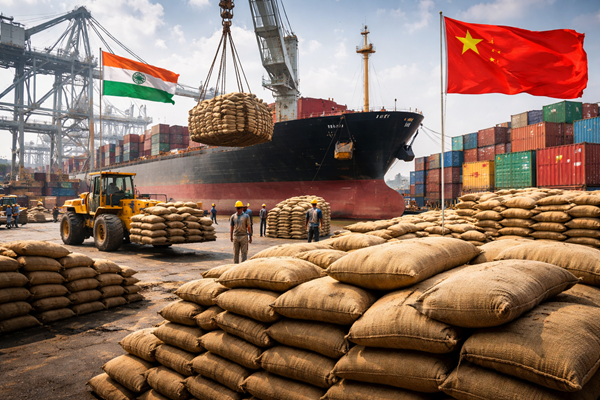
India’s oilmeal exports to China surged more than 20-fold in the current fiscal year, driven by competitive pricing and strong demand, but rising geopolitical tensions could threaten future shipments.
Data from the Solvent Extractors’ Association of India (SEA) showed exports to China reached 779,016 tonnes between April 2025 and February 2026, compared with just 38,240 tonnes a year earlier.
China drives surge in India oilmeal exports
China emerged as the largest buyer of Indian oilmeals, particularly rapeseed meal and castorseed meal.
During the period:
-
Rapeseed meal exports: 771,435 tonnes
-
Castorseed meal exports: 7,581 tonnes
The sharp increase reflects strong demand from China amid changing global trade dynamics.
Competitive pricing boosts Indian shipments
Indian exporters gained market share due to lower prices compared to global competitors.
Indian rapeseed meal is priced at around $225 per tonne, significantly cheaper than European supplies at about $297 per tonne.
This price advantage made India an attractive supplier for Chinese buyers.
China tariff policy reshapes trade flows
The surge in exports followed China’s decision in March 2025 to impose a 100% tariff on Canadian rapeseed meal, which reduced Canadian shipments.
India benefited from the supply gap and increased exports to China.
However, China has now suspended these tariffs from March 1, 2026 to December 31, 2026, which could intensify competition.
Exporters expect pressure on Indian shipments as Canadian supplies return to the market.
Overall oilmeal exports decline
Despite strong demand from China, India’s total oilmeal exports have declined.
-
February exports fell 22% to 257,961 tonnes
-
April–February exports declined 11% to 3.49 million tonnes
The decline reflects weaker demand in other markets and logistical challenges.
War disrupts shipments to Middle East and Europe
Geopolitical tensions in West Asia have disrupted shipping routes, affecting exports to key markets.
Around:
-
20% of exports to West Asia
-
15% of exports to Europe
are at risk due to instability in the Strait of Hormuz and the Red Sea.
Shipping companies are avoiding these routes, leading to longer transit times and higher costs.
Shipping delays increase export costs
Exporters are facing delays of 10–15 days due to rerouting shipments via the Cape of Good Hope.
This has created container shortages and increased freight costs.
Industry participants said these disruptions could reduce export competitiveness.
Market outlook
Analysts said the India oilmeal exports to China may remain strong in the short term.
However, rising competition from Canada and ongoing shipping disruptions could limit growth.
Market participants will closely monitor global trade policies and logistics conditions.
Related posts:
 Indian Soybean Complex Under Strain as War Chokes Oilmeal Exports
 India Port Suspension of West Asia-Bound Cargo Triggers Immediate Risk Repricing in Sesame and Agri Exports
 War May Slow Economy Briefly, India to Support Exporters
 India Likely to Extend Duty-Free Pulses Imports Amid Iran War and El Niño Concerns
 Ukraine Grain Exports Largely Unaffected by Iran War, Analyst Says
 Crop Prices Fall as Trump Signals Possible End to Iran War