
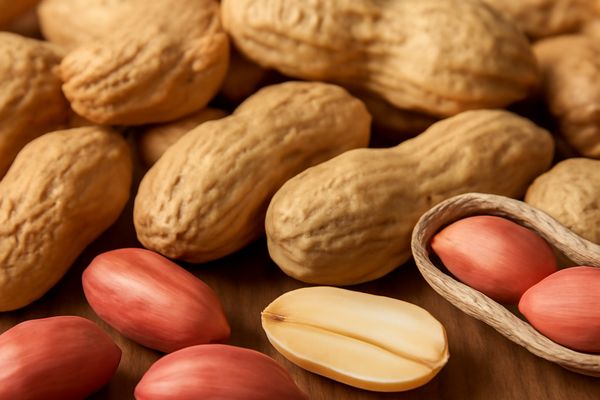
Indian groundnut prices are trading under pressure as higher production expectations and steady arrivals from Gujarat and Rajasthan weigh on average-quality lots, while premium kernels and Java grades remain comparatively firm.
The current market clearly rewards quality rather than volume. Abundant supplies are capping upside for standard groundnut in key mandis, keeping the national average around the lower end of the recent range, with government MSP forming a notional floor if procurement gains pace. At the same time, export-grade, low‑moisture kernels and Java varieties continue to command a premium, supported by better crushing and export margins. Traders and processors need to differentiate more sharply between bulk, average-quality arrivals and high-spec kernels to optimize procurement and hedge exposure over the coming 1–2 weeks.
Exclusive Offers on CMBroker

Peanuts
roasted split, 60/70/80
FOB 1.20 €/kg
(from IN)

Peanuts
raw
FOB 1.28 €/kg
(from BR)

Peanuts
birdfeed
CFR 1.06 €/kg
(from IN)
📈 Prices & Spreads
Average groundnut prices softened, with the national benchmark at about USD 80.00 per quintal (≈ EUR 73–75), down from USD 82.70 previously. Major markets show a wide dispersion, reflecting quality and regional factors: high quotes in Kallakurichi (USD 96.80) and Gingee (USD 108.90) versus weaker levels around Sriganganagar (USD 74.00) and Jaipur Kukadkheda (USD 66.70). Premium kernel markets such as Kalaburagi (kernel at USD 139.20 per quintal) remain significantly above the bulk pod segment, underlining strong kernel demand.
Kernel prices also illustrate the quality spread. Raw groundnut is around USD 1.03/kg (≈ EUR 0.94–0.96), while premium kernel trades near USD 1.33/kg and sortex-cleaned lots around USD 2.18/kg (≈ EUR 1.99–2.05). Variety-wise, Java 50–60 is indicated at USD 1.27–1.33/kg, above Bold 40–50 at USD 1.03–1.15/kg, consistent with the firmer tone in Java grades.
🌍 Supply & Demand Drivers
On the supply side, expectations of higher production this season and continuous arrivals from Gujarat and Rajasthan are the dominant bearish forces. Ample physical availability across major mandis is discouraging aggressive buying in average-quality pods, especially where moisture and grading are inconsistent. This oversupply environment limits any sharp upside in the broader market despite scattered strength in select centers.
Demand, however, is bifurcated. Standard-quality groundnut used for basic crushing and domestic consumption faces only routine buying, with buyers able to negotiate due to plentiful options. In contrast, demand for premium-quality, low-moisture and export-grade kernels is firm, driven by exporters and value-added processors who are willing to pay up for consistent size, color and low defect rates. Java grades and sortex-cleaned lots therefore maintain a notable premium over bold varieties and ungraded arrivals.
📊 Fundamentals & Policy Context
The government’s Minimum Support Price (MSP), around USD 87.80 per quintal (≈ EUR 80–82), is an important reference and potential downside cushion. With spot averages currently below this level in several regions, any scaling up of official procurement could stabilize or modestly lift prices in weaker mandis. However, in the absence of sustained MSP operations, the market is likely to trade independently, driven primarily by local supply-demand balances and export parity.
Trade data indicate a clear hierarchy in kernel values: bold runners and whole-with-skin kernels are trading at a discount to premium and Java kernels, reflecting relative scarcity of top-quality lots and steady export interest. Current export-oriented offers from India, such as Java 50–60 and 60–70 count, show firmer EUR-equivalent prices than bold 40–50 and 50–60 grades, aligning with the domestic pattern of strength in finer, well-graded material.
🌦 Weather & Crop Outlook (Key Indian Regions)
In the immediate term, there are no major weather disruptions reported for key groundnut belts of Gujarat and Rajasthan. With harvest largely advanced and arrivals continuing at a steady pace, short-term price action is more a function of marketing flows than of new crop risk. Mild and seasonally normal conditions support stable post-harvest quality, limiting any natural tightening on account of weather-related damage.
Given the already ample supply pipeline, even minor weather disturbances would likely have a limited bullish impact unless they materially affect stored stocks or late-planted fields. Market participants should nonetheless monitor any government advisories or regional rainfall anomalies that could influence storage losses or transportation, especially in interior markets.
📆 Near-Term Price Outlook (7–10 Days)
Over the next 7–10 days, groundnut prices are expected to trade broadly sideways to slightly weak within a range of roughly USD 78.50–82.30 per quintal (≈ EUR 72–77). Persistent high arrivals and comfortable stocks argue against a strong rally in average-quality pods. Only a clear acceleration in MSP-based procurement or a visible pickup in export buying is likely to push the national average decisively above the equivalent of USD 88.00 per quintal.
The quality premium should remain pronounced. Java, sortex and other export-grade kernels are likely to hold or marginally extend their gains versus bold and average lots. Regional leaders such as Kallakurichi, Gingee and high-quality kernel centers should continue to outperform weaker origins where supply is heaviest and quality more mixed.
🧭 Trading & Procurement Strategy
- Focus on premium quality: Prioritize Java, sortex-cleaned and well-graded kernels where demand and margins are structurally stronger than in bulk pod markets.
- Selective buying on dips: Use current weakness in average-quality pods for cautious, incremental procurement rather than aggressive accumulation, especially below the MSP-equivalent band.
- Watch MSP execution: Closely monitor the pace and regional spread of government procurement; active MSP operations could quickly harden prices in undersupplied mandis.
- Differentiate by region: Adopt a more defensive stance in surplus areas like parts of Rajasthan and Gujarat, while being prepared to pay modest premiums in quality-focused centers with strong kernel demand.
📍 3-Day Directional Outlook (Key Indian References, in EUR)
| Market / Product | Current Level (approx. EUR) | 3-Day Bias | Comment |
|---|---|---|---|
| All-India average pods | ~73–75 EUR/qtl | Mildly bearish to sideways | High arrivals; limited support unless MSP buying increases. |
| Java kernels (50–60 count) | ~1.15–1.20 EUR/kg | Sideways to slightly firm | Export and premium demand keep premiums intact. |
| Bold kernels (40–50 count) | ~0.94–1.05 EUR/kg | Sideways | Comfortable supply; trades at a discount to Java and sortex. |
| Sortex/export-grade kernels | ~2.00–2.05 EUR/kg | Firm | Tight availability of top specs and steady export interest. |
Related posts:
 Kashmir Almonds Under Pressure as Imports Tighten the Squeeze
 Cashews Under Pressure: Big 2025/26 Crop Caps Kernel Prices
 Global Cashew Market Under Pressure as African Crop Quality Weakens and War Disrupts Trade
 Indian Java peanuts firm as Brazilian raws plateau on flat demand
 India’s Walnut Sector Under Pressure: Undervalued Imports Disrupt Domestic Market