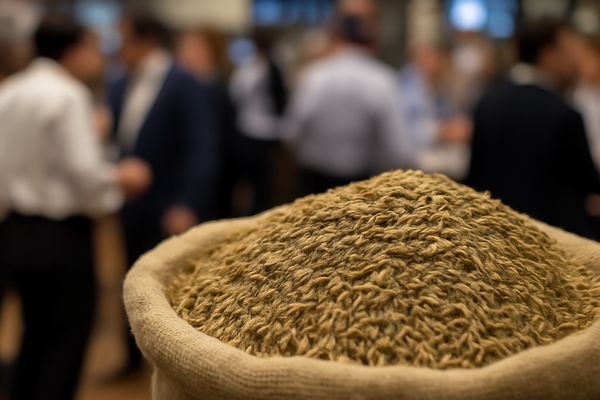
Organic dill seed FOB New Delhi has softened modestly over the past month, while conventional sortex quality remains flat, signalling a mildly corrective but still firm market.
Indian dill seed prices are moving in a narrow range, with organic offers from New Delhi easing for a fourth consecutive update, whereas conventional sortex material has been broadly stable. Exporters report generally good availability from the last harvest and active interest from Europe and the Middle East in the wider Indian spice basket, but without any fresh, dill-specific supply shock in the last few days. Weather in North India is seasonally warm and dry, supporting logistics and late-season field operations rather than constraining supply. In this environment, buyers are obtaining slightly better terms on organic grades, while sellers are reluctant to discount sortex-quality dill seeds.
Exclusive Offers on CMBroker

Dill seeds
FOB 1.27 €/kg
(from IN)

Dill seeds
sortex
99,95%
FOB 1.01 €/kg
(from IN)
📈 Prices & Recent Moves
All prices below are indicative FOB New Delhi and converted to EUR (approx. 1 USD ≈ 0.92 EUR).
| Product | Origin | Location | Last Update | Price (EUR/kg, FOB) | WoW Change |
|---|---|---|---|---|---|
| Dill seeds, organic | India | New Delhi | 20 Mar 2026 | ≈ 1.17 | -2.3% vs 14 Mar 2026 |
| Dill seeds, organic | India | New Delhi | 14 Mar 2026 | ≈ 1.20 | -1.5% vs 7 Mar 2026 |
| Dill seeds, sortex 99.95%, non-organic | India | New Delhi | 7 Mar 2026 | ≈ 0.93 | 0.0% vs 28 Feb 2026 |
- Organic FOB New Delhi has slipped from roughly 1.24 EUR/kg in late February to about 1.17 EUR/kg by 20 March, a cumulative decline of about 6–7% over four weeks.
- Conventional sortex material has held near 0.93–0.95 EUR/kg, showing a flat trend over the same period.
- The organic–conventional premium remains wide (around 25–30%), but the recent softening suggests improved organic availability or slightly weaker demand at the margin.
🌍 Supply, Demand & Trade Context
India remains the dominant global spice supplier, with exports projected around USD 4.45–4.7 billion in FY 2024–25, underpinned by strong demand from China, the US, UAE, UK, EU and others for a broad range of spices rather than any single item. While dill is a relatively small segment, it benefits from these established trade channels and logistics.
Recent Indian trade and policy news has been focused on the wider spice basket and on the India–EU Free Trade Agreement signed in January 2026, which reduces or removes tariffs for several processed foods and vegetable oils and is expected to improve overall agro‑food trade flows between India and the EU. While dill seeds are not singled out, lower trade frictions for food products generally support export sentiment and contract discussions for niche spices as well.
Current exporter commentary highlights tight freight capacity and some shipping cost volatility for general spice shipments from India, but there are no fresh, dill-specific disruptions reported in the last three days. Activity on trade forums in early to mid‑March 2026 suggests continued interest from EU and UK buyers in Indian whole spices, supported by new and expanding exporter networks.
🌦️ Weather & Crop Conditions (India – Focus Region IN)
For New Delhi and the North Indian plains, late‑March conditions are seasonally warm and generally dry, with the winter–spring western disturbance pattern weakening and the monsoon still months away. No extreme rainfall or temperature anomaly has been reported across major North Indian seed and spice belts over the past few days that would materially affect short‑term dill seed availability or logistics.
This stable weather backdrop supports smooth transport from producing regions into Delhi markets and ports. With sowing for several seed spices already completed earlier in the season and harvesting for some crops approaching, the primary weather risk window is more linked to upcoming pre‑monsoon heat waves rather than the immediate 3‑day horizon, implying limited near‑term weather‑driven price risk for dill.
📊 Fundamentals & Market Tone
- Availability: Price stability in conventional grades and a controlled easing in organic prices together point to adequate pipeline stocks and no acute shortfall.
- Demand: Demand from Europe and the Middle East for Indian spices remains constructive, supported by broader export growth; dill demand stays niche but steady within this flow.
- Policy & trade: The India–EU FTA signed in January 2026 is perceived as structurally positive for medium‑term spice exports, potentially reinforcing buyer confidence in long‑term sourcing from India.
- Costs & freight: Exporters note ongoing freight and routing challenges across several trade routes in March 2026, which can inject short‑term price volatility or delivery risk, though not yet clearly visible in dill FOB New Delhi benchmarks.
📆 Trading Outlook & 3‑Day Price Indication
- Bias: Mildly soft to sideways for organic, flat to slightly firm for conventional sortex over the next 3 days, given recent easing and stable fundamentals.
- For importers:
- Consider scaling into nearby organic dill seed coverage while prices are 6–7% off late‑February levels, especially for Q2–Q3 shipment windows.
- Maintain flexible shipment periods to manage possible freight disruptions, but negotiate for today’s relatively narrow trading range.
- For Indian exporters:
- Use the stable sortex price base to lock in forward contracts, emphasizing quality and traceability in anticipation of stricter EU requirements.
- For organic dill, protect downside with minimum price clauses where possible, as further sharp declines seem unlikely without a macro demand shock.
3‑Day Directional View (FOB New Delhi, EUR/kg)
| Product | Today (21 Mar 2026) | Day 2 | Day 3 | Direction |
|---|---|---|---|---|
| Dill seeds, organic | ≈ 1.16–1.18 | ≈ 1.16–1.18 | ≈ 1.16–1.19 | Sideways to slightly firm |
| Dill seeds, sortex 99.95%, non-organic | ≈ 0.93–0.95 | ≈ 0.93–0.96 | ≈ 0.94–0.96 | Mostly steady |
With weather benign and no fresh supply shocks visible, the dill market around New Delhi is likely to remain orderly in the very short term, with exporters focused on optimizing contract timing against a firm but not overheated global spice complex.