
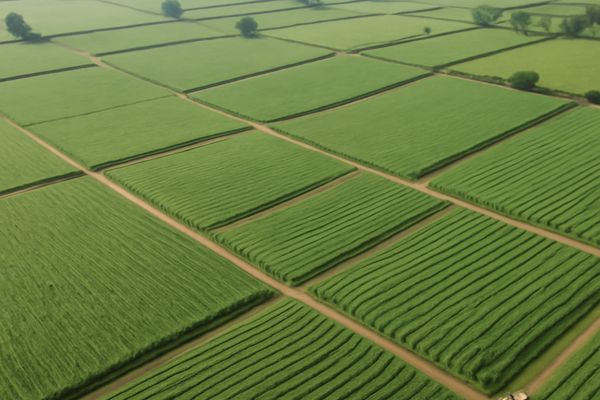
Indian fennel prices are broadly steady to slightly softer, with organic products easing week‑on‑week while conventional seed grades hold flat. Export interest remains firm but not exuberant, as buyers weigh elevated freight and geopolitical risks against comfortable Indian supply. In the near term, prices look range‑bound with a mild downward bias unless early heat stress in Gujarat and Rajasthan starts to threaten the next crop.
Fennel trade in India is currently supported by ample arrivals from the 2025/26 harvest and a still‑solid export pipeline, even as other agri chains (notably rice) face disruptions from Middle East tensions and freight volatility. Exporters are actively marketing Indian spices as buyers seek to diversify origins, but there is little evidence yet of an acute fennel shortage or demand spike. Weather is turning seasonally hotter in western India, with an early heatwave signal in Gujarat, which adds some medium‑term risk if it persists into flowering and seed‑setting in later‑sown fields.
Exclusive Offers on CMBroker

Fennel
whole
FOB 2.30 €/kg
(from IN)

Fennel seeds
grade - A
99%
FOB 1.16 €/kg
(from IN)

Fennel seeds
grade - A
98%
FOB 0.91 €/kg
(from IN)
📈 Prices & Spreads (FOB New Delhi, IN, in EUR)
Using an indicative rate of 1 EUR ≈ 90 INR for export conversions.
| Product | Spec | Latest price (EUR/kg) | 1-week change | 4-week trend |
|---|---|---|---|---|
| Fennel seeds | Grade A, 99% purity | ≈ 1.16 EUR | Stable vs 1.16 EUR | Flat to slightly higher from ≈ 1.12–1.14 EUR |
| Fennel seeds | Grade A, 98% purity | ≈ 0.91 EUR | Stable | Up marginally from ≈ 0.87–0.89 EUR |
| Fennel seeds | Loose, 99% purity | ≈ 1.05 EUR | Stable | Up from ≈ 1.00–1.02 EUR |
| Fennel seeds | Loose, 98% purity | ≈ 0.95 EUR | Stable | Up from ≈ 0.90–0.92 EUR |
| Fennel (organic) | Whole | ≈ 2.30 EUR | Down ≈ 0.05 EUR w/w | Down from ≈ 2.40–2.43 EUR |
| Fennel (organic) | Powder | ≈ 2.20 EUR | Down ≈ 0.05 EUR w/w | Down from ≈ 2.27–2.32 EUR |
Key takeaways:
- Conventional fennel seeds across 98–99% purity grades are holding firm, consolidating modest gains made since late February.
- Organic whole and powder show a mild, orderly correction of about 3–5% from late‑February highs, reflecting softer premium demand rather than a structural shift.
- The seed quality spread (98% vs 99%) remains stable at roughly 0.20–0.25 EUR/kg, signalling balanced demand across mid and top grades.
🌍 Supply, Demand & Trade Flows
India remains the dominant fennel supplier globally, with Gujarat and Rajasthan leading production, supported by Madhya Pradesh and Uttar Pradesh. Recent industry data confirm that fennel arrivals in these states over the last marketing years have been broadly stable, fluctuating around 90–120 thousand tonnes up to early 2024, with no sharp structural decline visible so far.
On the demand side, Indian spices overall continue to find strong export markets, though monthly fennel export volumes have shown volatility in recent years. Earlier figures for 2021–2024 indicate that monthly fennel exports can swing widely with currency moves and freight conditions, but there is no current evidence from the last three days of news of a sudden disruption in fennel‑specific export channels.
Geopolitical tensions in the Middle East are affecting Indian agri trade more broadly, particularly basmati rice, where several hundred thousand tonnes are reportedly stranded and exporters are shifting towards FOB terms to manage risk. While this does not directly hit fennel, it raises freight and insurance costs and encourages buyers to negotiate harder on prices across spice contracts. Some Indian exporters are actively marketing a diversified basket of spices, nuts and seeds to attract long‑term buyers in this environment, which indirectly supports fennel offtake without generating price spikes.
☀️ Weather & Crop Conditions (IN focus)
Weather in key fennel belts is turning seasonally hot. The India Meteorological Department recently issued an orange heat alert for Ahmedabad, with maximum temperatures reported above 41°C and an intense heatwave developing across parts of Gujarat. This is broadly consistent with the onset of pre‑summer heat in western India.
For the standing fennel crop and near‑term sowing decisions, this heat is a double‑edged sword. In already‑harvested areas it mainly aids drying and reduces disease pressure, but for late‑sown or seed‑filling fields, a prolonged heatwave could trim yields and essential‑oil quality. At this stage, there is no fresh evidence from the last three days of significant crop damage reports in Gujarat or Rajasthan specific to fennel. However, continued above‑normal temperatures into late March would start to skew medium‑term balance mildly bullish.
📊 Fundamentals & Market Drivers
- Arrivals & inventory: Recent data on fennel arrivals up to early 2024 show no structural supply shock, implying reasonably comfortable pipeline stocks entering 2026.
- Export performance: Historical exports for fennel from 2021–2024 show that monthly shipments can surge when prices are competitive and freight is manageable, but the latest commentary contains no sign of current export curbs or policy changes aimed at fennel.
- Macro spice context: India’s spice sector as a whole has expanded production to around 12–12.5 million tonnes in recent years, underpinning export capacity and limiting the upside in individual spice prices unless weather or policy shocks emerge.
- Logistics & freight: Disruptions around the Strait of Hormuz and elevated freight/insurance premiums—as seen in basmati rice—act as a headwind to net‐back prices, but also incentivise buyers to secure origin‑near stocks, favouring FOB deals ex‑India.
📆 Short‑Term Outlook & Trading Ideas (3–5 days)
With conventional fennel seed grades stable and organics drifting modestly lower, the near‑term bias is for a sideways market with a soft undertone, especially if heat remains within seasonal norms and no new export policy announcement appears.
Trading outlook (FOB India, in EUR)
- Exporters: Consider locking in forward sales for 99% purity Grade A around the current ≈1.15–1.18 EUR/kg band, using small discounts on powder and whole organic fennel to stimulate volume while protecting margins through FOB terms.
- Importers/industrial buyers: Use the present softness in organic fennel (≈2.20–2.30 EUR/kg) to extend coverage for Q2 shipments, but avoid over‑buying until there is clearer evidence of weather stress in Gujarat and Rajasthan.
- Traders/speculators: Bias towards range‑trading strategies, buying mild dips in conventional seeds if heatwaves intensify, and selling small rallies in organic grades if export demand remains moderate.
3‑Day Indicative Regional Price Direction (FOB, IN)
| Region / Hub | Product | Current level (EUR/kg) | 3‑day directional view |
|---|---|---|---|
| New Delhi (IN) | Fennel seeds, Grade A 99% | ≈ 1.16 | Stable (±1%) – good supply, balanced export demand |
| New Delhi (IN) | Fennel seeds, Grade A 98% | ≈ 0.91 | Stable to slightly firm – buyers favour value grades |
| New Delhi (IN) | Fennel organic whole | ≈ 2.30 | Slightly softer – mild correction after recent highs |
| New Delhi (IN) | Fennel organic powder | ≈ 2.20 | Slightly softer – limited immediate upside catalyst |
Overall, Indian fennel remains competitively priced in EUR terms, with only moderate short‑term weather and logistics risks. Market participants should monitor IMD heatwave alerts in Gujarat/Rajasthan and any spill‑over from Middle East freight disruptions for early signals of a change in this largely range‑bound structure.
Related posts:
 Cumin Prices Ease Slightly as Indian Harvest Progresses; Egypt and Syria Stable
 Indian Arrowroot Powder Prices Edge Higher Amid Early Heat in North India
 Indian Turmeric Prices Ease Slightly as New Crop Builds and Exports Stay Firm
 Cumin prices ease but tight Indian crop keeps market supported
 Pepper prices ease slightly in IN–LK–VN as Vietnam stays in charge
 Indian Fenugreek FOB Softens as Heat Builds Over North India
 Indian fennel FOB prices edge mixed as exports stay firm
 Egypt Hibiscus Prices Edge Higher as Heat Tightens Supply Mood