
🔵 Executive Summary
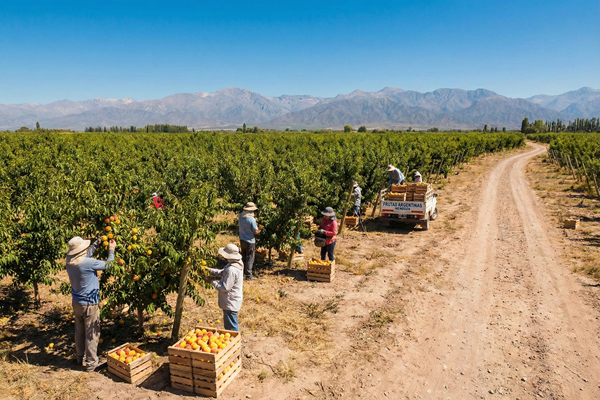
Argentina’s National Institute of Agricultural Technology (INTA) is introducing three new peach cultivars — Tehuelche INTA, Chamamé INTA, and Rosalinda INTA — set to reach consumers in November 2025 through a local commercial producer.
The varieties are part of a broader breeding program comprising 30 cultivars developed by INTA San Pedro. The initiative reflects long-term varietal research aimed at strengthening domestic fruit production, improving orchard renewal, and enhancing market competitiveness through differentiated attributes such as fruit color, size, and harvest timing.
Commercial integration began in 2021 and marks a gradual transition toward regionally adapted, locally developed peach genetics.
🌱 Breeding Background & Development Timeline
The three new cultivars originate from a registry of 30 varieties compiled in 2017 by INTA San Pedro.
The naming convention emphasizes Argentine cultural identity, referencing:
-
Indigenous communities
-
Folk dances
-
Rivers
-
Prominent national figures
Development Cycle
Fruit variety development remains a long-term process:
-
15+ years from breeding to official registration
-
Additional years for commercial-scale adoption
-
2–3 years post-planting before first harvest
While biotechnology tools now help predict fruit behavior based on molecular composition, full commercial validation still requires field testing and grower adoption.
🤝 Commercial Integration & Producer Adoption
The commercialization phase was formalized in 2021 through cooperation agreements with:
-
Chamber of Producers
-
Chamber of Producers and Packers (Northern Buenos Aires region)
Adoption Model:
-
Four companies planted five trees of each of the 30 cultivars for performance trials.
-
Two companies opted for commercial-scale orchards under the program.
The current market entry comes from a producer undergoing orchard renewal rather than a large-scale industrial grower — indicating measured but strategic adoption.
🌍 Regional Impact
Today, approximately 80% of peach varieties cultivated in northeastern Buenos Aires are materials introduced, evaluated, or registered by INTA San Pedro.
The new releases represent:
-
Continued modernization of the varietal portfolio
-
Integration of decades of regional fruit-growing knowledge
-
Enhanced adaptability to local climatic conditions
The program aims to update the production base with cultivars optimized for:
-
Harvest timing
-
Plant vigor and structure
-
Fruit color
-
Fruit size
-
Market presentation
📦 Market Implications
New peach varieties typically target:
-
Better shelf appeal
-
Improved post-harvest performance
-
Harvest window optimization
-
Alignment with domestic retail demand
As orchard renewal cycles progress, locally bred cultivars may reduce dependence on imported genetic material and enhance national branding.
Short-Term Impact:
Limited volume effect in 2025 due to gradual scaling.
Medium-Term Outlook:
Expanded acreage if performance meets commercial expectations.
🧭 CMB Market Interpretation
The release of Tehuelche INTA, Chamamé INTA, and Rosalinda INTA reflects a structural strategy to strengthen Argentina’s domestic stone fruit competitiveness through local breeding innovation.
Key Observations:
-
Long development cycles limit rapid market shifts.
-
Orchard renewal decisions are increasingly quality-driven.
-
Producers prioritize fruit size, color, and harvest timing for retail competitiveness.
-
Regional adaptation offers potential resilience against climate variability.
While initial production volumes will be modest, the broader 30-cultivar program suggests a sustained modernization push.
📊 Risk Assessment
| Factor | Risk Level |
|---|---|
| Commercial Adoption Pace | Moderate |
| Orchard Replacement Cycle | Gradual |
| Market Acceptance | Moderate |
| Climatic Variability | Ongoing |
| Export Expansion Potential | Emerging |
📌 Why This Matters Now
-
Orchard renewal is critical for long-term productivity.
-
Domestic breeding reduces reliance on imported cultivars.
-
Consumer preference increasingly favors appearance and uniformity.
-
Regional adaptability is becoming more important under climate variability.
The November 2025 rollout marks the first commercial exposure of these cultivars to Argentine consumers.
🏁 Conclusion
The market debut of Tehuelche INTA, Chamamé INTA, and Rosalinda INTA represents the culmination of over a decade of breeding work by INTA San Pedro.
While immediate production impact will be incremental, the initiative signals a long-term strategic shift toward locally adapted, performance-driven peach varieties.
The pace of adoption will determine whether these cultivars reshape Argentina’s regional stone fruit landscape over the coming years.