
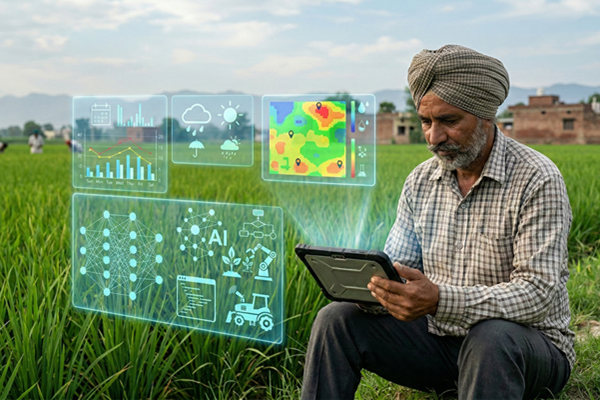
Artificial Intelligence (AI) is steadily emerging as a transformative force in Indian agriculture, a sector that employs nearly half of the country’s population and underpins national food security and economic stability.
As climate pressures intensify and market volatility increases, AI-driven tools are being integrated into agricultural policy and farm-level decision-making, marking a structural shift toward data-led farming practices.
From Traditional Farming to Data-Driven Agriculture
The integration of digital platforms, satellite imagery, remote sensing, and sensor-based systems is enabling farmers to access real-time insights on:
- Weather patterns
- Soil conditions
- Crop health
- Market trends
- Historical yield data
The central objective of AI adoption is twofold: reduce input costs and improve productivity.
In a climate-sensitive economy like India, AI applications are proving particularly valuable in managing:
- Unpredictable rainfall
- Pest and disease outbreaks
- Temperature fluctuations
- Price volatility in agricultural markets
Precision Farming Gains Ground
One of the most significant applications of AI lies in crop monitoring and early warning systems.
AI-enabled systems use satellite data and machine learning algorithms to:
- Detect pest infestations at early stages
- Identify crop diseases before visible damage occurs
- Monitor plant health remotely
This enables timely intervention, minimizing crop loss and reducing excessive pesticide use.
Several states have already deployed AI-based irrigation systems, optimizing water use through automated, data-driven scheduling — a critical advantage in water-stressed regions.
Forecasting Models Reduce Climate Risk
AI-powered forecasting models are enhancing farm-level risk management by analyzing:
- Rainfall patterns
- Temperature variations
- Seasonal climate data
These models generate predictive advisories that guide farmers on:
- Optimal sowing windows
- Irrigation scheduling
- Harvest timing
Such predictive capability helps reduce weather-related losses and stabilize farm incomes.
AI in Agricultural Marketing
Beyond production, AI is reshaping agricultural marketing channels.
Data analytics tools enable farmers to:
- Track real-time price movements
- Identify optimal selling windows
- Choose the most remunerative markets
AI-driven digital marketplaces are also connecting farmers directly with buyers, reducing intermediary layers and improving transparency in price discovery.
Structural Challenges to Adoption
Despite its potential, AI adoption in Indian agriculture faces significant structural constraints:
- Uneven access to smartphones and digital devices
- Limited internet connectivity in rural areas
- Gaps in digital literacy
- Variations in landholding size and production capacity
If access remains concentrated among larger or better-resourced farmers, technological inequality could widen.
Policy Imperatives
Experts emphasize that AI integration must be supported by:
- Strengthening rural digital infrastructure
- Expanding broadband connectivity
- Ensuring reliable agricultural data systems
- Providing structured training and extension support
Inclusive implementation is critical to ensuring AI benefits small and marginal farmers.
Strategic Outlook
If effectively embedded within agricultural policy frameworks, AI could play a decisive role in:
- Enhancing productivity
- Building climate resilience
- Improving farm management systems
- Supporting evidence-based policymaking
- Advancing sustainable agriculture
India’s agricultural modernization trajectory increasingly depends on how seamlessly AI technologies are integrated into grassroots farming systems.
Conclusion
Artificial Intelligence represents more than a technological upgrade — it signals a structural transformation in Indian agriculture.
With proper infrastructure, policy support, and inclusive deployment, AI has the potential to redefine productivity, strengthen resilience against climate shocks, and improve income stability for millions of farmers across the country.