
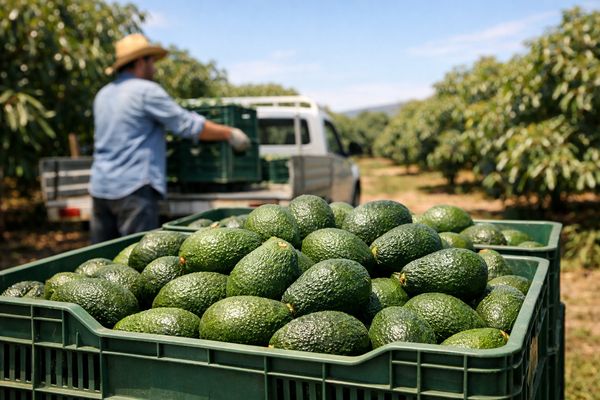
Avocado demand in 2026 remains structurally strong, driven by protein-forward eating and omnichannel shopping, while supply from Peru and Mexico is ample, capping sharp price rallies in the near term.
Across retail and foodservice, avocados have shifted from a niche trend to a weekly staple, embedding into routine baskets in the US and increasingly in Europe. Category value is now tied less to short-lived fads and more to durable consumption habits and meal structures built around protein. On the supply side, robust Mexican and Peruvian harvests point to comfortable volumes for key import markets. Together this suggests firm underlying demand but a broadly balanced market where localized tightness or promotions, rather than deep structural shortage, will be the main short-term price drivers.
📈 Prices & Demand Structure
Over the past decade, avocados have completed a transition from occasional purchase to high-frequency item, with industry data showing rising purchase frequency and stronger basket values. In 2026, omnichannel shoppers (those buying both in-store and online) are the most valuable segment, purchasing avocados around 16 times per year and spending roughly EUR 54–56 annually (converted from about USD 59). Their spend and frequency are around 50% higher than in-store-only shoppers, underlining the importance of digital channels for price realization and volume turnover.
At the basket level, avocados function as a value anchor. When they appear alongside protein items such as eggs, meat or dairy, total basket value rises by about EUR 45–50 on average. This means retailers can tolerate some price elasticity on the fruit itself, as the incremental revenue is captured across the wider basket. Combined with strong baseline demand, this dynamic supports relatively stable consumer-facing prices in the near term, even as upstream supply expands.
🌍 Supply & Trade Flows
Global supply into 2026 looks ample. Mexico entered 2026 with larger harvest volumes and favorable weather conditions, which pushed domestic prices down by roughly 25–30% year on year while exports to the US reached record levels ahead of peak demand events such as the Super Bowl. In Peru, industry body ProHass projects the 2026 Hass campaign at around 765–773 thousand metric tons, about 6–7% above 2025, consolidating its position as a key supplier to Europe and North America.
Europe is expected to absorb roughly two-thirds of Peruvian exports in 2026, with the US and Asia sharing most of the remainder. South African and other Southern Hemisphere origins add further seasonal coverage into the EU and UK. Preliminary 2026 supply projections for EU/UK show continued comfortable incoming volumes from multiple origins, suggesting strong competition among exporters for shelf space and buyer programs. In this context, trade flows are being shaped more by logistics, quality and program reliability than by outright scarcity.
📊 Fundamentals: Consumer Behaviour & Channel Mix
The main structural driver in 2026 is the protein-centric diet trend. About 70% of Americans report actively trying to consume more protein, up eight percentage points since 2021. Avocados, while not high in protein, pair naturally with protein-rich meals, providing healthy fats and fibre. This has repositioned them from a standalone “superfood” to a functional component in meals built around eggs, meat, dairy or plant proteins, reinforcing weekly purchase behaviour.
Retail channel dynamics amplify this effect. In 2025, around 21% of US households shopped both online and in-store, up from just 5% in 2019, and these omnichannel shoppers drive the highest avocado volumes and spend. Their behaviour is particularly important for price formation: they are less promotion-driven and more focused on availability and convenience, which supports stable baseline pricing and higher acceptance of premium ripe-and-ready or pre-packed formats.
Although the underlying data focuses on the US, similar patterns are visible in Europe, where avocados now feature in mainstream supermarket assortments and meal kits. This alignment of consumer trends across the Atlantic makes demand more resilient to moderate price fluctuations, reinforcing the fruit’s status as a core category rather than a discretionary add-on.
🌦️ Weather & Short-Term Outlook
Weather remains a key watchpoint, particularly in Peru and Mexico. For the current 2026 Peruvian season, El Niño-related heat has led to some fruit drop and pressure on commercial sizes in northern regions, but overall export volumes are still expected to grow mid-single digits versus 2025, implying that weather issues are significant at a micro level but not yet market-tightening at the macro level.
In the near term (next 30–90 days), demand in North America and Europe is expected to remain stable, underpinned by entrenched consumption habits. Seasonal production cycles across Mexico, Peru and South Africa will continue to influence weekly arrivals and spot pricing, but with multiple origins in play and strong export programs, global availability looks adequate. Buyers should focus on monitoring Q2 2026 harvest progress and size distribution rather than anticipating major volume shortfalls.
📆 Trading & Procurement Outlook
- Retailers (US & Europe): Treat avocados as a strategic, high-frequency category. Prioritize consistent quality and year-round availability over aggressive price discounting, as the main value lies in the higher overall basket spend when avocados pair with proteins.
- Importers & Category Managers: Use the current supply expansion from Peru and Mexico to lock in forward programs at competitive EUR prices, but build flexibility for size curves and potential quality variation due to weather-stressed orchards.
- Foodservice buyers: Given robust supply, leverage volume-based contracts rather than chasing spot market dips. Focus on ripeness specifications and waste reduction to protect margins rather than on cent-per-kilo savings.
- Producers & Exporters: With demand growth increasingly linked to omnichannel and health-driven segments, invest in branding, quality assurance (e.g., dry matter standards) and sustainability credentials to differentiate in a crowded supplier field.
📍 3-Day Directional Price Indication (EUR)
Explicit, harmonized wholesale price data for the next three days is limited, but based on current supply-demand balance and recent export estimates, the directional outlook in EUR is as follows:
| Market | Segment | Directional View (Next 3 Days) | Comment |
|---|---|---|---|
| EU main hubs (e.g., Rotterdam) | Conventional Hass, 4 kg equivalent (EUR/box) | Sideways to slightly soft | Comfortable early-season arrivals from Peru and other origins; strong competition among exporters limits upside. |
| US import gateways | Conventional Hass, per-kg equivalent (EUR/kg) | Sideways | High Mexican supply into the US offsets steady retail and foodservice demand; no immediate catalyst for sharp moves. |
| Southern Europe | Ripened program fruit (EUR/kg) | Stable | Strong retail pull from protein-forward and health-conscious consumers; supply adequate but not excessive in ripened segment. |
Overall, the avocado market enters mid-April 2026 with solid structural demand and expanding supply. Price action in the coming days is likely to stay range-bound, with tactical opportunities arising mainly from local imbalances, promotional activity and size-quality differentials rather than from broad fundamental shocks.