
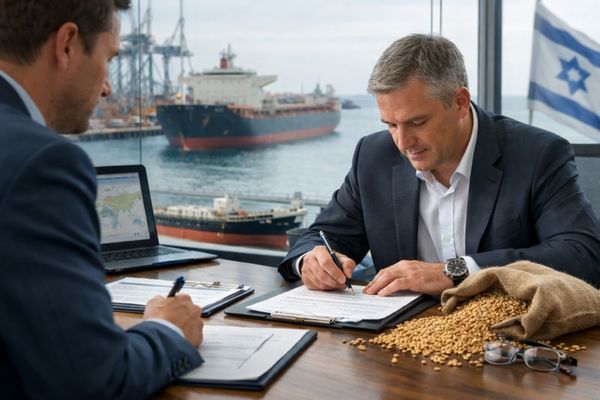
Ukraine’s formal protest over a Russian vessel carrying wheat from occupied Ukrainian territories to Israel’s port of Haifa has injected fresh geopolitical risk into Black Sea grain trade and the wider sanctions regime around Russian agricultural exports. The dispute centers on the Russian bulk carrier ABINSK and its wheat cargo, which Kyiv and investigative projects allege originated in Russian‑occupied regions of Ukraine. Traders now face renewed uncertainty over sanctions exposure, logistics routing and origin-risk premiums for Black Sea wheat.
While global benchmark wheat prices have been broadly stable in recent sessions, the Haifa incident is amplifying compliance concerns among buyers and insurers handling Russian or Black Sea grain. The case underscores how Russia’s so‑called shadow fleet is not only moving oil but also wheat into ports of countries closely linked to Western allies, potentially forcing a recalibration of due‑diligence standards and trade flows in the Eastern Mediterranean.
Introduction
According to Israeli and Ukrainian media, the Russian cargo ship ABINSK arrived at Haifa loaded with more than 43,000 tonnes of wheat that Ukraine says was taken from territories under Russian occupation, with Ukraine’s embassy and investigative outlet SeaKrime citing vessel‑tracking and cargo data. Ukrainian Foreign Minister Andrii Sybiha raised the issue directly with Israeli Foreign Minister Gideon Sa’ar, calling for Israel to detain the vessel and clarify its stance on allowing alleged stolen grain to be unloaded in a major Mediterranean port.
The dispute has immediate implications for commodity markets because it tests how far sanctions and soft‑law restrictions on Russian exports of contested-origin grain can be enforced beyond the EU and G7. Israel has not fully aligned itself with Western sanctions packages, and any precedent it sets for access by shadow fleet vessels will be closely watched by wheat exporters, importers and maritime service providers across the region.
🌍 Immediate Market Impact
The direct physical volume at stake — roughly 43,700 tonnes of wheat — is modest in global terms but significant as a test case for sanctions enforcement and logistics risk pricing in Black Sea wheat. The mere possibility that ports closely connected to Western economies might accept such cargoes could, in the near term, temper some buyers’ reluctance to handle Russian wheat, marginally supporting Russian export competitiveness.
Conversely, the sharp Ukrainian reaction and public scrutiny increase the likelihood of tighter compliance from shipowners, insurers and banks, especially where shadow fleet links are suspected. Investigations into shadow fleet operations have already highlighted the fleet’s role in moving sanctioned commodities, including looted Ukrainian grain, under opaque ownership and flag structures. That scrutiny may now extend more forcefully from oil into grain, raising transaction costs and potentially widening basis spreads between origin‑secure and origin‑contested wheat.
📦 Supply Chain Disruptions
If Israel ultimately decides to restrict or scrutinize shadow fleet arrivals more aggressively, Haifa’s role as a potential Eastern Mediterranean outlet for Russian and occupied‑territory grain could narrow. This would redirect some cargoes toward more distant or less well‑equipped ports, adding sailing time, freight costs and operational complexity for Russian exporters and intermediaries.
For Ukraine, the episode is part of a broader strategy to constrain the shadow fleet’s access to ports and insurance, building on past efforts in Turkey, Lebanon and EU jurisdictions where ships suspected of carrying stolen Ukrainian grain have faced detention or denial of entry. Any success in tightening these constraints would shift more volume back through regulated Black Sea or EU‑aligned outlets, reinforcing Ukraine’s efforts to differentiate its own FOB Odesa and other Ukrainian wheat offers from Russian-origin supply.
📊 Commodities Potentially Affected
- Wheat: Directly implicated as the cargo on ABINSK; sanctions and origin‑risk concerns may alter Black Sea basis levels, freight spreads, and demand for traceable Ukrainian and EU wheat versus Russian offers.
- Barley and Corn: Although not mentioned in this specific shipment, these are also major Black Sea exports and could see spillover in compliance checks and documentation requirements as authorities and buyers broaden scrutiny of bulk grain cargoes linked to Russian ports or shadow fleet tonnage.
- Vegetable Oils and Oilseeds: Sunflower oil and related products moving from the Black Sea may face more detailed origin verification where vessels or intermediaries overlap with known shadow fleet operators, increasing paperwork and potential delays.
- Shipping and Marine Insurance Services: Freight rates and war‑risk or sanctions‑risk premia for vessels calling at contentious ports or operating with opaque ownership may rise further as regulators and counterparties tighten controls on shadow fleet activities.
🌎 Regional Trade Implications
In the Eastern Mediterranean, any move by Israel to clamp down on shadow fleet wheat arrivals would likely push Russian and occupied‑territory grain toward alternative outlets such as Egypt, Syria or non‑aligned ports, where sanctions enforcement has historically been looser. This could reinforce bifurcation between compliant and non‑compliant trade lanes, with discounting for controversial origin grain in less regulated markets.
Ukraine and EU exporters could benefit indirectly if heightened scrutiny at Israeli and EU‑aligned ports raises the reputational and compliance cost of Russian Black Sea wheat, supporting demand for traceable Ukrainian, French and other origin wheat for institutional buyers and multinational food companies. At the same time, some import‑dependent MENA buyers may weigh the cost savings of discounted Russian cargoes against the risk of future sanctions exposure or supply disruptions if port‑state controls tighten further.
🧭 Market Outlook
In the short term, the Haifa dispute is more likely to manifest in higher legal, documentary and insurance hurdles than in large immediate price spikes, particularly as global wheat benchmarks remain well supplied. However, any follow‑up action by Israel — for example, detention of the vessel or alignment with US and EU sanctions guidance — could prompt renewed volatility in Black Sea FOB differentials and Eastern Mediterranean import tenders.
Over the coming weeks, traders will watch closely for formal statements from the Israeli government, potential US or EU secondary sanctions designations, and any replication of this enforcement pattern by other non‑aligned port states. For risk management, counterparties exposed to Russian wheat or mixed‑origin Black Sea cargoes may increasingly demand granular origin documentation and avoid vessels linked in open‑source reporting to the Russian shadow fleet.
CMB Market Insight
The Haifa incident marks a notable escalation in the contest over how, and where, Russia can monetize grain sourced from occupied Ukrainian territories. While the physical wheat volume involved is limited, the legal and reputational stakes are high, and the case will likely inform future sanctions guidance, port‑state behavior and private‑sector compliance norms.
For agricultural market participants, the key takeaway is that origin risk in Black Sea wheat is again moving to the foreground. Traders, millers and food manufacturers should reassess exposure to Russian and shadow‑fleet‑linked supply chains, prioritize transparent origin and routing, and anticipate that enforcement gaps may narrow as high‑profile cases like Haifa drive closer policy coordination among Western partners and regional states.