
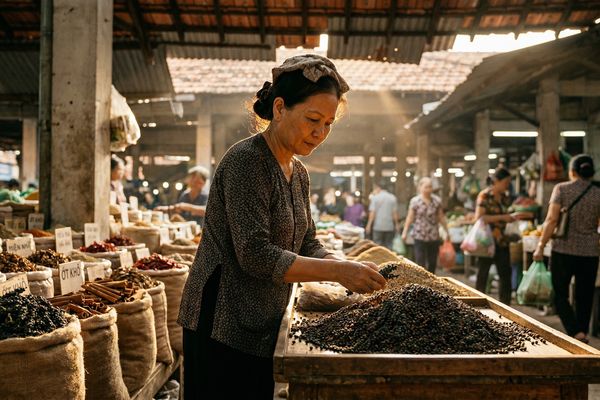
Black pepper prices are in a firm uptrend, driven by acute supply tightness in India and Vietnam and compounded by severe shipping disruptions in the Middle East. Market consensus points to another leg higher of roughly 100 INR/kg in the near term.
The global pepper market has moved decisively into a seller’s market. Indian black pepper output has dropped sharply year-on-year, while Vietnam’s crop is down by around 40%, removing a major pillar of global supply. At the same time, the Iran–US–Israel conflict has effectively choked off key maritime routes through the Gulf, delaying shipments and inflating logistics costs for Asian spices. Buyers are largely accepting higher offer levels, and very few sellers are willing to concede discounts, suggesting that current firmness is structurally supported rather than purely speculative. European and Asian buyers face a difficult procurement window through Q2.
Exclusive Offers on CMBroker

Pepper powder
black
FOB 8.75 €/kg
(from IN)

Pepper
white whole
FOB 7.05 €/kg
(from IN)

Pepper
green dehydrated
FOB 8.55 €/kg
(from LK)
📈 Prices & Market Structure
In India, average-quality black pepper is currently trading around 755–760 INR/kg, equivalent to roughly 8.10–8.20 EUR/kg, while fresh-delivery lots from Karnataka and Kerala are quoted at 775–780 INR/kg (about 8.35–8.40 EUR/kg). No major seller is reported willing to offer below these levels, indicating a strongly bid physical market with limited downside in the short term.
Export-oriented offers align with this picture. Organic black whole 500 g/l from India is indicated near 8.05 EUR/kg (FOB New Delhi), while cleaned 500 g/l black from India for conventional grades is around 5.89 EUR/kg. Vietnamese FOB levels for black 500–600 g/l FAQ to clean qualities cluster between roughly 5.70 and 6.45 EUR/kg, reflecting both lower origin costs and the structurally weaker Vietnamese currency, but the global benchmark remains anchored by the tight Indian market.
| Origin / Product | Grade | Location / Terms | Latest Price (EUR/kg) |
|---|---|---|---|
| India | Black pepper, domestic average | Spot (converted from INR) | ~8.10–8.20 |
| India | Black whole 500 g/l, organic | FOB New Delhi | 8.05 |
| Vietnam | Black 500 g/l, clean | FOB Hanoi | 6.05 |
| India | Pepper powder, black, organic | FOB New Delhi | 8.75 |
🌍 Supply & Demand Balance
India’s black pepper production has fallen from around 79,000–80,000 mt in each of the past two seasons to roughly 66,000–67,000 mt this year. This 15–17% decline is heavily concentrated in Karnataka and Kerala, which together account for 95% of Indian output. Local arrivals are light, and there is no evidence of pressure selling at the farm or stockist level.
Vietnam remains the pivotal global supplier, normally providing 250,000–300,000 mt and about 30% of world black pepper supply. This season’s crop is projected at roughly 150,000 mt, a near 40% fall that is the single most consequential shock to global availability. Brazil and Indonesia have also reported unfavourable growing conditions, further tightening the world balance sheet. End-user demand, especially from food manufacturing and spice blends in Europe and Asia, remains robust, so the current rally is fundamentally supply-driven rather than demand-destructive at this stage.
📊 Fundamentals & Geopolitics
The market is being reshaped by geopolitics. The ongoing Iran–US–Israel conflict has effectively shut or severely constrained shipping through key Middle East corridors, particularly the Strait of Hormuz, disrupting global trade lanes and raising freight, insurance and fuel costs. Recent situation reports confirm that maritime traffic through the strait has been largely halted since late February, forcing carriers to reroute cargo via longer and more expensive paths around southern Africa, with broad spillovers into agricultural trade and cold-chain logistics.
For pepper, this translates directly into delayed shipments and higher landed costs for buyers in Europe, the Middle East and parts of Africa that typically rely on Gulf hub ports for consolidation. Many importers report forward contracts being rolled or delayed, while a weaker Indian rupee increases local currency values of imported pepper, discouraging opportunistic imports. Traders and stockists in India are therefore able to hold firm on offers, confident that buyers have limited alternative origins or routing options in the short run.
📉 Weather & Production Outlook
Weather remains a key swing factor. In India’s major producing belts of Karnataka and Kerala, earlier unfavourable conditions have already translated into this year’s lower crop estimate. Near-term forecasts do not yet suggest a rapid rebound in the standing crop, so any recovery in Indian production would likely only materialise in the next marketing year.
In Vietnam, a combination of ageing plantations and past weather stress underpins the current subnormal harvest. While some recent assessments hint at slightly better-than-feared volumes versus the most pessimistic early estimates, the country’s 2026 output is still significantly below historical norms, and inventories have been drawn down. Brazil and Indonesia also report patchy conditions, which, taken together, mean that there is limited scope for other origins to fill the gap in Q2.
📆 Price Forecast & Risk Scenarios
Market participants broadly expect an additional 100 INR/kg (~1.05–1.10 EUR/kg) rally in Indian domestic prices in the near term, which would lift spot black pepper toward 800 INR/kg (around 8.60 EUR/kg). Over the next two to four weeks, prices are likely to test and potentially sustain levels above this threshold if current supply and logistics conditions persist.
Key downside risks to this bullish trajectory are a rapid de-escalation of the Iran conflict leading to restored shipping normalcy and freight cost relief, or a material upward revision in Vietnamese crop estimates. Both developments currently appear unlikely in the very near term, given ongoing military activity in the Gulf and already visible stress on Vietnamese plantations. As a result, the balance of risks for Q2 remains skewed to the upside.
🧭 Trading Outlook & Recommendations
- European and Middle Eastern importers: Consider extending forward cover at current levels, especially for Q2 and early Q3 needs, as both origin prices and freight surcharges are likely to remain elevated while Gulf logistics are disrupted.
- Food manufacturers and blenders: Review product formulations and hedging strategies to lock in key pepper requirements, prioritising higher-risk grades such as Indian black and Vietnamese clean 500–600 g/l, which are most exposed to the supply crunch.
- Producers and stockists: Holding strategies remain justified in the short term given strong bargaining power and limited downside catalysts; however, monitor closely for any signs of diplomatic breakthrough in the Middle East or surprise improvements in Vietnam’s export pace.
- Alternative origins and qualities: Buyers willing to switch to Brazilian or Indonesian material, or to slightly lower density/FAQ grades, may achieve modest cost savings, but should not expect a return to pre-conflict price levels while the global balance stays tight.
📍 3-Day Regional Price Indication (Directional)
- India (domestic spot, average black): Slightly higher bias; prices expected to hold 755–780 INR/kg (~8.10–8.40 EUR/kg) with potential incremental gains on strong stocking interest.
- FOB India (black whole 500 g/l, organic): Firm around 8.0–8.2 EUR/kg; sellers likely to resist discounts given domestic tightness and export demand.
- FOB Vietnam (black 500–600 g/l, clean): Steady to slightly higher in the 5.8–6.5 EUR/kg range as exporters balance limited raw material availability against competitive pressure from Indian offers.
Related posts:
 Cumin market finds a floor as Indian supply tightens and exports resume
 Turmeric Market Tightens Again as New Crop Disappoints
 Indian Coriander Rally Tightens Global Supply and Lifts Reference Prices
 India’s Coriander Market Tightens as Domestic Demand Crowds Out Exports
 Indian Mustard Seed Rally Tightens Global Cold-Pressed Oil Market
 Indian Coriander Tightens Sharply as Crop Shortfall Fuels Bullish Rally
 Indian Black Pepper Holds Firm as Geopolitics Cap Upside
 Indian chilli prices stay near multi‑year highs as supply squeeze deepens