
China Positions Itself as Global Trade Leader as U.S. Retreats
Beijing, October 31, 2025 – A symbolic moment played out in the skies over Asia: while U.S. President Donald Trump’s Air Force One departed from Busan after a brief visit to South Korea, Chinese President Xi Jinping’s Hongqi N701 limousine was already en route to the Asia-Pacific Economic Cooperation (APEC) summit just 80 kilometers away.
The contrast highlighted a fundamental shift in global economic leadership. As Washington turns inward and focuses on “America First,” Beijing is seizing the opportunity to present itself as the new guardian of global trade and multilateral cooperation.
Multilateralism vs. “America First”
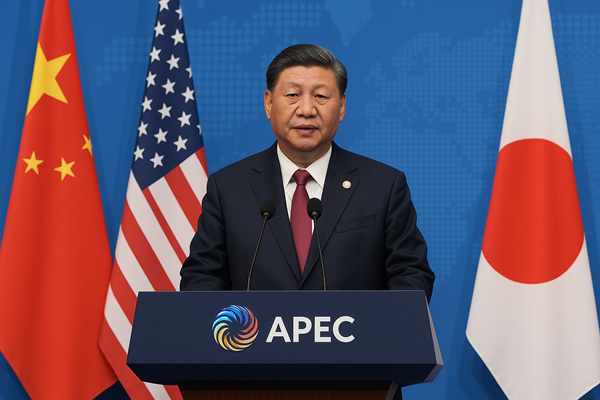
At the APEC summit, Xi Jinping called on world leaders to strengthen the global trading system with the World Trade Organization (WTO) at its core.
“We must practice true multilateralism and enhance the authority and effectiveness of the multilateral trading system,” Xi said, urging countries to modernize global trade rules to better reflect the needs of developing economies.
The message was unmistakable: while Trump’s administration focuses on tariffs, bilateral deals, and protectionist measures, China is stepping into the vacuum as the predictable, stable voice of free trade.
Xi’s presence at both the APEC and ASEAN meetings this month underscored China’s strategy of long-term engagement, contrasting sharply with Washington’s short, transactional approach.
In Malaysia, Chinese Premier Li Qiang signed an upgraded China–ASEAN Free Trade Agreement, further expanding Beijing’s regional footprint.
Asia’s Mixed Reaction
While many Asian countries welcome China’s economic presence, they remain cautious about its growing dominance.
Japan, in particular, voiced concern over China’s selective use of trade leverage.
“China tries to act as if it is the guardian of free trade, but in reality, it uses export restrictions and political pressure to advance its own agenda,” said Toshihiro Kitamura, spokesperson for Japan’s foreign ministry.
China’s recent move to tighten exports of rare earths — essential materials for electronics and renewable technologies — sent shockwaves through already strained global supply chains. This decision reinforced fears that Beijing is weaponizing trade policy to gain political influence.
Reshaping the Global Trade Order
Analysts say China’s actions go far beyond short-term diplomacy. They form part of a long-term strategy to restructure global trade and bind Asian economies more closely to China.
“China’s goal is to use trade, infrastructure, and supply chain integration to lock this region into its economic orbit — to the point where decoupling becomes nearly impossible,” said Eric Olander of the China Global South Project.
Beijing’s latest five-year economic plan explicitly calls for safeguarding the multilateral trading system and promoting broader international economic flows — a clear signal of its ambition to redefine global commerce.
The U.S. Steps Back
Trump’s decision to skip APEC marks a sharp reversal from Washington’s traditional engagement in the Asia-Pacific. The United States, which co-founded APEC in 1989, is now increasingly seen as disengaged and unpredictable in regional economic diplomacy.
While Xi deepens China’s economic ties with Asia, Trump’s focus remains domestic. Upon returning to Washington, he hosted the White House’s annual Halloween celebration — a striking visual contrast to the global trade negotiations happening across the Pacific.
The difference in optics is telling:
- China projects itself as a consistent, long-term partner.
- The United States appears selective and conditional, participating in trade talks only when it serves immediate political goals.
Outlook: A New Trade Reality
China’s renewed commitment to multilateral engagement is reshaping the balance of power in global trade.
By offering long-term cooperation while the U.S. imposes new tariffs and restrictions, Beijing is steadily building a regional trade network centered around its own economic model.
However, behind the rhetoric of “mutual prosperity” lies a calculated strategy: to establish lasting economic dependencies that will extend China’s influence across the Asia-Pacific for decades to come.
Sources: Reuters (Oct 31, 2025), AP News, Nikkei Asia, ASEAN Summit Communiqué