Colombia’s grain sector is heading into marketing year 2026/2027 under significant production pressure, with corn and rice output both forecast to decline as persistently low farmgate prices continue to discourage farmers from expanding or even maintaining their planted areas. A new Grain and Feed Annual report published on March 19, 2026 by the United States Department of Agriculture’s Foreign Agricultural Service in Bogota presents a comprehensive picture of a grain market that is becoming increasingly dependent on imports to feed its livestock and human population, even as domestic producers struggle with production costs that in many cases now exceed the prices they can obtain at market.
The United States is expected to consolidate its dominant position as Colombia’s primary supplier across all three major grain categories — corn, rice, and wheat — benefiting from the preferential access provided by the US-Colombia Trade Promotion Agreement, competitive international pricing, and logistical advantages that South American competitors are finding increasingly difficult to match. Total corn imports are projected to reach 8.3 million metric tons in marketing year 2026/2027, rice imports are forecast to surge by 67 percent year-on-year to 200,000 metric tons on a milled rice equivalent basis, and wheat imports are expected to rise modestly to 2.05 million metric tons — all against a backdrop of declining or stagnant domestic production that shows little prospect of meaningful near-term recovery.
Corn: Production Declines as Weather and Weak Prices Squeeze Farmers
Colombia’s corn production is forecast to decline by 3.4 percent year-on-year in marketing year 2026/2027 to 1.40 million metric tons, continuing a downward trend that reflects the deeply unfavourable commercial environment facing domestic corn growers. Harvested area is projected to contract to approximately 350,000 hectares, while yields are expected to slip slightly due to weather-related disruptions that have affected recent planting cycles, particularly along Colombia’s north coast.
The fundamental driver of the production decline is the sustained weakness in farmgate prices, which have made corn cultivation commercially unattractive for a growing number of producers. When the returns available in the market fall below the cost of production — which is the situation facing many Colombian corn farmers today — the rational response is to reduce planted area or exit the sector entirely, and that is precisely what the data shows is happening across the country’s major corn-growing regions.
The marketing year 2025/2026 production estimate has also been revised downward to 1.45 million metric tons, reflecting the damage caused by adverse weather conditions that struck several producing regions in early 2026. A heavy and atypical cold front affected the Caribbean and Andean regions in the early part of the year, with the departments of Córdoba, Cundinamarca, and Tolima bearing the brunt of the damage. Córdoba — Colombia’s second-largest corn-producing department — received more than 200 millimeters of rainfall within just a few days during what is normally a dry period of the calendar. The precipitation arrived at a particularly damaging time, coinciding with critical harvest stages. It delayed field operations, elevated grain moisture levels requiring costly additional drying, and severely limited access to waterlogged fields — a combination of factors that contributed to significant grain quality deterioration and elevated fungal disease pressure. The National Federation of Cereal, Legume, and Soybean Growers, known as Fenalce, estimates that approximately 2,373 hectares of corn were directly affected by the rainfall event, impacting more than 1,000 individual producers.
Colombia’s corn production is geographically concentrated, with roughly 70 percent of total output originating across three distinct regional clusters — the northern coast departments of Córdoba, Sucre, and Bolívar; the central region departments of Tolima, Huila, and Valle del Cauca; and the eastern plains department of Meta. Yellow corn accounts for approximately 70 percent of total production, followed by white corn at around 27 percent, with the remaining 3 percent destined for silage use. Commercial farming operations dominate the output side, accounting for around 80 percent of production from approximately 60 percent of planted area, with average yields close to $5.70 per metric ton. In contrast, smaller traditional subsistence farmers achieve yields near $2.00 per metric ton, reflecting the vast productivity gap between Colombia’s modern commercial agricultural sector and its traditional smallholder farming base.
Colombia has an estimated 16 million hectares identified by the Agricultural Rural Planning Unit as being suitable for corn cultivation — a vast resource that remains almost entirely underdeveloped. Expansion into this potential growing area, particularly in the eastern plains, is constrained by a combination of infrastructure deficits, restricted access to agricultural inputs, investment barriers, and critically, unresolved land tenure disputes that continue to deter private sector capital from committing to large-scale agricultural development projects in the region. Private sector initiatives — including the Soya-Maiz Proyecto Pais programme launched in 2020 — are attempting to address this untapped potential, but progress has been slower than hoped, in part because of the land tenure issues that make long-term investment planning difficult.
In 2024, Colombia planted approximately 131,450 hectares of genetically engineered corn, representing a 7 percent decline compared to 2023 and broadly mirroring the overall contraction in domestic corn production. The main genetically engineered corn producing departments were Meta, Córdoba, Tolima, Valle del Cauca, and Cesar.
Corn Consumption: Feed Demand Drives Growth Despite Economic Headwinds
On the consumption side, corn demand in Colombia is forecast to increase slightly to 9.77 million metric tons in marketing year 2026/2027, driven primarily by continued modest growth in the animal feed sector. Food, seed, and industrial use of corn is expected to remain broadly stable, with per capita FSI corn consumption estimated at approximately 30 kilograms annually.
Feed demand is the dominant force in Colombia’s corn market, and it is projected to reach 8.15 million metric tons in 2026/2027 — a reflection of continued expansion in livestock production despite the headwinds of persistent inflation and a moderating economic growth outlook. Colombia’s Central Bank projects inflation to rise to 6.3 percent in 2026 before declining to 3.7 percent in 2027, while economic growth is expected to moderate to 2.6 percent in 2026 and slow further to 1.6 percent in 2027. These macroeconomic conditions are not conducive to rapid demand expansion, but the structural growth story in Colombian animal protein consumption is providing a solid underlying floor for feed grain demand.
Chicken remains by a wide margin the most widely consumed animal protein in Colombia, with per capita consumption approaching 38 kilograms per person in 2025. Beef consumption stands at approximately 18 kilograms per capita annually, followed by pork at roughly 16 kilograms. Pork consumption has grown steadily in recent years, reflecting rising incomes and shifting dietary preferences among Colombian consumers. Fish consumption remains comparatively low and actually declined slightly in 2025, reaching approximately 9 kilograms per capita. The poultry industry is by far the largest consumer of imported feed corn, accounting for approximately 65 percent of corn imports, followed by the pork sector at 17 percent, the cattle sector at around 8 percent, and aquaculture and pet food together accounting for the remaining 10 percent.
The marketing year 2025/2026 total corn consumption estimate has been revised upward to 9.66 million metric tons, primarily reflecting stronger-than-expected feed demand. Lower international corn prices and the appreciation of the Colombian peso reduced feed costs significantly, supporting more competitive pricing for animal proteins and encouraging production expansion in the poultry and pork sectors — the two segments that collectively drive the vast majority of Colombia’s feed grain requirements.
Corn Trade: US Dominates with Over 95% Market Share
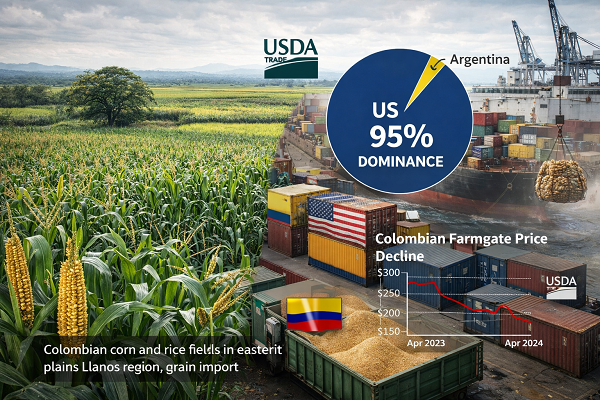
Colombia’s corn import market is extraordinarily concentrated in favour of the United States, which is expected to retain a market share exceeding 95 percent in both the current and forecast marketing years. This near-total dominance of Colombian corn imports by a single origin is the direct result of the duty-free access granted to US corn under the US-Colombia Trade Promotion Agreement, which phased out tariffs on both yellow and white US corn in 2023, combined with the substantial tariffs applied to corn originating from Mercosur countries — primarily Argentina and Brazil — under the Andean Price Band System.
The APBS tariffs on Mercosur corn have ranged from 21 to 35 percent on yellow corn during the 2025-2026 period, with the specific rate adjusted biweekly based on prevailing international reference prices. For yellow corn, the Andean Community of Nations has set floor prices of $292 per metric ton and ceiling prices of $360 per metric ton for the April 2026 to March 2027 period, with white corn floor prices at $310 per metric ton and ceiling prices at $382 per metric ton. These price band mechanisms create a dynamic tariff structure that adjusts automatically as international prices move, but the effect in practice has been to make Mercosur-origin corn consistently more expensive for Colombian importers than US corn, which enters duty-free.
Total corn imports are projected to reach 8.3 million metric tons in marketing year 2026/2027, a 1.2 percent increase from the revised 2025/2026 estimate of 8.2 million metric tons. The growth in imports directly compensates for the decline in domestic production and the increase in feed sector demand, maintaining the domestic market in overall supply balance. Ending stocks for 2026/2027 are estimated at approximately 302,000 metric tons — roughly two weeks of domestic consumption — reflecting the tendency of Colombian grain importers to operate with lean inventory levels and frequent purchasing cycles rather than building substantial buffer stocks.
Rice: Farmgate Prices Below Production Costs Trigger Protests and Planting Cuts
Colombia’s rice sector is experiencing one of its most difficult commercial environments in recent memory, with farmgate prices that have fallen significantly below production costs triggering widespread protests by growers and prompting a sustained contraction in planted area that is now feeding through into lower production forecasts. Milled rice production for marketing year 2026/2027 is forecast at 1.85 million metric tons on a milled rice equivalent basis — a 5.1 percent decline from the revised 2025/2026 estimate — driven primarily by the reduction in planted area as producers respond to prices that simply do not cover their costs of cultivation.
As of February 2026, prices received by rice farmers were approximately 5.6 percent lower year-on-year, a figure that understates the severity of the situation for many growers because it represents a national average that includes the better-yielding irrigated production zones. In the rain-fed eastern plains regions, where yields are lower and input costs higher relative to output, the gap between market prices and production costs is even more acute. Fedearroz — the Colombian Rice Growers Federation — has published detailed data showing that farmgate prices in early 2026 are running below both rain-fed and irrigated production cost benchmarks, meaning that the average Colombian rice farmer is currently losing money on every metric ton of paddy rice they bring to market.
The downstream consequences of this price-cost squeeze were felt acutely during 2025, when road blockades by rice growers prompted the Ministry of Agriculture to intervene with a one-time financial support package of approximately $5 million for small and medium-sized farmers, aimed at covering production costs and facilitating sales. The ministry also issued Resolution 241 of 2025, establishing a supervised pricing regime for green paddy rice with region-specific reference prices and standardised quality parameters. Industry groups, however, criticised the administered prices as set too high — reflecting the complexity of balancing farmer income support with the commercial realities facing millers and processors — and initially refused to purchase at those rates. This standoff was resolved through a voluntary stabilisation agreement brokered by the Superintendence of Industry and Commerce in August 2025, setting minimum prices, payment terms, and quality standards across the rice value chain. The minimum price mechanism was subsequently extended through May 31, 2026 by a further ministerial resolution issued in February 2026.
The 2025/2026 marketing year rice production estimate has been revised upward slightly to 1.95 million metric tons, to reflect updated harvest data showing that while planted area declined due to lower prices, the favorable growing conditions experienced during the second half of 2025 supported improved yields in the areas that were planted, partially offsetting the impact of the area reduction.
Colombia has approximately 16,000 rice producers distributed across five primary production regions. The eastern plains — comprising the Casanare and Meta departments — and the central region, which includes Tolima and Huila, together account for more than 70 percent of national rice output. The eastern plains region contributes approximately 40 percent of total production under predominantly rain-fed conditions, with average yields of around 4 metric tons per hectare. Producers in this region have greater flexibility to adjust planted area due to the availability of relatively large tracts of underutilised land. The central region accounts for approximately 30 percent of national production, relies largely on irrigation infrastructure, and achieves significantly higher average yields of around 6.5 metric tons per hectare. The national average yield for calendar year 2025 is estimated at approximately 5 metric tons per hectare on a paddy basis.
One structural characteristic of the Colombian rice sector that amplifies the commercial vulnerability of producers is the near-universal absence of on-farm drying and storage infrastructure. The vast majority of rice growers lack the facilities needed to store their freshly harvested paddy rice and market it later in the year when prices may be more favourable. As a result, producers are typically compelled to sell green paddy directly to millers immediately after harvest — accepting whatever prices the market offers at that moment — while millers handle drying, storage, and processing. This structural imbalance in bargaining power between producers and the milling sector has long been a source of tension in the Colombian rice value chain. The milling sector itself is dominated by approximately 95 rice milling companies operating 121 mills nationwide, with the two largest firms — ORF S.A. and Grupo Diana — together accounting for nearly half of total national milling capacity and market share.
Rice Trade: US Set to Recapture Market Share as Ecuador Dispute Escalates
Colombia’s rice import market is undergoing a significant shift in supplier dynamics as a bilateral trade dispute between Bogota and Quito disrupts the previously growing flow of Ecuadorian rice into the Colombian market and redirects purchasing interest toward the United States. Rice imports are forecast to surge by 67 percent year-on-year in marketing year 2026/2027 to 200,000 metric tons on a milled rice equivalent basis, reflecting lower domestic production, favorable international prices, and the strengthening of the Colombian peso — which enhances the purchasing power of Colombian importers in global markets.
The United States is expected to recapture meaningful market share in the Colombian rice market in 2026, supported by competitive pricing and the disruption to Ecuadorian trade flows caused by escalating reciprocal tariff measures between the two Andean neighbors. During the April to December 2025 period of the current marketing year, Colombia had been importing larger volumes of Ecuadorian rice, attracted by its high quality and competitive prices. Ecuador and Colombia are both members of the Andean Community of Nations and therefore benefit from zero-tariff duties on mutual rice trade — a framework that had been making Ecuadorian rice increasingly competitive in Colombia’s southwestern market.
However, the trade relationship deteriorated sharply in early 2026. Ecuador imposed a “security tariff” on Colombian imports, prompting Colombia’s Ministry of Trade, Industry and Tourism to respond on February 20, 2026 with a reciprocal decree imposing 30 percent ad valorem tariffs on 73 tariff codes, including paddy and milled rice, and prohibiting overland imports of Ecuadorian rice at border crossings. When Ecuador subsequently escalated its own security tariff to 50 percent effective March 1, 2026, Colombia’s government published a draft decree proposing to match that rate with a 50 percent reciprocal tariff — citing high domestic rice inventories and concerns about contraband as additional justifications for the restrictive measures.
This trade friction with Ecuador is directly creating commercial space for US rice in the Colombian market. The first 2026 Colombia Rice Export Quota auction under the CTPA tariff-rate quota mechanism was fully subscribed, allocating 102,452 metric tons on a milled rice equivalent basis — representing approximately 70 percent of the total annual quota of 146,304 metric tons. The out-of-quota duty rate for US rice currently stands at 24.6 percent, but the CTPA tariff-rate quota schedule is on a path toward full liberalisation, with the quota and out-of-quota duties both set to be eliminated by 2030, at which point US rice will enter Colombia entirely duty-free and quota-free. Two additional COL-RICE auctions are scheduled for June and October 2026 to allocate the remaining 43,852 metric tons of the annual quota. Industry sources attribute the strong subscription to the first 2026 auction to a combination of competitive US rice pricing, the appreciation of the Colombian peso, and higher effective prices for domestic rice resulting from government price intervention measures.
Rice is a staple of the Colombian diet, consumed regularly by approximately 98 percent of households, with per capita annual consumption averaging between 40 and 46 kilograms — among the highest rates in South America. Retail distribution is dominated by small neighbourhood stores known as tiendas, which account for approximately 90 percent of rice sales, with supermarkets and traditional wholesale markets making up the remainder. Discount retail chains have been expanding their footprint and introducing private-label rice brands that are gaining ground among price-sensitive consumers.
Wheat: Near-Total Import Dependence as Canadian and US Suppliers Compete
Colombia’s domestic wheat production is negligible by any meaningful measure — forecast at just 4,000 metric tons in marketing year 2026/2027 on a harvested area of approximately 1,800 hectares, concentrated in high-altitude growing zones in the departments of Boyacá, Cundinamarca, and Nariño, with Boyacá alone accounting for nearly 90 percent of national output. Wheat cultivation in Colombia is fundamentally uneconomic at scale, constrained by low yields and challenging climatic conditions at the high elevations — between 2,800 and 3,200 meters above sea level — where the crop is grown. Most farms are tiny operations of under two hectares, producing primarily for local traditional food markets rather than for the commercial milling sector.
The practical consequence is that Colombia relies on imports for essentially all of the wheat consumed by its milling industry, food processors, and households. Wheat imports are forecast at 2.05 million metric tons wheat grain equivalent in marketing year 2026/2027, a modest increase from the revised 2025/2026 estimate of 2.0 million metric tons. The slight downward revision to the 2025/2026 import figure reflects softer-than-expected demand, particularly from the animal feed sector, which has been substituting wheat with more competitively priced feed ingredients including corn and dried distillers grains. In addition, higher consumer taxes on certain processed wheat products — introduced under Colombia’s healthy tax legislation — have tempered import growth at the retail end of the value chain.
Canada and the United States are Colombia’s two principal wheat suppliers, accounting for the overwhelming majority of total import volumes. However, the competitive dynamics between the two origins are shifting noticeably. Recent trade data shows that US wheat has been gaining market share at Canada’s expense, driven by competitive US pricing, favorable exchange rate conditions for Colombian peso-based buyers, and the logistical advantages provided by US Gulf export terminals for shipments to Colombian Atlantic coast ports. The diversity of US wheat classes is also a commercial advantage — it allows Colombian millers to blend different protein levels to meet the specific flour specifications required for different wheat-based products, providing flexibility that is commercially valued by the milling industry.
Canada has traditionally dominated the Colombian wheat import market on the strength of its high-protein Canadian Red Spring and Prairie Spring Red varieties, which are prized by Colombian millers for their suitability in bread flour production requiring protein levels above 13.5 percent. US wheat exports to Colombia have historically been weighted toward Soft Red Winter varieties — used primarily in cookie and confectionery production — along with Hard Red Winter and Hard Red Spring varieties. The shift toward greater US market share does not indicate a change in end-use preferences but rather reflects the commercial advantage that US origin has established through pricing and logistics in the current market environment.
Colombia’s wheat milling industry comprises around 40 milling facilities, primarily located in the northern coast, central, and southwestern regions, producing roughly 1.5 million metric tons of wheat flour annually. The milling factor is estimated at between 77 and 79 percent. Bread products dominate domestic wheat consumption, accounting for approximately 70 percent of total use, followed by cookies and crackers at 12 percent, pasta at 11 percent, household baking at 3 percent, and a small residual used in animal feed. Bread’s role as a daily staple — consumed by nearly 70 percent of Colombian households every day, with per capita consumption estimated at around 22 kilograms annually — gives the bread production segment a stable demand base that is largely insulated from the economic cycle. The bakery sector supports more than 25,000 pastry and bakery shops operating across the country.
Total wheat consumption in marketing year 2026/2027 is forecast at 2.02 million metric tons wheat grain equivalent, reflecting modest growth driven by gradual economic recovery and stable household demand for wheat-based food products, even as persistently high inflation continues to constrain consumer purchasing power. Colombian households spent approximately 7.6 percent of total food expenditures on wheat-based foods in 2024, underlining the central role of wheat products in the national diet.
Colombia maintains an open trade policy for wheat imports, reflecting the country’s comprehensive dependence on foreign supply. The country currently has 18 trade agreements in force, the majority of which provide zero-percent import duties on wheat, including shipments from Canada and the United States. A government decree published in August 2025 established zero-percent tariffs on wheat imports from all origins for a two-year period, extending a policy first introduced in 2020 to mitigate global supply disruptions during the COVID-19 pandemic. This broad tariff elimination policy helps maintain stable import flows and supports price stability for wheat-based food products across the country.
Colombia’s healthy tax legislation — Law 2277 of 2023 — has introduced a new variable into the demand picture for processed wheat products. The law implemented a 10 percent tax on ultra-processed foods high in sodium, added sugars, and fats in 2023, rising to 20 percent in January 2025. The tax applies to products such as cookies and certain pastry items that exceed established nutritional thresholds. Bread is exempt from the healthy tax due to its classification as a staple food. While the measure’s primary objective is public health improvement rather than trade regulation, its practical effect on consumption of higher-margin processed wheat products is a factor that millers, importers, and food processors are actively monitoring.
Market Outlook
The overall outlook for Colombia’s grain sector in marketing year 2026/2027 is characterised by declining domestic production across both corn and rice, rising import volumes, and deepening dependence on the United States as the dominant origin for all three major grain categories. The structural forces driving this trajectory — weak farmgate prices, high production costs, infrastructure constraints, and the strong commercial advantages enjoyed by US exporters under the CTPA — are unlikely to reverse meaningfully in the near term without significant and sustained policy interventions that go beyond the targeted support measures currently in place.
For US grain exporters, Colombia represents a large, growing, and increasingly open market where preferential trade access under the CTPA continues to deliver tangible and expanding commercial advantages. The near-complete elimination of Mercosur corn from the Colombian import market, the recapture of rice market share from Ecuador driven by bilateral trade friction, and the competitive gains being made in the wheat market against Canadian suppliers all point to a trade relationship that is becoming progressively more concentrated and commercially significant for US agricultural interests.
Colombian domestic producers face a more difficult near-term outlook. Rice and corn farmers are producing at or below cost in an environment of weak prices, limited government financial support, and strong import competition. Without a meaningful recovery in farmgate prices — which would likely require either a significant reduction in production costs through input subsidies and infrastructure investment, or a tightening of global supply that lifts international commodity price levels — the incentive to expand planted area remains absent and further production declines are the most likely outcome in the years immediately ahead.