
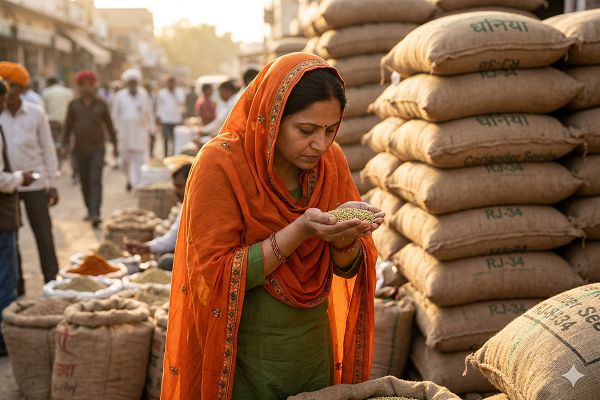
Coriander prices are trading with a firm bias in India as the new rabi crop enters the market into a structurally tight supply environment. Lower sowing, weather setbacks and robust export demand are underpinning values, even as the recent rally leaves the market vulnerable to short technical corrections.
Across key Indian centres, coriander is moving from a soft patch into a demand-led bull phase. Wholesale markets in Rajasthan and Delhi have registered gains of ₹500–1,200 per quintal in recent weeks, while arrivals from the new harvest remain insufficient to meaningfully ease tightness. International buyers, especially in Europe, face a competitive, seller-driven environment and may benefit from locking in forward cover before summer heat risks and continued export pull further constrain availability.
Exclusive Offers on CMBroker

Coriander seeds
whole
FOB 2.10 €/kg
(from IN)

Coriander seeds
powder
FOB 2.45 €/kg
(from IN)

Coriander seeds
eagle, split
98%
FCA 1.13 €/kg
(from IN)
📈 Prices & Market Tone
In Rajasthan’s core producing belt, badami-grade coriander at Ramganj and Baran is quoted around $104.81–106.95 per quintal, with eagle-grade at roughly $110.16–114.44 per quintal after recent gains of ₹500–₹700 per quintal over the past weeks. Delhi’s wholesale spice hub is trading at a visible premium: badami has risen by ₹1,000–₹1,200 per quintal to about $138.90–141.18, while green-grade now commands roughly $149.73–171.12 per quintal, reflecting aggressive covering by domestic processors and exporters.
Export-oriented FOB indications from New Delhi in late March confirm a generally firm undertone, though with some grade-wise divergence. Organic whole coriander seeds are offered near EUR 2.10/kg, with organic powder around EUR 2.45/kg. Conventional export grades range roughly from EUR 0.94–1.31/kg depending on specification and purity, indicating that physical export prices are aligned with the domestic mandi rally rather than signalling any major softening.
🌍 Supply & Demand Drivers
On the supply side, the present firmness is rooted in decisions taken a season earlier. Farmers reduced coriander acreage across major producing regions after disappointing price realisations in the previous year, and this acreage contraction was later compounded by unfavourable weather during crop development. Traders had already pencilled in a production deficit well before harvest; early arrivals of about 2,000 bags at Baran and 5,000–6,000 bags at Ramganj are too modest to significantly pressure prices.
Weather conditions in northern and central India add nuance but do not fundamentally alter the tight setup. For early April, the meteorological outlook points to an unusually wet, somewhat cooler pattern across Rajasthan and adjoining states, with repeated western disturbances bringing rain, thunderstorms and even localised hail through April 4. This could briefly slow harvesting, support quality in already-matured fields and delay arrivals, lending near-term support to domestic prices.
Demand remains robust both domestically and internationally. India’s processed food and spice-blending sectors are actively covering forward requirements, while export data for the first ten months of FY 2025–26 show shipments of 52,006 tonnes, up about 5.3% year-on-year in volume and roughly 9.6% in value. This resilience in overseas demand — against a backdrop of no reported bumper crops in Morocco or Eastern Europe — keeps India in a favourable position as a key supplier to global buyers.
📊 Fundamentals & Risk Factors
The current market balance is clearly tilted toward tightness: reduced acreage, weather-affected yields, firm export offtake and controlled arrivals all argue for continued strength. At the same time, the speed of the recent up-move has introduced short-term froth. Stockists who built long positions earlier in the season are being encouraged to systematically book profits into rallies, while end-users continue to buy dips, creating a push–pull dynamic that may increase intraday volatility.
Weather is the key near-term wild card. The wet, cooler-than-usual April pattern in north and central India may temporarily ease heat stress on late fields, but it also heightens the risk of localised damage from storms and hail. As the season progresses toward May and June, forecasts of rising heatwave frequency across several Indian regions raise concerns about post-harvest handling, storage losses and farmer selling behaviour, which could tighten effective availability even if headline production estimates hold.
📆 Short-Term Outlook (2–4 Weeks)
Over the next 2–4 weeks, coriander prices are expected to maintain a firm undertone. The structural supply deficit and solid export momentum suggest that any downside is likely to be shallow and driven more by profit-taking than by a true improvement in fundamentals. A key parameter to watch is the pace of arrivals in Rajasthan’s main mandis: if daily volumes at Ramganj and Baran accelerate toward or above 8,000–10,000 bags, a short, corrective phase could emerge as liquidity improves.
For now, however, the mix of limited arrivals, cautious farmer selling and steady export inquiries keeps the bias upward. Internationally, the absence of surplus crops in Morocco and Eastern Europe means little external pressure to cap Indian prices, leaving the market largely driven by Indian supply dynamics and regional weather. European spice buyers are therefore likely to face a sellers’ market into at least mid-2026, especially for consistent-quality lots.
🧭 Trading & Procurement Recommendations
- Indian traders/stockists: Maintain a bullish bias but avoid chasing spikes; stay long on price dips and book incremental profits as mandis test recent highs, particularly if arrivals briefly surge.
- Domestic processors and blenders: Use any profit-taking-led corrections to secure 1–2 months of physical coverage, prioritising quality lots before possible heatwave-related storage losses later in the season.
- European and other importers: Consider forward cover at current EUR levels for the next quarter, as the global supply picture outside India is not signalling significant relief and freight or weather disruptions could tighten availability further.
📍 3-Day Indicative Direction (Key Hubs, EUR Basis)
| Market / Grade | Indicative Price Level* | 3-Day Bias |
|---|---|---|
| New Delhi FOB, whole organic | ≈ EUR 2.10/kg | Slightly firm |
| New Delhi FOB, conventional export mix | ≈ EUR 0.95–1.30/kg | Stable to firm |
| Rajasthan mandis (badami/eagle, ex-market) | Firm vs. recent weeks (local currency) | Stable to firm, high intraday volatility |
*Indicative, converted to EUR for reference; actual trades depend on quality, terms and logistics.
Related posts:
 Coriander edges higher in India as new-crop arrivals meet firm restocking demand
 Indian Coriander Rally Tightens Global Supply and Lifts Reference Prices
 Indian Coriander Prices Soften Slightly as New Crop Flows Improve
 Indian Chilli Prices Hold Firm on Tight Quality Supply and Export Interest
 Indian Fennel FOB New Delhi Eases Slightly as Export Demand Stays Firm
 Indian Coriander Tightens Sharply as Crop Shortfall Fuels Bullish Rally
 Indian Chilli Prices Hold Firm at Peak Arrivals as Cyclone Losses Tighten Supply
 Coriander drifts lower as fresh Indian crop caps prices