
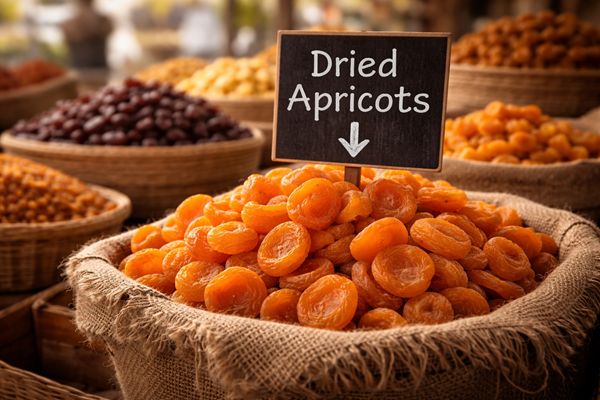
Export activity in dried apricots remains muted after the Ramadan holiday, while spot prices in Türkiye are broadly stable but softening slightly in some grades. Weather-related uncertainty in both Turkish and Central Asian orchards is emerging as the key driver for the coming weeks, limiting willingness to make long‑dated commitments despite comfortable nearby availability.
Volatility in weather patterns is shaping farmer sentiment. Recent frost episodes down to around -7°C in Uzbekistan, Kyrgyzstan and Tajikistan have damaged flowering trees, potentially tightening regional supply later in the season and indirectly supporting Turkish price ideas. At the same time, unstable and rainy conditions in Türkiye during flowering have hampered pollination and caused flower drop, making the size and quality of the 2026 crop unusually hard to predict. Market participants are effectively in a waiting mode until clearer signals emerge in April.
Exclusive Offers on CMBroker

Apricots dried
no: 5, unsulphured
FOB 7.80 €/kg
(from TR)

Apricots dried
no: 4, unsulphured, organic
FOB 9.30 €/kg
(from TR)

Apricots dried
no: 4, unsulphured
FOB 8.00 €/kg
(from TR)
📈 Prices & Export Activity
Export flows last week were slow, largely due to the impact of Ramadan on trading activity rather than a structural demand problem. Sellers report more inquiries than firm business, with buyers reluctant to chase prices higher while the new crop outlook is still opaque.
FOB Malatya prices on 24 March 2026 show a broadly sideways trend with a mild downward bias versus mid‑March. Conventional unsulphured dried apricots are indicated around EUR 7.80–8.65/kg (no.5–2), while higher grades no.1–3 stand near EUR 7.90–8.55/kg. Organic material carries a consistent premium, with unsulphured organic no.1–3 around EUR 9.30–10.35/kg.
| Product | Grade / Type | Location / Terms | Latest Price (EUR/kg) | 1–2 week trend |
|---|---|---|---|---|
| Dried apricots | No.1 unsulphured | Malatya, FOB | 8.55 | Lower vs 9.05 (early March) |
| Dried apricots | No.2 unsulphured | Malatya, FOB | 8.65 | Slightly lower vs 8.75 |
| Dried apricots | No.5 unsulphured | Malatya, FOB | 7.80 | Stable to slightly softer |
| Dried apricots | No.1 sulphured | Malatya, FOB | 8.70 | Marginally lower vs 8.85 |
| Dried apricots | No.8 sulphured | Malatya, FOB | 6.30 | Slightly down vs 6.45 |
🌍 Supply, Weather & Crop Uncertainty
Farmers and traders are watching not only their local orchards but also competing origins in Central Asia. Reports from Uzbekistan, Kyrgyzstan and Tajikistan indicate recent cold snaps down to about -7°C at flowering stage, which have likely inflicted some damage on apricot trees. The precise impact on total crop volume and quality is still unknown, but expectations are already being adjusted towards a smaller or at least riskier Central Asian crop.
In Türkiye, apricot trees have already flowered, but the weather since the beginning of the week has been unsettled. Persistent rains and cool conditions have disrupted bee activity, limited pollination and caused flower drop in some orchards. With the main flowering phase coming to an end, farmers are increasingly cautious: some are reassured by potential losses in competing origins, yet they are also concerned that their own yields and sizing could be compromised if the pattern continues into early April.
Short‑term weather forecasts for Malatya (24–26 March) point to mostly cloudy, cool conditions with scattered showers and daytime highs around 10–13°C. This suggests that the recent sub‑optimal pollination window may extend a little longer, reinforcing the view that reliable crop estimates will not be possible before April field checks. In contrast, key apricot areas in Uzbekistan and Kyrgyzstan are currently seeing milder, sunnier weather, which should at least stabilise orchards after the earlier frost episodes.
📊 Market Fundamentals & Demand
Physical availability of old‑crop dried apricots in Türkiye remains adequate, but export demand is seasonally subdued and was further dampened by Ramadan. Many buyers have already covered nearby needs and are in no rush to extend coverage before there is greater clarity on 2026 crop size and competition from Central Asia.
The combination of weak short‑term demand and heightened weather risk typically leads to a stand‑off: sellers resist further discounts, citing potential future tightness, while buyers press for concessions based on current slow offtake. This is reflected in the modest easing of prices across several grades in early to mid‑March, followed by a stabilisation around current levels as market participants wait for new signals.
📆 Trading Outlook & Risk Scenarios
- Short term (next 1–3 weeks): Sideways to slightly firm tone is likely. Limited export interest and holiday effects cap the upside, but weather‑related uncertainty and potential damage in Central Asia discourage aggressive selling.
- Medium term (April–May): Price direction will hinge on orchard assessments in Türkiye and confirmed damage levels in Uzbekistan, Kyrgyzstan and Tajikistan. A clearly reduced regional crop could trigger a firmer market, especially in higher grades and organic supply.
- Risk factors: Continued heavy rain or a late frost in Turkish growing regions, larger‑than‑expected damage in Central Asia, or, conversely, evidence that flowering losses are less severe than feared could all shift the balance quickly.
🎯 Strategy Hints for Market Participants
- Importers / industrial users: Consider covering a portion of Q2–Q3 needs at current levels, particularly for specific grades (no.1–3, organic) where replacement risk is higher if the crop disappoints. Avoid over‑committing until April crop signals are clearer.
- Packers / exporters in Türkiye: Maintain disciplined offers and avoid deep discounts while monitoring actual export demand post‑Ramadan. Be ready to adjust pricing quickly if field reports in April confirm significant regional losses.
- Retail buyers: Use current stability to negotiate medium‑term contracts but retain flexibility on volumes and specifications where possible, given unusually high agronomic uncertainty.
📍 3‑Day Directional Outlook (Prices in EUR)
- Malatya FOB, unsulphured no.1–3: Around EUR 7.90–8.55/kg, expected broadly steady; small downside limited by weather risk.
- Malatya FOB, sulphured no.4–8: Around EUR 6.30–7.50/kg, likely flat to slightly softer where sellers need liquidity.
- EU warehouse (NL, cubes / processed): EUR 5.50–6.35/kg FCA; stable with very limited spot activity, tracking origin prices and FX rather than independent demand strength.
Related posts:
 Turkish Dried Apricots Hold Steady as Market Watches Weather and Demand
 Turkish Dried Apricots: Softening FOBs While EU Demand Holds Steady
 Raisin Prices Steady to Softer as Turkish FOB Edges Higher, Asia Eases
 Turkish Dried Apricots Ease Slightly But Stay Historically Tight
 Coconut Prices Hold Flat as Asia Supply Risks Stay Elevated
 Turkish Dried Apricots Stay Firm as Malatya Weather Turns Critical