
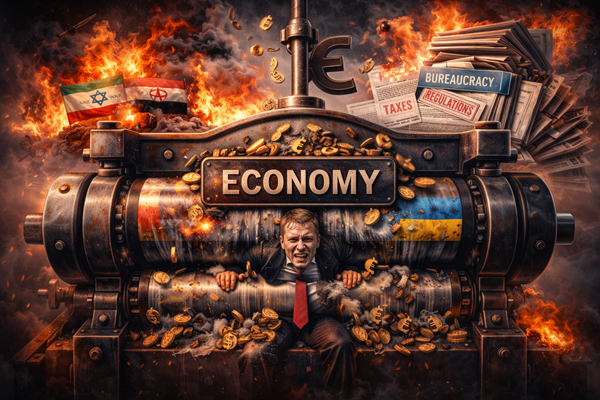
Energy Panic: Iran War Could Send Oil to $100 and Hit Europe’s Economy Hard
Here is the complete CMB News report in English, including the geopolitical energy shock analysis and the structural economic pressures in Europe you mentioned.
Energy Shock Risk: Iran War Could Push Oil to $100 – Europe’s Economy Faces Double Pressure
CMB News | Energy & Commodity Markets | March 2026
Almost a week after the outbreak of the Iran war, the duration of the conflict remains uncertain. While many analysts still assume that the military dominance of the United States and Israel could lead to a relatively short conflict, the risk of a prolonged war is growing.
If the conflict continues for several months rather than weeks, the consequences for global energy markets, inflation, financial markets and commodity prices could become significant.
The key risk lies in the potential disruption of oil and gas flows through the Strait of Hormuz, one of the most important energy transport routes in the world.
Up to 20% of Global Energy Trade at Risk
Approximately 20% of global oil shipments and a significant share of LNG exports pass through the Strait of Hormuz.
If military activity or security concerns were to disrupt shipping in the region for an extended period, a large share of global energy supply could temporarily fail to reach international markets.
In such a scenario, a supply reduction of around 20% could push the oil price toward $100 per barrel.
LNG prices would likely rise even further, particularly in Europe where gas markets are already tight.
A complete closure of the Strait of Hormuz remains unlikely, as Western naval forces would likely attempt to secure shipping routes. However, even partial disruptions could trigger significant price movements.
Europe More Vulnerable Than the United States
An energy shock would affect Europe far more severely than the United States.
The euro area remains heavily dependent on imported energy. Higher oil and gas prices would therefore quickly impact:
- household purchasing power
- industrial production costs
- transportation and logistics
Economic growth in the euro area could fall by around 0.4 percentage points, effectively cutting expected growth for 2026 nearly in half.
The United States, by contrast, is now a net exporter of energy, which makes its economy more resilient to rising oil prices.
Inflation Could Rise Above 3%
Higher energy prices would feed rapidly into consumer inflation.
Oil price increases affect:
- gasoline prices
- heating oil
- transportation costs
Gas prices typically influence inflation with a delay, as utilities adjust tariffs over time.
In this scenario, euro area inflation could climb back above 3% for much of the year, remaining well above the European Central Bank’s target.
Structural Weaknesses Increase the Pressure on Europe
However, the energy shock would not hit Europe in a vacuum. Many European companies are already under structural pressure.
One major factor is the growing regulatory burden and bureaucracy across the European Union, which increases costs and slows investment decisions.
At the same time, high labor costs, particularly in Germany, are becoming an increasing challenge for companies competing in global markets.
For many years, Germany was able to offset these costs through superior product quality and technological leadership. But in many sectors this advantage has narrowed.
Today, production costs in Germany are often significantly higher than in competing regions.
Global Competition – Not Just European Competition
A key misunderstanding in many economic debates is the idea that companies mainly compete within Europe.
In reality, European companies compete globally with firms from:
- China
- the United States
- India
- Southeast Asia
These regions often benefit from lower labor costs, lower regulatory burdens and in many cases cheaper energy.
Unless this reality becomes more widely recognized in political and economic discussions, structural competitiveness problems in parts of Europe are likely to persist.
Central Banks Face a Difficult Trade-Off
A prolonged energy shock would also create challenges for monetary policy.
Higher inflation would normally argue for higher interest rates, while weaker economic growth would suggest lower interest rates.
Financial markets have already begun adjusting expectations.
Many analysts expect the European Central Bank to keep its policy rate near 2%, arguing that the inflation spike would likely be temporary and largely energy-driven.
Stronger Dollar and Pressure on Equity Markets
Geopolitical crises typically strengthen the U.S. dollar, due to its role as the world’s primary reserve currency.
A similar pattern occurred after the start of the Ukraine war in 2022, when the euro weakened sharply against the dollar as energy prices surged.
Equity markets could also come under pressure.
Current forecasts expect global corporate earnings to grow by roughly 14% this year, but sustained high energy prices could reduce profit margins and slow revenue growth.
In a prolonged conflict scenario, the MSCI World index could fall between 10% and 20% from its peak.
Commodity Markets Would Also Feel the Impact
An energy shock would quickly ripple through commodity markets.
Higher energy costs directly affect:
Fertilizers
Natural gas is the key input for ammonia-based fertilizers.
Agricultural commodities
Energy influences production, processing and transport costs for crops such as:
- wheat
- corn
- sugar
- oilseeds
As a result, energy shocks often trigger broader commodity price cycles.
Outlook
The decisive factor for markets will be the duration of the conflict and the stability of shipping routes in the Persian Gulf.
A short conflict would likely limit the economic impact.
A prolonged war, however, could trigger a global energy price shock with significant consequences for inflation, economic growth, financial markets and commodity prices.
For Europe, the situation would be particularly challenging, as external energy shocks would hit an economy already facing structural cost and competitiveness pressures.