
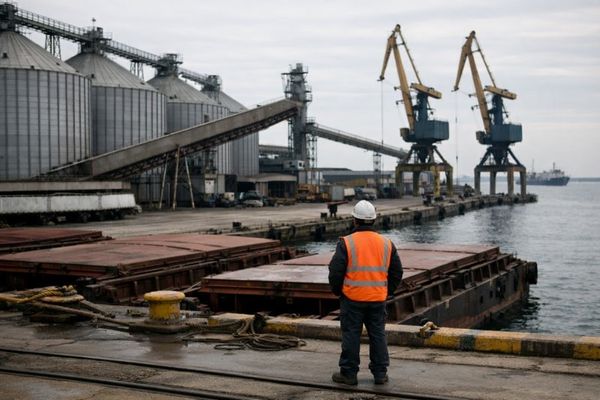
EU Merger Review Keeps Key Polish Grain Terminal Idle as Domestic Surplus Builds
Poland is facing a significant grain surplus and depressed farm-gate prices just as one of its largest grain terminals in Gdynia remains idle pending an EU merger-control decision. Despite recent port investments lifting theoretical handling capacity to around 12 million tonnes annually, actual grain exports remain constrained more by weak global prices and ample world stocks than by Polish logistics.
The prolonged European Commission review of the future operator’s capital concentration at the Baltic Grain Terminal in the Port of Gdynia has halted any grain transshipments there for months, removing a facility capable of shipping hundreds of thousands of tonnes of grain per month from the export system.
Introduction
According to recent Polish and industry reports, domestic grain stocks are running well above average after large 2025 harvests in Poland and across the EU, while global grain and oilseed production also remains high. Analysts note that export margins are under pressure as world grain prices soften, limiting the incentive to push additional volumes onto the seaborne market.
At the same time, the Baltic Grain Terminal in Gdynia, one of Poland’s main dry bulk grain facilities, has not handled any grain cargoes for several months while the European Commission continues proceedings on a notified concentration of the future lessee. Local media highlight that, once operational, the terminal could move several hundred thousand tonnes of grain per month, representing a material share of Poland’s potential grain export flows.
🌍 Immediate Market Impact
The regulatory standstill at Gdynia coincides with a period of structurally low grain prices driven by heavy global supply, including record or near-record harvests in key exporting regions. Market commentary indicates that Polish grain prices are being set primarily by global benchmarks rather than by domestic port constraints, with local surpluses limiting any upside.
In the very short term, the Gdynia bottleneck narrows Poland’s ability to route additional volumes via the Baltic should international demand or arbitrage opportunities emerge. However, existing private investments in other grain-handling terminals along the Polish coast mean that current volumes still use well below the system’s theoretical export capacity, suggesting that price effects will continue to stem more from global market weakness than from lost terminal throughput.
📦 Supply Chain Disruptions
The main logistical impact of the merger review is the underutilisation of deep-water capacity in Gdynia. With the Baltic Grain Terminal idle, operators have to reroute part of the surplus through alternative terminals in Gdańsk and other Baltic ports or rely more heavily on overland exports by truck and rail into Western Europe.
Industry observers estimate that Poland’s overall port grain-handling capacity has roughly doubled in recent years thanks to private investments. Nonetheless, the absence of one of the country’s largest specialised grain terminals reduces flexibility during peak shipping windows and may raise logistics costs for certain inland origins that are naturally oriented toward Gdynia. Border controls and congestion on key road and rail corridors with Germany and Lithuania add further friction to overland flows, increasing the sensitivity of delivered export prices to local bottlenecks.
📊 Commodities Potentially Affected
- Wheat (milling and feed) – Poland is a structural wheat surplus producer; with full silos and subdued global prices, any limitation or delay in seaborne export channels can weigh further on domestic bids.
- Corn (feed) – Ample domestic and EU maize supply combined with constrained export optionality may depress interior corn prices, particularly in regions most dependent on port outlets.
- Barley and rye – Smaller but still relevant export cereals that compete for logistics capacity; delays or higher transport costs can narrow sale opportunities into Northern and Western Europe.
- Rapeseed and rapeseed meal – Oilseed and by-product exports using bulk terminals could face scheduling pressures when grain flows are concentrated through a reduced number of berths.
🌎 Regional Trade Implications
For now, a substantial share of Poland’s grain surplus is moving overland, especially into Germany, which remains a key buyer of Polish feed grains. The combination of high stocks and favourable price differentials supports continued cross-border truck and rail shipments, partially offsetting limits in seaborne capacity from Gdynia.
Should the European Commission’s merger decision further delay the restart of the Baltic Grain Terminal, neighbouring EU ports around the Baltic and North Seas could capture incremental volumes, particularly from international tenders requiring larger vessels. Conversely, once approval is granted and the terminal recommissioned, Poland could quickly reassert itself as a more competitive origin for wheat exports to non-EU destinations in North Africa and the Middle East, potentially shifting some flows away from other EU suppliers.
🧭 Market Outlook
In the short term, traders expect Polish grain prices to remain closely aligned with global benchmarks, with domestic surpluses and elevated EU stocks capping rallies. The Gdynia terminal’s idle status adds an element of operational risk rather than a direct structural cap on exports, given that total Baltic port capacity still exceeds current utilisation.
Market participants will monitor three key variables: the timing and outcome of the European Commission’s concentration decision for the Baltic Grain Terminal; any further policy moves affecting cross-border road and rail flows, particularly with Germany and Lithuania; and signals on new-crop yields across the EU. A quicker-than-expected restart at Gdynia could improve Poland’s ability to exploit export windows if global prices recover later in the season.
CMB Market Insight
The current situation underscores that, for Poland, regulatory and corporate decisions on port infrastructure interact with but do not override the dominant influence of global supply-demand fundamentals on grain prices. Export capacity along the Baltic remains broadly sufficient in aggregate, yet the prolonged standstill at a major terminal reduces resilience and optionality just as large domestic stocks need to be liquidated.
For traders, importers and processors, the Polish case illustrates the importance of monitoring EU competition policy timelines and port-operator strategies alongside standard market indicators. In a surplus environment, access to diversified, reliable logistics routes can be as critical as outright production volumes in determining which origins remain competitive in global grain trade.