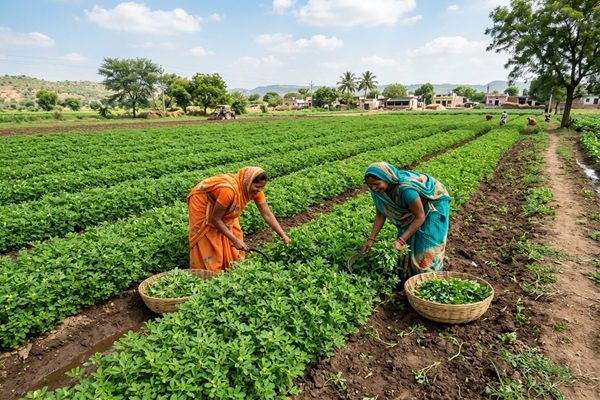
Fenugreek seed prices in Delhi have broken out of a sideways pattern with a modest but significant uptick, driven by tight arrivals from Rajasthan and the onset of the seasonal stocking cycle. With processors and exporters now actively building inventories into the lean period, current levels look close to a seasonal floor, with a mild upward bias over the coming weeks.
Fenugreek remains one of the few spices showing independent strength against a softer broader spice complex. The latest rabi crop has largely reached the market, but lower-than-expected arrivals from Rajasthan, Gujarat, and Madhya Pradesh — following adverse weather and below-normal yields in key districts such as Nagaur, Sirohi, and Jodhpur — are underpinning the market. Demand from food manufacturers and the pharmaceutical/nutraceutical sector is steady to firm, while export of both whole seeds and extracts to Europe, the Middle East, and the US continues to trend higher.
Exclusive Offers on CMBroker

Fenugreek seeds
FOB 0.98 €/kg
(from IN)

Fenugreek seeds
99%
FOB 0.65 €/kg
(from IN)

Fenugreek seeds
powder
FOB 1.10 €/kg
(from IN)
📈 Prices & Recent Moves
On 9 April, Delhi wholesale fenugreek seed (methi dana) gained about EUR 0.91–1.03 per quintal (USD 2.16) to reach an estimated EUR 0.91–1.03 per quintal equivalent, marking a clear break from recent sideways trading. This move ran counter to a broader easing in other wholesale spices, signaling commodity-specific tightness rather than generalized speculative buying.
Export-oriented FOB offers from New Delhi for Indian fenugreek, converted to EUR/kg, currently indicate a relatively stable external price structure:
| Product | Origin | Specification | Location / Terms | Price (EUR/kg) | Last Update |
|---|---|---|---|---|---|
| Fenugreek seeds (organic) | India | — | New Delhi, FOB | 1.00 | 4 Apr 2026 |
| Fenugreek seeds (99% purity) | India | 99% | New Delhi, FOB | 0.64 | 4 Apr 2026 |
| Fenugreek seeds powder (organic) | India | — | New Delhi, FOB | 1.12 | 4 Apr 2026 |
| Fenugreek seeds (machine clean FAQ) | India | FAQ | New Delhi, FOB | 0.63 | 4 Apr 2026 |
| Fenugreek seeds | Egypt | — | Cairo, FOB | 0.98 | 3 Apr 2026 |
FOB quotations in EUR/kg thus broadly align with the firm undertone seen in the domestic Indian wholesale market, with only marginal week‑on‑week changes but growing upside risk if arrivals tighten further.
🌍 Supply & Demand Drivers
India’s fenugreek supply for 2026 is centered on Rajasthan, with smaller contributions from Gujarat and Madhya Pradesh. The rabi harvest (February–April) has largely reached the markets, yet arrivals are lagging expectations due to adverse in-season weather. Reports of below-normal yields in Rajasthan’s Nagaur, Sirohi, and Jodhpur districts highlight a structurally tighter supply base compared to recent years.
On the demand side, domestic food processing remains the anchor, as fenugreek is a key input in spice blends, curry powders, and pickles. Parallel demand stems from pharmaceutical and nutraceutical applications, where seeds are processed for compounds such as diosgenin and trigonelline used in steroid synthesis and blood sugar management products. Export flows to Europe, the Middle East, and the US for both whole seeds and extracts are described as steadily expanding, adding incremental pressure on a constrained domestic balance sheet.
Seasonally, April marks the start of the summer stocking phase, when processors and exporters typically build inventories in anticipation of the lean supply period. This year, the usual seasonal buying is colliding with thinner arrivals, amplifying upward price inertia and reducing the likelihood of any near-term correction.
📊 Fundamentals & Weather Outlook
Fundamentally, fenugreek is shifting from a neutral to a mildly bullish configuration. On-hand physical supplies in major mandis are adequate for spot demand, but the lower pipeline replenishment from farms means any incremental buying quickly tightens visible stocks. The recent gain in Delhi, in contrast to broader weakness in other spices, underscores that current price strength is grounded in physical fundamentals rather than speculative activity.
Looking ahead, weather in Rajasthan and adjoining regions becomes less critical for the now-harvested rabi crop but will matter for soil moisture and farmer planting decisions for the next season. In the near term (next 1–2 weeks), weather-related disruptions to logistics or quality are likely to be limited, so the dominant driver remains the rate of daily arrivals and the aggressiveness of processor and exporter stocking.
📆 Short-Term Outlook (2–4 Weeks)
The market tone for fenugreek over the next two to four weeks is expected to remain firm with a clear upward bias. As April progresses, the summer stocking cycle will intensify while arrivals from Rajasthan taper further, especially if farmers hold back stocks in expectation of better prices.
Under these conditions, current domestic wholesale levels in Delhi are likely close to a seasonal floor. Upside moves are expected to be incremental rather than explosive, but any further decline in daily arrivals could accelerate gains. European buyers in particular, sourcing for health supplements or food industry applications, should assume limited downside and plan procurement on the basis of stable-to-higher prices through May.
💡 Trading & Procurement Recommendations
- European and Middle Eastern buyers: Consider advancing purchases for Q2–early Q3 needs, as current EUR-denominated offers are near seasonal lows with more upside than downside into May.
- Indian processors and blenders: Use any brief intraday dips to secure coverage for the lean season; downside is limited as long as Rajasthan arrivals stay below normal.
- Exporters: Lock in raw seed supplies early for fenugreek extract programs, as growing pharmaceutical and nutraceutical demand may tighten high-quality seed availability later in the season.
- Risk management: Avoid excessive short positions in fenugreek relative to other spices, as its fundamentals are comparatively stronger and less correlated to the broader softening trend.
📍 3-Day Directional Outlook (Key Hubs)
- Delhi wholesale (India): Slightly firmer bias; stable to modestly higher prices expected over the next 3 days as stocking demand continues.
- FOB New Delhi (export, India): Largely steady in EUR terms, with a mild upward bias if domestic mandi prices edge higher.
- FOB Cairo (Egypt): Stable; may act as a partial price cap but is unlikely to fully offset Indian firmness for buyers needing Indian origin or specific quality profiles.