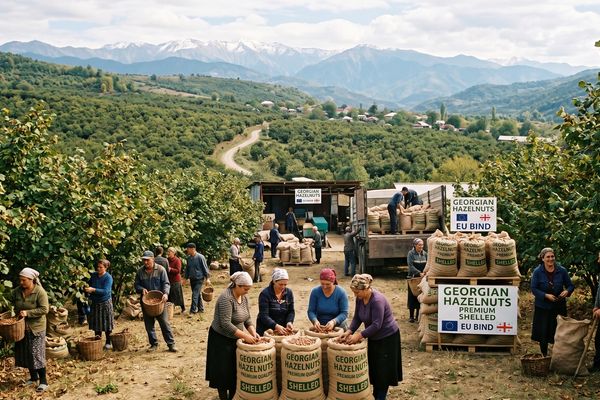
Georgia’s hazelnut export profile is shifting decisively toward higher-value shelled product: volumes in March 2026 declined, but export revenue and average prices jumped sharply, signalling tighter and more expensive supply for European buyers.
The latest trade data highlight a maturing Georgian nut sector that is capturing more value per tonne just as weather volatility and supply uncertainty keep global hazelnut markets nervous. While Turkey still dominates world production, Georgia’s role as a diversified, premium-origin supplier into the EU is becoming more important. At the same time, a surge in Georgian almond imports hints at rising regional nut demand and processing activity, adding another layer to price formation in the South Caucasus.
Exclusive Offers on CMBroker

Hazelnut kernels
Hazelnut kernels 15+
FCA 11.20 €/kg
(from PL)

Hazelnut kernels
natural, 13-15mm
FCA 11.00 €/kg
(from PL)

Hazelnut kernels GE
natural 11-13mm
FCA 10.45 €/kg
(from PL)
📈 Prices & Market Structure
In March 2026, Georgia exported 1,300 tonnes of hazelnuts worth USD 14.3 million. Compared with March 2025, export volume fell by 8% (down 113.3 tonnes), but export value rose by 39%, adding roughly USD 4 million year-on-year. This pushed the implied average export price from about USD 7,923 per tonne in March 2025 to around USD 11,000 per tonne in March 2026, underlining a clear move up the value chain.
Spot offers in Europe confirm that Georgian kernels are currently pricing at a premium to Turkish origin. Recent offers for Georgian hazelnut kernels FCA Warsaw are around EUR 10.45–11.20/kg for natural kernels (11–15+ mm), while comparable Turkish natural kernels FOB Istanbul are near EUR 8.05–8.53/kg. The sizeable price spread reflects both quality positioning and the greater share of processed, shelled product in Georgia’s export mix.
| Origin / Product | Spec | Location / Term | Latest Price (EUR/kg) | 1–3 week Trend |
|---|---|---|---|---|
| Georgia | Kernels 11–13 mm | Warsaw, FCA | 10.45 | Softening slightly |
| Georgia | Kernels 13–15 mm | Warsaw, FCA | 11.00–11.20 | Softening slightly |
| Turkey | Natural kernels 11–13 mm | Istanbul, FOB | 8.05 | Firm to higher vs. late April |
| Turkey | Natural kernels 13–15 mm | Istanbul, FOB | 8.53 | Firm to higher vs. late April |
🌍 Supply, Demand & Trade Flows
Over the first eight months of the 2025/26 marketing season (1 August 2025–31 March 2026), Georgia shipped 10,700 tonnes of hazelnuts to EU member states, with Italy, Spain, Germany, France and Greece as the main destinations. This aligns with Europe’s strong concentration of confectionery and chocolate manufacturing, where reliable kernel supply is critical.
Outside the EU, Syria received 1,100 tonnes, Russia 557 tonnes and Armenia 516 tonnes, underlining Georgia’s complementary role in regional supply. Globally, Turkey remains the dominant producer, with world hazelnut output for 2025/26 projected at roughly 1.08 million tonnes and Turkey accounting for well over half of total supply. Crop variability and weather-related risks along Turkey’s Black Sea coast continue to support the strategic value of Georgian origin as a diversification tool for European buyers.
The 39% jump in Georgian export value in a single month suggests that shelled suppliers currently hold pricing power, especially as buyers seek to secure higher-quality, traceable product. For EU processors, this means that procurement strategies built on flat or declining kernel prices are increasingly out of sync with fundamentals.
📊 Fundamentals & Weather Outlook
Structurally, the key driver behind Georgia’s rising unit export values is the growing share of processed (shelled) hazelnuts versus raw in-shell shipments. Shelled product commands a consistent premium in European and Middle Eastern markets, reflecting added processing costs, tighter quality control, and lower logistics waste. Georgia’s positioning as the world’s third-largest hazelnut producer after Turkey and Italy amplifies the impact of this shift on regional price benchmarks.
Weather and macro conditions in the wider Black Sea region remain a watchpoint. Recent meteorological reports point to persistent rain, colder-than-normal temperatures and strong winds across parts of Turkey and the western Black Sea coast in early May 2026, with some unseasonal snowfall in higher inland areas. While this is still early for definitive 2026/27 crop assessments, such patterns reinforce perceptions of climate-related volatility in key hazelnut-growing belts.
On the demand side, Georgia’s nut trade is becoming more diversified. In Q1 2026 the country imported 297 tonnes of almonds worth USD 631,000, up more than 300% in volume and value versus the same period of 2025. Azerbaijan supplied 264 tonnes and Turkey 33 tonnes. These flows hint at growing domestic consumption, re-processing or transit trade into neighbouring markets, and point to a broader South Caucasus nut demand story that could gradually tighten regional availability.
📌 Strategic Takeaways for Market Participants
- Budget for a higher Georgian premium: With average export prices up from about USD 7,923 to roughly USD 11,000 per tonne year-on-year in March, and spot kernels near EUR 10.5–11.2/kg in Central Europe, forward budgets should assume a structurally higher baseline rather than a temporary spike.
- Rebalance origin mix: European buyers relying heavily on Turkey should consider locking in part of their Georgian coverage despite higher unit prices, to hedge against potential Turkish crop or policy shocks and to secure higher-value kernels for premium product lines.
- Watch South Caucasus nut demand: The sharp increase in Georgian almond imports, concentrated from regional suppliers, signals strengthening local and transit demand. This may gradually influence price relationships between hazelnuts and almonds in regional snacking and confectionery segments.
- Incorporate weather risk premia: Recent cold and wet anomalies around the Black Sea, together with ongoing climate concerns for hazelnut orchards, justify maintaining weather-related risk premia in forward pricing for both Turkish and Georgian origins.
📆 Short-Term Price Outlook (Next 3 Days)
- Georgian kernels, Central Europe (EUR): Prices around EUR 10.5–11.2/kg FCA are likely to remain broadly stable, with only minor day-to-day fluctuations as buyers digest the latest export data and as weather signals for the new crop remain mixed.
- Turkish kernels, FOB origin (EUR): Current levels near EUR 8.0–8.5/kg are expected to hold or firm slightly, supported by lingering export sluggishness but elevated domestic costs and ongoing weather-related uncertainty in the Turkish Black Sea region.
- EU processing margins: With origin prices high and premiums for shelled product intact, processors should expect continued margin pressure unless downstream confectionery demand softens or retail prices adjust upward.