
Germany at a Crossroads: How the Country Can Restore Its Global Competitiveness
CMB News | Economy & Competitiveness | March 10, 2026
Germany remains one of the world’s most advanced industrial economies. The country still hosts globally competitive sectors in engineering, chemicals, and automotive manufacturing, and continues to rank among the largest exporting nations. Yet a growing number of economists, industry associations, and international institutions warn that the country’s economic model is under increasing pressure.
Weak economic growth, high production costs, demographic change, and intensifying global competition from the United States and China are forcing Germany to reconsider how it positions itself as an industrial and innovation hub.
The challenge is not a single structural weakness. Rather, it is the cumulative effect of multiple factors that together risk eroding the competitiveness of Europe’s largest economy.
Global Comparison: Germany vs. Major Competitors
A useful benchmark for Germany is not only Europe but the world’s largest economic powers. When comparing key structural indicators, the differences become clear.
Corporate Tax Burden
| Country | Corporate Tax Rate |
|---|---|
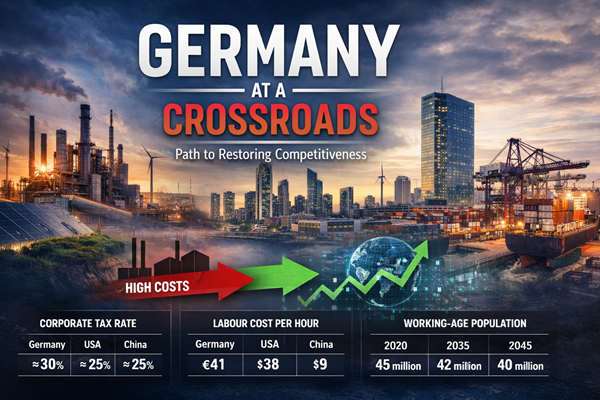
| Germany | ~30% |
| United States | ~25–27% (federal + state) |
| China | ~25% |
| Ireland | 12.5% |
Germany’s combined federal, state and municipal tax system results in one of the higher corporate tax burdens among advanced economies.
Industrial Electricity Prices
Energy costs are increasingly decisive for industrial investment decisions.
| Country | Industrial Electricity Price |
|---|---|
| Germany | 18–25 ct/kWh |
| United States | 7–10 ct/kWh |
| China | 8–11 ct/kWh |
| France | 10–14 ct/kWh |
Germany’s industrial electricity prices remain among the highest in the industrialized world, creating pressure on energy-intensive sectors such as chemicals, metals, paper and glass.
Labour Costs per Hour (Industry)
| Country | Labour Cost per Hour |
|---|---|
| Germany | ~41 € |
| United States | ~38 € |
| China | ~8–12 € |
| Poland | ~15 € |
Germany’s workforce remains highly productive, but the cost base is significantly higher than many competing production locations.
Demographic Pressure on the Labour Market
Germany’s demographic outlook is one of the most important structural challenges for the coming decades.
Working-Age Population Trend
| Year | Working Population |
|---|---|
| 2020 | ~45 million |
| 2035 | ~42 million |
| 2045 | ~40 million |
As the large baby-boomer generation retires, fewer workers will be available to sustain industrial output and finance the social security system.
Working Time Comparison
Another structural difference between Germany and other major economies lies in the number of hours worked per employee.
Average Annual Working Hours
| Country | Hours per Worker |
|---|---|
| Germany | ~1,340 |
| United States | ~1,810 |
| Poland | ~1,830 |
| China | ~2,100 (estimated) |
Germany’s economy is highly productive per hour worked, but the total labour volume per worker is comparatively lower.
Energy Shock and the Industrial Model
The energy crisis triggered by geopolitical tensions and the restructuring of European energy markets has hit German industry particularly hard. Energy-intensive sectors, which historically formed the backbone of Germany’s export strength, face significant cost pressures.
Chemical companies, metals producers and manufacturing groups are increasingly evaluating investments in regions with lower energy costs, including North America and parts of Asia.
Where Germany Still Leads
Despite these challenges, Germany continues to possess significant structural advantages:
- world-class engineering and manufacturing expertise
- strong industrial supply chains
- highly skilled workforce
- stable institutions and legal certainty
- strong export-oriented mid-sized companies (“Mittelstand”)
These strengths explain why Germany remains one of the largest export economies globally.
What Germany Must Do to Restore Competitiveness
A broad consensus among economists and industry leaders suggests that restoring competitiveness requires action in several key areas.
1. Reduce the Tax Burden on Labour
Lower payroll taxes and increase net income incentives for workers to strengthen labour participation and economic activity.
2. Stabilise Energy Costs
Accelerate investment in power generation, grid infrastructure and storage to create predictable and competitive industrial energy prices.
3. Accelerate Planning and Permitting
Major infrastructure and industrial projects often require years of approval procedures. Shorter planning cycles are essential to attract investment.
4. Encourage Investment and Innovation
Improve access to venture capital, simplify regulation and strengthen technological ecosystems in areas such as AI, advanced manufacturing and clean technologies.
5. Expand the Labour Supply
Higher workforce participation, targeted immigration policies and more flexible labour markets can help offset demographic decline.
Strategic Perspective
The global economic landscape is shifting rapidly. The United States benefits from deep capital markets, strong technology sectors and relatively low energy prices. China continues to expand industrial capacity and deploy large-scale state-backed industrial policies.
Germany cannot replicate either model. Its competitiveness will depend instead on maintaining technological leadership while improving efficiency, reducing structural costs and accelerating economic decision-making.
Outlook
Germany’s industrial strength, engineering expertise and export orientation remain powerful assets. However, sustaining them will require decisive reforms.
The coming decade will likely determine whether Germany continues to function as Europe’s leading industrial economy—or whether investment, innovation and production gradually migrate to faster-growing regions of the world.