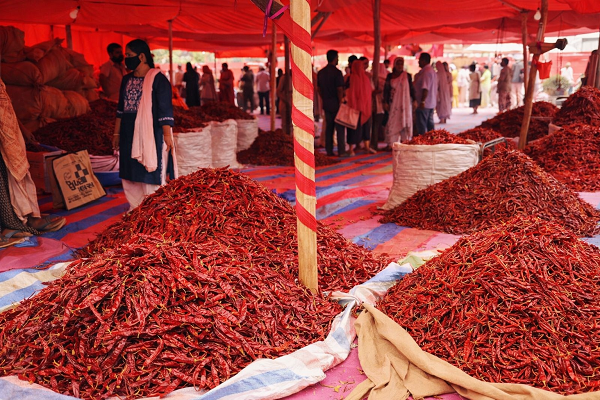
During a recent visit to the local spices and grain market, our team interacted with wholesalers (brokers) and farmers to understand current price trends, supply conditions, and their impact on consumers. The findings reveal a market marked by sharp contrasts—significant price increases in some commodities and noticeable declines in others.
Brokers Dominate Market Operations
Most traders in the market operate as brokers, acting as intermediaries between farmers and buyers. They procure produce directly from farmers and sell it in the market, earning a commission on each transaction.
For instance, in the red dry chilli trade, brokers charge approximately ₹10(0.11USD) to ₹12(0.13USD) per kg as commission.
Red Chilli Prices Surge Dramatically
One of the most striking observations was the steep rise in red chilli prices.
-
Last Year: ₹250 per kg (2.72 USD per kg)
-
Current Year: ₹550 to ₹750 per kg (5.98 to 8.15 USD per kg)
According to market participants, the primary reason behind this surge is irregular rainfall, which affected crop supply and quality in several regions.
Mixed Price Movement Across Commodities
While red chilli and some other commodities witnessed sharp increases, others recorded a decline:
-
Cumin: Dropped from ₹350/kg ($4.22/kg) to around ₹260/kg ($3.13/kg)
-
Coriander: Fell from ₹180/kg ($2.17/kg) to ₹110–₹130/kg ($1.33 – $1.57/kg)
-
Wheat: Increased from ₹500–₹550 ($6.02 – $6.63) per 20 kg bag to ₹600–₹750 ($7.23 – $9.04) per 20 kg bag
Additionally, prices of fennel seeds, pigeon peas, and beans have risen by approximately ₹30(0.33$) to ₹40(0.43$) compared to last year.
Production Remains Stable, Yet Prices Fluctuate
Despite the price surge, Gujarat’s red chilli production remains relatively stable.
-
2023–24 Production: ~36,128 metric tonnes
-
2024–25 Estimate: Similar levels expected
Farmers explained that although total production figures are steady, uneven rainfall has disrupted supply chains and affected crop quality, leading to higher market prices.
Impact on Consumers
The rising cost of essential spices and grains is putting pressure on household budgets, particularly for middle-class families. Increased food prices are contributing to higher monthly expenses, making daily consumption more costly.
A Market of Contrasts
Overall, the spices and grain market currently reflects a mixed trend:
-
Price Increase: Red chilli, wheat, fennel seeds, pigeon peas, beans
-
Price Decrease: Cumin, coriander
As weather patterns and supply dynamics continue to influence production, market volatility is expected to persist in the coming months.