
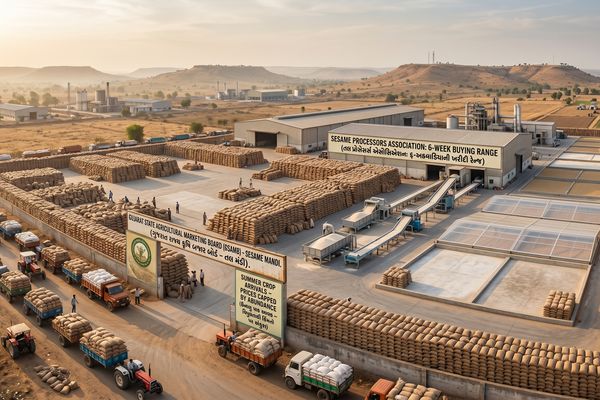
Fresh summer sesame arrivals in Gujarat are accelerating just as processors signal a six‑week price window, with black sesame expected to hold in a relatively firm band and white sesame trading softer under the weight of new crop supply.
Over the coming weeks, the key question for farmers and buyers alike is whether prices will stay in the indicated ranges as arrivals from Gujarat, Andhra Pradesh, Telangana and Maharashtra converge on the market. Weather stability through late May, harvesting methods and export-quality compliance will determine whether the upper end of the current projections is achievable, particularly for premium grades. Concurrently, elevated Chinese port stocks limit near‑term upside even as export demand remains fundamentally supportive.
📈 Prices & Ranges
Processors in Rajkot are guiding towards a clearly defined six‑week trading corridor for the new summer sesame crop, assuming stable weather into late May and no major harvest disruptions.
- Black sesame: expected in a range of $31.55–$35.76 per quintal (approx. €29–€33 per 100 kg).
- White sesame: projected at $18.93–$22.08 per quintal (approx. €17–€20 per 100 kg).
- Heavy overlapping arrivals from Saurashtra and other producing states are acting as a ceiling, preventing any sharp price spike despite reasonable export interest.
| Sesame type | Projected price range (EUR / quintal) | Time window |
|---|---|---|
| White sesame | ≈ €17 – €20 | Next 2–6 weeks |
| Black sesame | ≈ €29 – €33 | Next 2–6 weeks |
🌍 Supply & Demand Balance
Current summer production estimates point to a sizeable but manageable crop, with regional dynamics and canal irrigation shaping the supply profile.
- Output: white sesame at 100,000–110,000 tonnes and black sesame around 40,000 tonnes for the season.
- Geography: strong arrivals from Junagadh, Jamnagar, Rajkot, Porbandar, Amreli, Mehsana and Bhavnagar; Surendranagar is adding volume thanks to Narmada canal‑enabled summer expansion.
- Canal factor: closure of canal water on 30 April 2026 is now slowing early kharif preparations but has already delivered an extended summer sesame area and higher supply in the current window.
- Global context: Chinese port stocks at about 327,678 tonnes are elevated, tempering the scope for a strong near‑term price rebound from India despite healthy underlying demand.
📊 Quality, Harvesting & Export Compliance
Quality outcomes in late May will be decisive for price realisations, especially for export‑grade black and white sesame.
- Late sowing upside: some late‑sown fields could still deliver better‑than‑expected quality if weather remains benign through the end of May.
- Labour vs. mechanisation: structural labour shortages are pushing growers toward mechanical harvesting, but processors strongly advise against hullers/harvesters due to higher seed damage and visible quality loss.
- Price penalty risk: machine‑processed lots typically receive discounts versus hand‑threshed sesame, especially where buyers demand intact, visually clean seeds.
Export markets, particularly the EU and Japan, are sharpening their focus on pesticide residues, adding another layer of quality risk.
- Chlorpyrifos issue: five EU border rejections of Indian sesame between January and 05 May 2026 highlight persistent residue‑compliance challenges.
- Farmer guidance: adherence to recommended doses of approved pesticides is critical; excess use raises the risk of rejection and depresses export bids for otherwise good‑quality lots.
🌦 Weather & Short-Term Outlook
The next two to four weeks are pivotal, with weather and arrivals driving whether prices lean toward the lower or upper edge of the current ranges.
- If weather stays stable and arrivals begin to moderate, particularly for high‑grade material, black sesame has a better chance of testing the upper band around roughly €33 per quintal.
- If late‑May weather events hurt quality, volumes of premium grades could tighten, also supporting prices closer to the top of the projected corridor.
- Conversely, continued heavy arrivals without quality issues would keep both white and black sesame anchored near the mid to lower end of the bands.
📌 Trading & Procurement Guidance
- Farmers in Gujarat: prioritize hand‑threshing despite labour constraints to protect price realisations; avoid over‑application of pesticides to maintain export eligibility and reduce rejection risk.
- Domestic processors: use the current 6‑week window to build coverage in stages within the projected price bands, with a quality premium for hand‑processed, residue‑compliant lots.
- Exporters: focus procurement on traceable, low‑residue supplies; leverage ample arrivals and competing Chinese stocks to negotiate but remain prepared to pay up for top‑spec material.
- Overseas buyers (EU, Japan): this is a favourable timing window to secure volumes from India at capped price levels, while insisting on strict residue and processing‑method assurances.
📆 3‑Day Price Direction (Indicative, in EUR)
- Gujarat spot mandis – white sesame: broadly sideways to slightly soft within ≈€17–€20/quintal as arrivals remain strong.
- Gujarat spot mandis – black sesame: sideways with mild upward bias toward the mid‑range ≈€31/quintal if quality premiums emerge.
- Export parity (EU/Japan, FOB equivalent): range‑bound, with small quality‑linked spreads; no sharp move expected while Chinese port stocks remain high.
Related posts:
 Ukraine soybeans: processors outbid exporters as new rules reshape flows
 Sunflower Seeds Edge Higher as Ukraine Holds Range and China Firms
 Sunflower Market Steady as SAFEX Firms and Black Sea Prices Hold Range
 Sunflower Market Steady as SAFEX Firms and Black Sea Prices Hold Range
 Indian Sesame Expands: Gujarat Sowing Surge Signals Softer Prices Ahead