
Rajkot Fuel Shortage Exposes India’s West Asia Supply Chain Vulnerability
RAJKOT, March 24, 2026 —
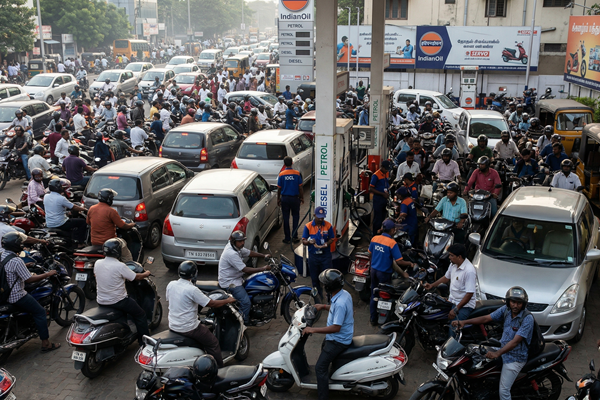
India’s fuel distribution network faces acute pressure as the Iran-US conflict drives crude oil prices sharply higher, triggering pump closures, panic buying, and informal rationing across Rajkot and Gujarat’s major cities.
Market Context and Background
India imports a significant share of its crude oil through the Strait of Hormuz. This waterway has become increasingly difficult to navigate since the Iran-US conflict escalated. The disruption arrives at a moment when India’s energy import bill was already rising.
The Indian crude basket averaged $69.01 per barrel in February 2026. However, by March, prices had surged to approximately $117.09 per barrel. Meanwhile, global Brent crude climbed to around $112 per barrel, compounding pressure on Indian refiners and distributors.
The Policy and Market Development
Crude price shock combined with rupee depreciation has tightened fuel supply chains across Gujarat. The rupee fell to 93.49 against the US dollar on March 21, compared to 91.07 on February 28. As a result, import costs rose sharply within weeks.
Oil companies responded by cutting petrol and diesel deliveries to retail outlets by approximately 50 percent. Additionally, bulk supply to large industrial consumers was suspended entirely. Pumps that previously received four tanker deliveries daily now receive just two.
Supply Chain and Trade Flow Impact
In Rajkot, seven Indian Oil Corporation petrol pumps and several private outlets closed temporarily. Furthermore, Nayara Energy and Reliance outlets reported reduced operations. Tanker deliveries that previously arrived daily now take three to four days.
In Surat, daily deliveries fell from three tankers to one or two. Meanwhile, transporters linked to Kandla and Mundra ports announced a 20 percent freight rate increase from March 24. Bulk diesel prices reportedly rose to approximately Rs 112 per litre, versus around Rs 96 per litre at retail pumps, redirecting bulk buyers toward ordinary retail outlets and worsening queues.
Causes and Policy Drivers
Two overlapping causes drove the crisis. First, a payment system change removed dealer credit arrangements. Dealers previously received fuel in the morning and paid by evening. Consequently, many could not process advance payments during the Eid public holiday weekend. Second, the Iran-US conflict pushed crude prices to multi-year highs within weeks.
Nayara Energy’s Vadinar refinery faces additional pressure. The European Union designated the refinery — 49.13 percent owned by Russia’s Rosneft — under sanctions for refining Russian crude. Therefore, Nayara’s supply position is structurally weaker than other operators entering this period of geopolitical stress.
Market Reactions and Stakeholder Views
Gujarat’s Deputy Chief Minister Harsh Sanghavi stated publicly that no shortage exists and attributed the crisis to social media misinformation. Nevertheless, the Federation of Gujarat Petrol-Diesel Dealers Association confirmed that more than 1,000 petrol pumps in Saurashtra and Kutch link to Indian Oil Corporation. IOC subsequently introduced a joint-lifting provision allowing two dealers to procure 20,000 litres together where individual dealers cannot meet advance payment requirements.
Global Context
Prime Minister Narendra Modi acknowledged in the Lok Sabha that India imports a large share of crude and gas through the Strait of Hormuz, where shipping has become structurally more difficult. Moreover, the Iran-US conflict is reshaping Asian energy trade flows, with buyers across the region facing similar supply-cost pressure. India’s vulnerability reflects a wider structural dependence on West Asian crude shared by Japan, South Korea, and several Southeast Asian economies.
Market Outlook
Near-term supply pressure is likely to persist through April if Strait of Hormuz shipping disruption continues. Additionally, the rupee’s depreciation trajectory will determine how quickly rising crude costs translate into further retail pricing stress. Authorities may face pressure to formally announce rationing measures if depot-to-pump flow does not normalise within 30 days.
Over the medium term, the 6 to 12 month outlook depends significantly on diplomatic resolution in West Asia. However, India’s structural exposure to Hormuz-routed crude means any prolonged conflict could force accelerated diversification toward alternative suppliers. Meanwhile, Nayara’s dual exposure — to Russian sanctions and Iranian supply disruption — represents a specific operational risk that could affect retail availability in Gujarat disproportionately relative to other Indian states.
Related posts:
 Colombia Grain and Feed 2026: Corn and Rice Output Set to Fall as US Dominates Imports and Wheat Dependence Deepens
 Restaurant Orders Recover as LPG Shortage Disrupts Kitchens
 Govt to Allocate 20% LPG Supply to Commercial Units Amid Ongoing Shortage
 LPG Shortage Forces 40% of Restaurants in Kerala to Shut Down
 LPG Cylinder Shortage Hits Mumbai Bakeries, Bread Supply at Risk
 Iran Export Ban Pushes Food Prices Higher in Turkmenistan and Central Asia
 Oman Evacuates Major Oil Export Port as Tanker Attacks Deepen Middle East Energy Crisis
 IEA Considers Historic Oil Reserve Release as Iran War Drives Crude Prices Higher