
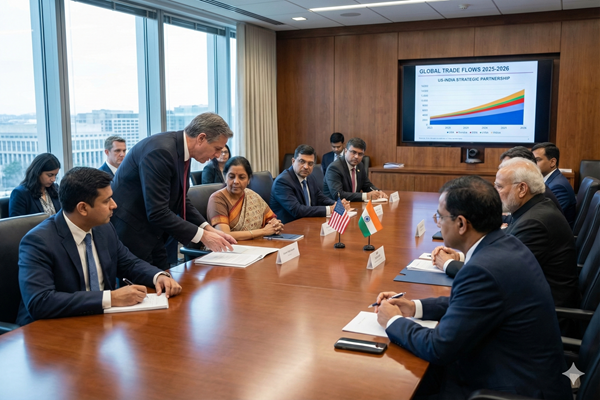
Negotiations for the proposed India–United States trade agreement have been delayed, with officials now expecting it to take another three to four months before a revised framework can be finalised.
The shift follows a U.S. Supreme Court ruling that struck down tariffs imposed under the International Emergency Economic Powers Act (IEEPA), prompting both countries to reassess the basis of the negotiations.
Government sources said the court decision has effectively paused the talks while India evaluates which legal tools Washington may use to impose future tariffs.
Tariff Ruling Triggers Review Clause
According to officials, the court ruling has activated Clause 8 of the Indo-US joint statement, which allows the agreement to be revisited if circumstances change.
“Trade deals are about preferential treatment. Once tariffs were declared illegal, we had the opportunity to rework the deal,” a senior government source said.
India will now examine whether a revised deal still offers balanced benefits depending on the tariff mechanisms the U.S. administration chooses to pursue.
Alternative Tariff Tools Available to the U.S.
Despite the IEEPA ruling, Washington still has several legal options under U.S. trade law to impose tariffs.
Officials identified four potential instruments:
Section 122 – US Trade Act of 1974
Allows tariffs of up to 15% for 150 days to address balance-of-payments issues.
Section 232 – US Trade Expansion Act
Permits tariffs of 50–100% on specific countries or products for national security reasons.
Section 338 – Smoot-Hawley Tariff Act of 1930
Allows the U.S. president to impose tariffs on any country for any duration, though it has never been used.
Section 301 – US Trade Act
The most commonly used provision enabling investigations into unfair trade practices, often resulting in tariffs on entire sectors or countries.
Officials noted that Section 301 has historically been the most powerful tool, with the U.S. government prevailing in most cases.
India Seeks Balanced Trade Partnership
Despite the uncertainty, New Delhi has indicated it wants to maintain constructive trade relations with Washington.
Officials described the United States as a “$30-trillion economy” and a crucial trading partner for India.
However, policymakers are closely monitoring the Trump administration’s tariff strategy, which is expected to be shaped partly by domestic economic considerations, including efforts to avoid triggering inflation.
“They are selectively putting tariffs so that inflation does not go up,” the official said.
Outlook for the Trade Agreement
The Indian government expects negotiations to restart soon, with both sides attempting to finalise a revised agreement within the next three to four months.
However, the final outcome will depend largely on which tariff mechanisms Washington ultimately deploys and how they affect the balance of trade concessions between the two countries.