
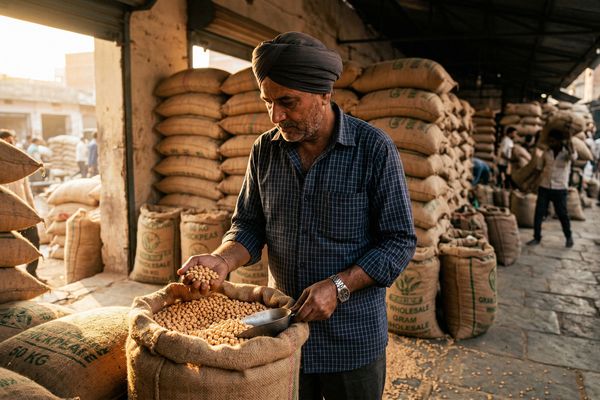
Indian chickpea prices are holding firm to higher for a third consecutive session, defying the usual harvest-pressure pattern as mill demand collides with tight arrivals and rising freight costs linked to the Gulf conflict. For European buyers, the $59–$60 per quintal band for standard Indian grades looks like a short‑term floor, with more upside than downside risk through April.
Indian spot markets remain the key driver. Despite the ongoing rabi harvest, arrivals from Gujarat, Karnataka and Maharashtra are lagging last year, while dal processors continue to cover nearby needs. Stockists are lifting offers, government procurement has only partially absorbed the crop, and higher crude oil prices are edging freight rates upward, all of which underpins chickpea and Kabuli values into Q2.
Exclusive Offers on CMBroker

Chickpeas dried
count 42-44, 12 mm
FCA 0.97 €/kg
(from IN)

Chickpeas dried
count 44-46, 11 mm
FCA 0.94 €/kg
(from IN)
📈 Prices & Spreads
In Delhi wholesale trade, new-crop desi chickpeas from Rajasthan have firmed to about $59.9–$60.2 per 100 kg, with Madhya Pradesh-origin lots close behind at $59.1–$59.4. The Jaipur line has moved in tandem, trading around $59.6–$59.9, confirming a broad market floor just under $60 per quintal for standard domestic grades.
Kabuli chickpeas are outperforming: medium qualities have risen from roughly $65–$69 to $68–$73 per 100 kg, with top-end grades maintaining a premium on top of that range. Chana dal has also rebounded, climbing from a recent low near $66.5 to about $67.6 per quintal, and dry-split grades are closing firm, signalling that downstream processing margins are being squeezed rather than prices easing at origin.
Indicative export-oriented offers in India for dried chickpeas (FOB New Delhi) translate into the following approximate EUR levels, using an indicative EUR/USD rate of 1.08:
| Origin / Size | Location / Term | Latest Price (EUR/kg) | Update Date |
|---|---|---|---|
| IN 42–44, 12 mm | New Delhi, FOB | ≈ 0.88 EUR/kg | 27 Mar 2026 |
| IN 44–46, 11 mm | New Delhi, FOB | ≈ 0.85 EUR/kg | 27 Mar 2026 |
| IN 46–48, 10 mm | New Delhi, FOB | ≈ 0.83 EUR/kg | 27 Mar 2026 |
| IN 58–60, 9 mm | New Delhi, FOB | ≈ 0.79 EUR/kg | 27 Mar 2026 |
| MX 42–44, 12 mm | Mexico City, FOB | ≈ 1.19 EUR/kg | 27 Mar 2026 |
This keeps Indian-origin chickpeas at a clear discount to Mexican material for comparable large sizes, which supports continued demand for Indian supplies in price‑sensitive Mediterranean and European destinations.
🌍 Supply, Demand & Policy
The current rally is unusually strong for peak arrival season. Fresh crop inflows that typically weigh on prices have failed to materialise at expected volumes from Gujarat, Karnataka and Maharashtra, leaving processors and traders to compete for limited spot stocks. In contrast, Madhya Pradesh and Rajasthan are expected to post larger rabi chickpea harvests, and their arrivals should build through April, but this relief is still ahead.
On the demand side, dal mills are described as price takers in the near term, forced to secure raw chickpeas to maintain operations even as spot offers rise. This underpins both whole chickpeas and chana dal values and encourages stockists to hold or even accumulate inventory ahead of India’s new financial year.
Government intervention remains moderate but important. Procurement at the Minimum Support Price has reached about 100,000 tonnes so far, while central pool stocks sit near 300,000 tonnes of chickpeas. Full‑scale MSP buying from major producing states has yet to start, and port stocks are comfortable, so the import channel remains open as a buffer if domestic tightness persists.
📊 External Drivers & Freight
Geopolitical tensions in the Gulf region are adding a freight and risk premium to pulse trade flows. The ongoing Iran–Gulf conflict and disruptions around the Strait of Hormuz have pushed Brent crude back above US$100 per barrel in late March, with some market commentary pointing to spot levels above US$107 on March 30 and ongoing volatility.
Higher bunker fuel prices and elevated insurance premiums are pushing up global shipping costs, with benchmark tanker routes from the Middle East to Asia recently touching record daily earnings. For chickpeas, this translates into upward pressure on landed costs for import-dependent buyers and may erode the competitiveness of distant low-cost origins versus nearer suppliers, particularly if conflict-related disruptions extend into Q2.
For now, Indian ports are operating, and chickpea stocks at key terminals are reported as comfortable. However, if freight and insurance rates continue to rise with crude, the import economics into the EU could deteriorate even without further gains in FOB prices, supporting firm EUR-denominated replacement values for both desi and Kabuli varieties.
🌦 Weather & Crop Outlook
Chickpeas in India are part of the rabi crop cycle, sown in winter and harvested from March to May. With the 2025/26 rabi harvest already underway, short‑term price dynamics are being driven more by logistics, arrivals and policy than by weather shocks. Recent agronomic updates for rabi pulses highlight their central role in Indian pulse production but do not signal a major weather‑related production failure this season.
Looking into April, where weather remains normal, the key focus will be the pace at which Madhya Pradesh and Rajasthan bring new-crop chickpeas to market and how quickly procurement agencies scale up MSP purchases. A smooth harvest and marketing campaign in these states is critical to easing tightness seen in western and southern producing regions.
📆 Trading Outlook & Recommendations
- European importers: Expect firm to slightly higher EUR values through April. Consider booking a portion of Q2 needs now, especially for Kabuli and larger-size desi grades, while retaining some flexibility in case arrivals from Madhya Pradesh and Rajasthan accelerate faster than expected.
- Indian stockists and traders: Current fundamentals support holding a cautiously bullish bias. However, once large-state arrivals and full-scale MSP procurement start, basis relationships could shift quickly; monitor port stock levels and government buying closely.
- Food manufacturers and dal mills: Margin pressure is likely to persist. Where possible, hedge exposure via staggered purchases and explore blending strategies across sizes and origins to manage input costs while freight and crude remain elevated.
📉 3‑Day Price Indication (Directional, in EUR)
Over the next three trading days, with no immediate catalyst for relief on either supply or freight, Indian chickpea prices in EUR terms are expected to remain stable to slightly firmer:
- India (New Delhi, FOB desi 42–44, 12 mm): ~0.88 EUR/kg, bias: sideways to +1–2%.
- India (New Delhi, FOB smaller desi 58–60, 9 mm): ~0.79 EUR/kg, bias: sideways to modestly higher as processors trade down in size.
- Mexico (FOB large Kabuli 42–44, 12 mm): ~1.19 EUR/kg, bias: broadly stable; relative premium to India limits further upside near term.
Any sharp move in Brent crude or a sudden improvement in Indian arrivals could alter this picture, but for now the balance of risks for chickpeas remains skewed to the upside.
Related posts:
 Indian Chickpea Market Finds a Floor as New Crop and Imports Build Pressure
 Chickpea Rally Tests Its Limits as Indian Harvest and State Buying Ramp Up
 New Indian Crop Pressures Chickpea Prices as MSP Support Looms
 Indian Chickpea Market Firms as MSP Buying Ramps Up, Imports Cap Upside
 Chickpea Prices Steady but Supported as Indian Procurement Ramps Up
 Lentil Market Tracks Indian Pulse Tensions and Rising Freight Risk
 Indian Lentil Jitters: Duty Risk Meets Heavy Global Supply
 Chickpea Market Softens: Indian Desi Chana Under Demand Pressure