
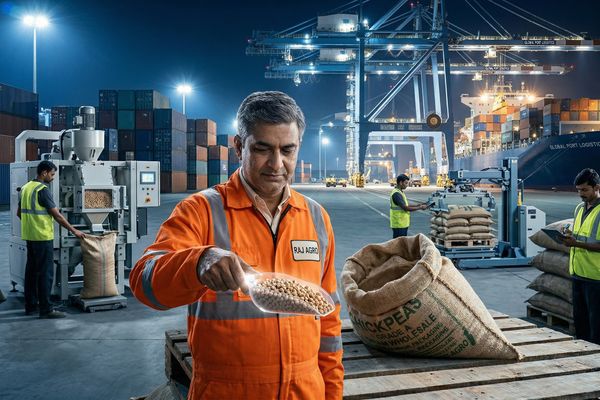
Indian chickpea prices are firming into the harvest, supported by tight arrivals, delayed Australian imports and low government buffer stocks, with downside likely limited in the coming weeks.
India’s domestic chickpea market is staging a counter‑seasonal rally, defying normal harvest pressure as mills step up buying while new-crop arrivals stay well below expectations. Structural tightness in India’s balance sheet, rising import values and logistics delays are narrowing the window for international buyers – especially in Europe – to secure volume at current price levels.
Exclusive Offers on CMBroker

Chickpeas dried
count 42-44, 12 mm
FCA 0.97 €/kg
(from IN)

Chickpeas dried
count 44-46, 11 mm
FCA 0.94 €/kg
(from IN)
📈 Prices & Short-Term Trend
At New Delhi’s Lawrence Road wholesale market, Rajasthan-origin chickpeas are trading around the equivalent of EUR 0.79–0.80 per kg (USD 59.45–59.98 per 100 kg), up about EUR 0.01 per kg on the day as buying emerged at lower levels. New-crop Rajasthan lots are quoted slightly lower, roughly EUR 0.78–0.79 per kg, with Madhya Pradesh-origin near EUR 0.77–0.78 per kg after a similar daily gain.
Jaipur-line chickpeas are broadly aligned, indicating a firm but not overheated spot market. Parallel indications from export-oriented offers in New Delhi show dried chickpeas (count 42–44, 12 mm) around EUR 0.97 per kg FCA, with smaller calibres trading down to roughly EUR 0.79 per kg, confirming a generally supported price structure across sizes.
| Market / Product | Specification | Price (EUR/kg) | Trend (2–3 days) |
|---|---|---|---|
| New Delhi wholesale (Rajasthan) | New crop, domestic | ≈ 0.79–0.80 | Firm, +~1–2% |
| New Delhi FCA export | 42–44, 12 mm, IN origin | 0.97 | Stable–firm |
| New Delhi FCA export | 58–60, 9 mm, IN origin | 0.79 | Stable–firm |
| Mexico City FOB | 42–44, 12 mm, MX origin | 1.28 | Sideways |
🌍 Supply & Demand Balance
Fresh chickpea arrivals from key Indian producing states are running 31–32% below last year for the same period, sharply limiting the typical harvest-season pressure. Holiday-related market closures for Ram Navami have further curtailed arrivals from Maharashtra, Madhya Pradesh, Karnataka, Gujarat and Rajasthan, tightening spot availability in hub markets such as Delhi.
India’s domestic production is estimated around 9.5 million tonnes versus consumption near 14 million tonnes, leaving a structural gap of roughly 4.5 million tonnes to be filled via imports. This entrenched deficit continues to underpin a medium-term bullish bias, especially when new-crop yields in Maharashtra and Rajasthan are already reported below earlier expectations.
📊 Trade, Imports & Policy Drivers
On the import side, Australian chickpeas are indicated around USD 565 per tonne CFR Mumbai for May–June, a level that has risen by roughly USD 20–25 per tonne in recent weeks. A key shipment expected at Mundra port has been delayed due to maritime security risks, reducing the near-term visibility of imported supply and tempering hopes for quick relief on prices.
Government procurement at the Minimum Support Price has so far covered only about 100,000 tonnes, while the central buffer stock in chickpeas remains modest at around 300,000 tonnes against an overall pulses buffer target of 3.5 million tonnes. With procurement likely to accelerate in Madhya Pradesh and Rajasthan, further volumes will be taken off the open market, reinforcing the floor under domestic prices.
🏭 Mill Buying Behaviour & Market Sentiment
Dal processing mills, which had been buying hand-to-mouth in anticipation of heavier arrivals and cheaper Australian cargoes, are now shifting strategy. With domestic yields disappointing in parts of Maharashtra and Rajasthan and imported flows delayed, mills are more willing to cover near-term needs at current levels rather than risk tighter availability later in the season.
Broader pulses strength is adding to the constructive tone: rising prices in pigeon peas and black gram are supporting sentiment and encouraging cross-commodity substitution and stock-building. Overall, the market tone in India has turned from cautious to defensively bullish, with participants now treating recent lows as unlikely to be revisited in the very near term.
📆 2–4 Week Outlook
Over the next two to four weeks, Indian chickpea prices are expected to remain supported within an approximate band of EUR 0.76–0.81 per kg (USD 57.50–61.00 per quintal), assuming stable FX and freight. Increased April arrivals from Madhya Pradesh and Rajasthan may add some marginal softness, but this is likely to be capped by ongoing government procurement, delayed Australian imports and tightening old-crop stocks.
For European buyers relying on Indian chickpeas for food manufacturing, the current period likely represents a narrowing window to secure volume at today’s levels. Should import delays persist or government procurement accelerate faster than expected, international offer prices in EUR terms could firm further, particularly for larger calibres and consistent qualities.
💡 Trading Outlook & Recommendations
- Importers / European buyers: Consider advancing purchases for Q2–Q3 coverage while Indian wholesale prices remain within the projected EUR 0.76–0.81 per kg band; upside risk outweighs near-term downside.
- Indian millers: Avoid excessive hand-to-mouth strategies; staggered buying on minor dips may be preferable to waiting for a deeper correction that is increasingly unlikely in the short term.
- Producers in India: With government procurement ramping up and private demand firm, holding a portion of stock where cash flow permits could capture further gains, particularly if import arrivals stay disrupted.
📍 3-Day Regional Price Indication (Directional)
- New Delhi wholesale (India): Slightly firmer to steady in EUR terms as mills continue covering and arrivals normalise after festival closures.
- Indian export parity (FCA/FOB New Delhi): Steady to firm across main calibres, with limited downside given external demand and policy buying.
- Mexico FOB (large-size chickpeas): Broadly sideways in EUR, maintaining a premium over Indian origin and offering limited arbitrage for most destinations.
Related posts:
 Indian Chickpea Rally Meets Tight Supply and Rising Freight Risk
 Indian Chickpeas Ease from Highs as Supplies Rebuild and Heat Sets In
 China’s White Bean Export Triangle Faces Price Pressure Despite Quality Edge
 Chinese Lentil FOB Prices Edge Higher Amid Easing Canada–China Trade Tensions
 China Bean FOB Prices Edge Mixed as Export Demand Stabilises
 Canadian Lentils Edge Higher as India Tariffs and Weather Risks Loom
 Chickpeas Hold Firm as New Crop Arrivals Fail to Pressure Prices
 Kabuli Chickpeas Under Pressure: Soft Market, Steady Supply, Limited Upside