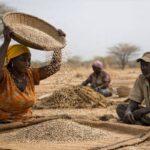
Indian and Chadian sesame prices are edging slightly lower to sideways in early May, with comfortable nearby supply and only selective export demand preventing any sharp rally.
Across key Indian hubs, quotations for natural and hulled sesame have softened marginally over the past week, mirroring a broader easing in oilseed sentiment and cautious overseas buying. Early‑May market commentary also points to relaxed short‑term demand from some Asian destinations, keeping Indian offers competitive but capping upside momentum. In Chad, very hot, dry weather continues to dominate the outlook, but there are no fresh reports of major crop losses, so European FCA prices for Chadian origin are holding broadly steady. For the next few sessions, sesame stays in a narrow range, with more risk of mild downside than a sudden spike.
Exclusive Offers on CMBroker

Sesame seeds
99,95%
FCA 1.71 €/kg
(from DE)

Sesame seeds
hulled
99,98%
EXW 1.71 €/kg
(from DE)

Sesame seeds
99,95%
FOB 1.71 €/kg
(from IN)
📈 Prices & Short-Term Trend
For reference, current spot/offer levels (converted to EUR) indicate:
| Origin / Grade | Location & Term | Current Price (EUR/kg) | 1w Δ (EUR/kg) | Direction |
|---|---|---|---|---|
| India – Natural 99.95% | FOB Kolkata | ≈ 1.71 | -0.03 | Softening |
| India – Hulled 99.90–99.98% | FOB New Delhi | ≈ 1.41–1.48 | -0.01 | Slightly lower |
| Chad – Hulled 99.95% | FCA Germany | ≈ 1.65–1.71 | +0.01 | Sideways / firm |
External price checks from early May show a similar pattern: Indian and Egyptian sesame offers have eased on the back of comfortable availability and restrained buying interest, with exporters reporting softer demand and a notable year‑on‑year decline in shipments in early 2026.
🌍 Supply, Demand & Logistics
In India, the near‑term supply picture remains comfortable. Recent commentary highlights that sesame arrivals and exportable stocks are adequate, while buyers in key Asian and Middle Eastern markets are purchasing cautiously, leading to only modest price competition among origins. Exports are reported to be down versus last year, reinforcing the slightly bearish bias despite steady structural demand from food, bakery and oil segments.
Logistics for Indian agricultural exports continue to face some volatility in Gulf routes, but recent discussions among freight operators suggest that congestion around UAE hubs is easing compared with earlier this year, with alternative routings via Oman and overland corridors helping restore schedule reliability. These options have so far a limited direct price impact on sesame but can elongate lead times, encouraging some importers to maintain higher working stocks rather than chase nearby prices.
Chad’s sesame sector remains export‑oriented, with supply flows mainly into Middle Eastern and Asian markets. While detailed, up‑to‑the‑day trading data are scarce, structural reports underline that smallholder output and traditional trading networks dominate, which tends to smooth short‑term shocks but also limits the likelihood of rapid supply surges. Combined with current stable FCA quotations into Europe, this argues for a broadly balanced near‑term outlook for Chadian origin.
🌦 Weather Outlook – IN & TD
Across India, the next three days (6–8 May) are forecast to remain very warm with hazy sunshine and highs around 34°C, with only localized thunderstorms in parts of central India. For sesame, which is largely past the most weather‑sensitive stage in key belts, such conditions are neutral to mildly supportive for late fieldwork and logistics but do not currently pose a major yield risk.
Seasonal guidance from India’s meteorological authorities points to above‑normal heatwave days in May, even as overall rainfall is expected to be slightly above average, linked to evolving El Niño/Indian Ocean Dipole signals. For sesame, the key risk would be if extreme heat aligns with sensitive flowering or pod‑filling windows in later‑sown areas; at this stage, that risk is on the radar but not yet translating into a weather premium in prices.
In Chad, the short‑term forecast calls for very hot, mostly sunny conditions, with maximum temperatures around 43–44°C and warm nights near 25–26°C through the coming three days. Such heat is typical for the season. While it increases evaporation and can stress any standing crop without adequate moisture, there are no fresh indications of widespread sesame damage or planting failure tied to this latest spell, so the market is treating weather as a background factor rather than a primary driver.
📊 Fundamentals & Market Sentiment
Domestic mandi data in India show sesame (til) prices in producing regions drifting modestly lower in early May, broadly in line with the small declines seen in export offers. This reflects comfortable near‑term availability and a lack of aggressive stock‑building by traders. A wider edible‑oilseed complex marked by steady to slightly softer prices is also limiting any speculative push into sesame.
On the demand side, global usage for bakery, snack foods, tahini and oil remains firm, but buyers are price‑sensitive and willing to switch between origins such as India, East Africa and Egypt. Recent early‑May coverage notes that importers have been in no rush to chase the market higher, given the absence of major weather or policy shocks. As a result, sentiment is best described as cautiously neutral: downside is checked by replacement costs and long‑term demand growth, while upside is capped by slow export offtake.
📆 3‑Day Price & Trading Outlook
Given current fundamentals and weather, sesame is expected to stay range‑bound over the next three sessions, with a mild downward bias where export interest is thin.
- India – FOB / FCA (natural & hulled, white grades): Slight easing or sideways. Traders should expect offers to hover close to current levels in EUR/kg, with occasional discounts on volume parcels if export buying remains slow.
- India – Premium black grades (regular, semi Z, super Z): Stable to fractionally softer, as niche demand is steady but not accelerating.
- Chad – Hulled, FCA EU: Broadly steady, with any changes likely limited to minor basis adjustments rather than structural moves.
🧭 Trading Recommendations (Short-Term)
- Buyers (importers, crushers, food processors): Use the current soft tone to cover nearby needs and a portion of Q3 at staggered intervals, rather than waiting for a significant correction that fundamentals do not strongly justify.
- Indian exporters: Focus on competitive pricing and logistics reliability toward Middle East and East Asia; consider small tactical discounts for prompt shipments to stimulate demand without undermining overall price structure.
- Producers & aggregators (India & Chad): Avoid heavy destocking at minor dips; with no major bearish shock in sight and structural demand intact, retaining some inventory for potential weather‑ or freight‑driven spikes later in the season remains prudent.