
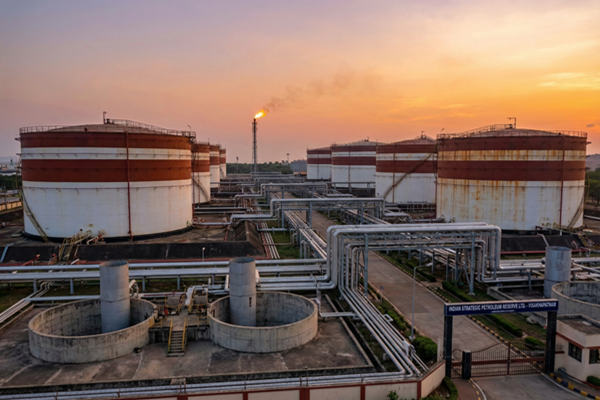
India currently holds more than 250 million barrels of crude oil and refined petroleum products in its energy buffer, equivalent to around 4,000 crore litres, according to a government report highlighting the country’s energy security strategy.
The stockpile provides seven to eight weeks of supply coverage across the entire fuel chain, significantly higher than claims that India holds only 25 days of reserves.
The reserves are stored across underground strategic caverns in Mangalore, Padur and Visakhapatnam, along with above-ground storage tanks, pipelines and offshore vessels.
Diversified Energy Supply
The report states that India’s oil procurement strategy is based on diversified sourcing, reducing reliance on any single supplier or transit route.
Currently, India imports oil from around 40 countries, compared to 27 countries a decade ago.
Although the Strait of Hormuz remains a key global energy chokepoint, only about 40% of India’s crude imports pass through it. The remaining 60% arrive through alternative routes from regions including:
-
Russia
-
West Africa
-
The Americas
-
Central Asia
According to the report, this diversification ensures that disruptions in a single corridor lead only to “managed sourcing adjustments rather than supply emergencies.”
Russia Remains Largest Oil Supplier
As of February 2026, Russia continues to be India’s largest supplier of crude oil.
The report notes that despite geopolitical pressure in recent years, India has continued to purchase Russian oil while complying with G7 price cap regulations.
It also refers to a 30-day waiver issued by the US Treasury, allowing continued purchases and easing trade friction.
Officials said the waiver recognises India’s role in helping stabilise global energy markets.
Ethanol Programme Reduces Oil Dependence
India’s ethanol blending programme, which now stands at 20% blending, has reduced the country’s crude oil demand.
The initiative is estimated to displace around 44 million barrels of crude oil annually.
At the same time, India’s refining capacity has reached 258 million metric tonnes per annum (mmtpa), exceeding domestic fuel demand of 210–230 mmtpa.
This surplus capacity has allowed Indian refiners to supply fuel to global markets, including Europe following sanctions on Russian crude oil.
Fuel Prices Remain Stable
The report highlights that India’s fuel prices have remained relatively stable despite global energy market volatility.
Between February 2022 and February 2026:
-
Petrol prices in Delhi fell by 0.67%
-
Prices rose 55% in Pakistan
-
Prices increased 22% in Germany
To maintain price stability, India’s public sector oil companies absorbed significant financial losses.
These include:
-
₹24,500 crore in losses on petrol and diesel
-
Around ₹40,000 crore in losses on LPG
Energy Security Strategy
The report concludes that India’s energy policy is guided by three key priorities:
-
Affordability
-
Availability
-
Sustainability
Officials emphasised that due to improved infrastructure and diversified sourcing, no fuel pump in India has run dry in the past twelve years, demonstrating the resilience of the country’s energy supply system.