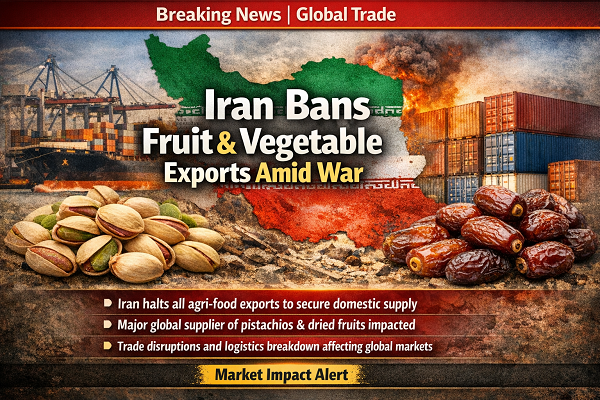
Iran has imposed a ban on fruit and vegetable exports, halting trade flows amid the ongoing conflict and raising concerns over global supply chains, particularly for key products such as pistachios, dates and dried fruits.
The export ban, in place since March 3, 2026, has effectively stopped agricultural trade between Iran and its major partners.
Iran export ban hits global fruit and nut trade
Iran is a major global supplier of pistachios, dates, sultanas and dried fruits, making the export halt significant for international markets.
The country exports large volumes to the Gulf region, Central Asia, Russia and India, with total fruit exports estimated at €2.6 billion annually.
Vegetable exports are valued at around €1.3 billion, highlighting Iran’s strong presence in global fresh produce trade.
EU exposure remains limited but significant
The European Union is not heavily dependent on Iran, but trade volumes remain notable.
EU imports of fruit, vegetables and nuts from Iran exceeded $245 million (€225 million) in 2025.
-
Fruit and nuts accounted for 93% of imports
-
Vegetables contributed about $16 million (€15 million)
Iran represents only 0.6% of total EU imports from third countries, limiting overall exposure.
Pistachios dominate EU imports from Iran
Pistachios are the most important product in EU-Iran agricultural trade.
-
Shelled pistachios: $121 million (€112 million)
-
In-shell pistachios: $7.3 million (€6.7 million)
Other key imports include:
-
sultanas: $59 million (€54 million)
-
dates: $30 million (€28 million)
These three products form the backbone of Iran’s exports to Europe.
Germany leads EU imports
Germany is the largest importer of Iranian agricultural products in the EU.
-
Germany: $105 million (€97 million)
-
Netherlands: $25 million (€23 million)
-
Italy: $24 million (€22 million)
-
Spain: $16 million (€15 million)
The Netherlands plays a key role as a trade hub, while Italy remains a major destination for specialty products like truffles.
EU exports to Iran remain minimal
EU exports of agricultural products to Iran are limited.
Total exports stood at just $6.4 million (€5.9 million), mainly consisting of:
-
processed vegetables
-
dried vegetable mixes
-
seed potatoes
France, the Netherlands and Hungary are the leading exporters.
The trade balance remains heavily in Iran’s favor.
Iran among top global producers
Iran ranks among the top 10 global producers of several agricultural products, including:
-
pistachios
-
pomegranates
-
dates
-
cherries
-
apples
-
almonds
-
onions
The country also ranks among top exporters for many of these products.
Imports and trade flows now stalled
Iran imports limited quantities of fresh produce, mainly bananas and nuts, with total imports valued at around:
-
vegetables: $174 million (€160 million)
-
fruit and nuts: $622 million (€570 million)
With the export ban in place, both imports and exports have largely come to a standstill.
Market outlook
Analysts say the export ban could tighten global supply of key products such as pistachios and dried fruits, potentially pushing prices higher.
However, the overall impact on Europe may remain limited due to low dependency.
Market participants will closely monitor the situation, as Iran’s large production capacity could significantly influence global markets once trade restrictions are lifted.