
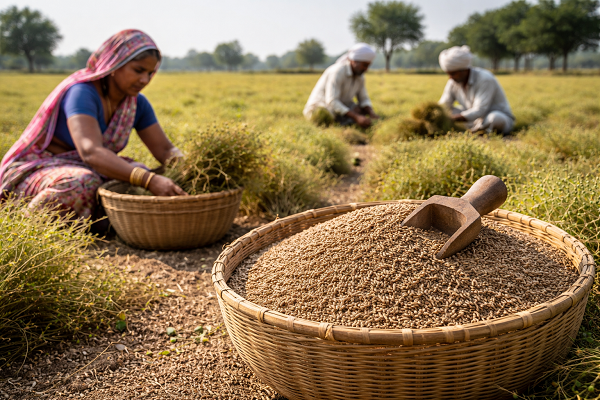
The cumin (jeera) market is holding a firm to steady tone in India, with prices edging higher even as physical arrivals remain strong. Selective but robust demand for premium-quality lots, together with active export buying, is underpinning the market. Lower grades continue to move slowly, reinforcing a quality-driven market structure where bold and super-best material capture the bulk of price support.
With around 42,000 bags arriving, the market has comfortably absorbed fresh supplies without any marked downward pressure. Domestic buyers are clearly prioritising quality, while exporters are stepping in at key price levels around the current export benchmarks. At the same time, FOB offers in EUR from India show only marginal week-on-week weakness, pointing more to healthy two-way trade and normal profit-taking than to any structural demand problem.
Exclusive Offers on CMBroker

Cumin seeds
whole, grade - A
FOB 4.35 €/kg
(from IN)

Cumin seeds
grade - A
99%
FOB 2.24 €/kg
(from IN)

Cumin powder
grade - A
FOB 3.50 €/kg
(from IN)
In the broader global context, India remains the cornerstone supplier of cumin, while countries such as Egypt, Syria and Turkey provide competition mainly in specific segments and destinations. Recent trade data underline growing global cumin consumption, driven by ethnic and convenience foods, but also point to a more competitive landscape with China and other origins expanding footprints. For now, however, India’s combination of scale, quality spectrum and pricing flexibility continues to anchor international benchmarks.
📈 Prices & Market Structure
The core domestic jeera market is currently characterised by a firm undertone and incremental daily gains. According to the raw physical market data, jeera prices are up by about ₹30–40 per 20 kg, equivalent to roughly USD 0.36–0.48 per kg, even as arrivals remain sizable at around 42,000 bags. This price action clearly signals that demand for good-quality material is comfortably absorbing supply.
Within the quality spectrum, bold premium cumin is quoted around USD 53.0–56.0 per 20 kg, new super-best at USD 48.0–50.5, medium quality at USD 45.5–46.5, and trade quality at USD 44.0–45.5 per 20 kg. Export prices for new crop are clustering around USD 51.0 per 20 kg, reflecting the willingness of overseas buyers to pay up for reliable Indian quality. Old crop Rajasthan-origin jeera is trading near USD 20.0–21.0 per kg, while Gujarat-origin old crop is slightly lower at USD 18.8–19.5 per kg.
A key market feature at present is the divergence between strong demand for top-end grades and slower offtake for lower grades. This bifurcation keeps headline prices supported while creating selective pressure on trade-quality material. Export buying, especially for consistent bold and new super-best grades, remains a decisive floor for the market and helps explain why prices have risen despite sizeable arrivals.
📊 Indicative Export & FOB Price Overview (Converted to EUR)
Assuming an approximate exchange rate of 1 USD = 0.92 EUR and using current Indian and international offers, indicative price levels are as follows:
| Product / Origin | Location | Specification | Latest Price (EUR) | Previous Price (EUR) | Weekly Change (EUR) | Sentiment |
|---|---|---|---|---|---|---|
| Cumin seeds, whole grade A, organic (IN) | New Delhi (FOB) | Whole, organic | 4.45 | 4.50 | -0.05 | Firm, mild correction |
| Cumin seeds, grade A 99% (IN) | New Delhi (FOB) | Conventional | 2.32 | 2.35 | -0.03 | Steady to slightly soft |
| Cumin powder, grade A organic (IN) | New Delhi (FOB) | Organic powder | 3.60 | 3.65 | -0.05 | Stable, light profit-taking |
| Cumin seeds 98% (IN) | Unjha, Gujarat (FOB) | Conventional | 2.20 | 2.23 | -0.03 | Stable with firm undertone |
| Cumin seeds 99% (IN) | New Delhi (FOB) | Conventional | 2.28 | 2.30 | -0.02 | Steady |
| Cumin seeds 99.9% (EG) | Cairo (FOB) | Conventional | 4.35 | 4.40 | -0.05 | Slightly weaker, competitive vs India |
| Cumin seed (SY) | Dordrecht, NL (FCA) | Conventional | 3.60 | 3.60 | 0.00 | Stable |
On a week-on-week basis, Indian FOB offers in EUR have eased by about EUR 0.02–0.05/kg across most grades, despite the firm rupee-based spot trend indicated in the raw text. This apparent divergence is consistent with slightly softer export offers in dollar or euro terms to stimulate demand, while domestic mandi prices for premium lots remain supported by steady buying.
🌍 Supply & Demand Dynamics
Arrivals and domestic flow
Arrivals of around 42,000 bags in the key Indian markets highlight that the harvest pipeline is functioning smoothly. Crucially, these volumes have not translated into any significant price correction; instead, the market has strengthened modestly. This confirms that consumption and export channels are efficiently absorbing fresh supplies, particularly for higher-grade jeera.
Lower grades, described as moving slowly, indicate some congestion at the trade-quality end of the spectrum. Traders holding such stocks may be more sensitive to small shifts in export interest or domestic blending demand. Nonetheless, with export demand for good-quality lots reported as strong, the overall supply–demand balance leans slightly in favour of sellers for premium grades and remains broadly neutral for medium and trade-quality material.
Global demand and trade flows
Global cumin demand remains on an upward trajectory, driven by the rise of spice-heavy cuisines and processed foods worldwide. Recent market research suggests the global cumin seed market is expected to grow steadily over 2026–2035, supported by robust consumption in Europe and North America and rising interest in organic and sustainably sourced cumin.
India continues to dominate world cumin exports, with recent export campaigns showing double-digit growth in shipped volumes as international buyers lean on Indian availability and price competitiveness. Official and industry data indicate that Indian cumin exports in recent seasons have surged significantly, reinforcing the country’s status as primary global supplier even as other origins like Turkey and Syria maintain meaningful shares.
Competing origins
Egypt and Syria are offering competitive FOB levels, especially into Europe and parts of the Middle East where logistical proximity is an advantage. Current Egyptian offers around EUR 4.35/kg FOB Cairo for high-purity cumin underline their positioning in the higher-value segment. Syrian cumin, offered around EUR 3.60/kg FCA Netherlands, provides buyers with an alternative in mid-quality categories, but volumes and consistency are generally lower than those of India.
In recent years, China has also emerged as a notable player in cumin exports, capitalising on prior supply tightness in India and investing in processing capabilities. While Chinese-origin cumin remains a smaller share of global trade compared with Indian product, its presence adds another layer of competition, particularly during periods when Indian prices spike.
📊 Fundamentals & Market Drivers
Quality-driven pricing
The current market is clearly segmented along quality lines. Bold premium and new super-best lots command strong demand and higher prices, while medium and trade-quality material trade at noticeable discounts. This is fully in line with the raw text, which notes that good quality stock sees strong demand, whereas lower grades are moving slowly.
Export buyers typically prioritise consistent colour, essential oil content, and low contamination levels, which favours bold and super-best grades. The price ladder from trade quality (around USD 44.0–45.5 per 20 kg) up to bold premium (USD 53.0–56.0 per 20 kg) reflects these quality differentials. For old crop, Rajasthan material trades at a slight premium over Gujarat, suggesting perception of marginally better keeping quality or established customer preferences.
Stocks and carry-over
While precise current stock figures are not supplied in the raw text, recent industry commentary indicates that India has rebuilt cumin inventories after earlier weather-related tightness in 2021–2023. Supply recovery, together with strong export campaigns, means that available stocks are healthy but not burdensome, especially for top-quality grades.
Carry-over old-crop stocks are now largely concentrated in mid and lower grades, as better-quality old crop has already been liquidated or blended. The fact that old crop still trades at attractive levels (near USD 20–21/kg Rajasthan) suggests that there is no panic selling and that these stocks remain relevant for price formation, particularly for buyers willing to substitute some new crop with old crop in blends.
Speculative and institutional influence
Exchange-traded cumin futures (e.g., on Indian commodity exchanges) continue to influence spot sentiment by signalling the market’s view on future balance sheets. Recent reports point to relatively stable to slightly softer futures curves compared with the sharp rallies seen during earlier supply shocks, reflecting improved production and more cautious speculative participation.
When futures fail to rally aggressively despite firm spot prices, it often indicates that commercial participants believe current firmness is fundamentally justified but do not expect a sustained runaway bull market. That pattern is consistent with the raw-text outlook of a firm to steady market, with any sharp rise contingent on export activity and the pace of stock drawdown.
🌦️ Weather Outlook – Key Indian Growing Regions (IN)
Current conditions (Gujarat – Unjha cluster)
Latest weather data for Unjha, a central hub for Gujarat’s cumin belt, show very warm to hot conditions with maximum temperatures mostly in the 34–39°C range and lows around 20–23°C. The coming week is expected to remain dry with a mix of sun and partial cloud cover and no significant rainfall events on the horizon.
For harvested or nearly harvested cumin, such hot and dry weather is generally favourable for drying, cleaning and bagging operations, reducing moisture-related quality risks. However, prolonged heat can raise storage risks if warehouses are poorly ventilated, potentially encouraging insect activity; exporters and stockists should therefore monitor warehouse temperatures and fumigation schedules closely.
Rajasthan cumin belt
While specific station data for Rajasthan’s cumin heartlands are not detailed in the tool output, broader regional patterns in March typically feature warm and dry conditions, with minimal rainfall. Given that cumin in Rajasthan is largely at advanced growth or harvest stages in March, such weather usually supports final maturation and harvest operations, provided there is no late-season rainfall.
Recent seasons have shown that unseasonal rain or heat spikes in Gujarat and Rajasthan can sharply disrupt yields and quality, contributing to volatility in jeera prices. Market participants therefore remain highly sensitive to any updated meteorological warnings through late March and early April; as of now, the forecast points to a broadly supportive environment for post-harvest handling rather than a fresh weather shock.
🌍 Global Production & Trade Overview
| Country | Role | Recent Production / Export Signal | Market Impact (Qualitative) |
|---|---|---|---|
| India | Largest producer & exporter | Production above 800,000 tonnes in recent years; exports above 1.8–2.0 lakh tonnes in latest seasons | Sets global benchmark; drives price for most destinations |
| Turkey | Key secondary exporter | Exports ~25,000 tonnes of cumin seeds (HS 090930) in 2024 | Important for Europe and regional trade; moderate price influence |
| Egypt | Specialty & regional supplier | High-purity cumin exports at premium prices (around EUR 4.35/kg FOB) | Benchmark for certain EU buyers; quality competition for India |
| Syria | Alternative origin | Exports via EU hubs such as Netherlands at around EUR 3.60/kg FCA | Provides mid-range alternative; limited volume vs India |
| China | Emerging exporter | Increased presence over last decade as processor and re-exporter | Adds competition in some markets, especially when Indian prices spike |
India’s dominant position is underpinned by both sheer scale and the breadth of quality segments it can supply, from trade-quality to premium organic grades. Recent trade statistics show that India’s cumin exports have grown at a strong pace over the last several years, with particularly sharp increases in 2023–2025 as production recovered and international buyers diversified away from more expensive origins.
Turkey, Egypt and Syria play crucial balancing roles by supplying regional demand and specialty niches. Their combined exports, while significant, are still overshadowed by India’s volumes. Nonetheless, their pricing—currently broadly competitive in EUR terms—acts as a cap on extreme rallies in Indian export offers, especially for buyers with flexible origin requirements.
📆 Short-Term Outlook & Trading Strategy
Fundamental outlook (next 4–6 weeks)
The raw text clearly indicates that the jeera market is expected to remain firm to steady, with prices likely to hold as long as strong demand for quality material persists. Any sharp upward move is explicitly tied to export activity and the pace of stock movement. Given the current hot, dry and harvest-friendly weather, no immediate supply shock is visible, but export demand remains a key swing factor.
Export interest for premium Indian cumin is being assisted by slightly softer EUR-denominated FOB offers, even as rupee spot prices remain firm. This mix suggests an environment supportive of steady physical flows rather than explosive price action. As a result, baseline expectations should favour sideways to mildly upward price evolution, with volatility largely driven by shifts in international buying programmes.
Key risks
- Upside risk: Sudden acceleration in export buying from key markets (e.g., Middle East, Europe) at a time when quality stocks are tightening could trigger sharper price appreciation, especially for bold and super-best grades.
- Downside risk: If lower grades continue to move slowly and exporters become more selective, trade-quality stocks could accumulate, weighing on average prices despite firmness in top-end lots.
- Policy and logistics: Any disruption in port logistics, freight spikes, or regulatory changes (tariffs, quality norms) in major importing regions could temporarily dampen export flows and pressure local prices.
📌 Trading Recommendations
- For Indian farmers and stockists: Given the firm to steady tone and strong demand for quality, staggered selling of premium grades is advisable rather than aggressive liquidation. Focus on maintaining quality in storage, as price differentials between bold/super-best and lower grades are likely to widen further if quality issues emerge.
- For domestic traders: Maintain a balanced book, being long in bold and new super-best grades while being more cautious with large inventories of trade-quality stock. Consider using any short-term dips driven by currency or futures volatility to add to premium-quality positions.
- For exporters: Lock in forward contracts with reliable buyers at current export benchmarks (~USD 51 per 20 kg for good-quality lots), especially if you can secure consistent farm-gate quality. Monitor EUR and USD exchange moves closely to fine-tune offer levels without undercutting domestic price signals.
- For international buyers (EU, Middle East, North America): With Indian FOB offers in EUR slightly softer week-on-week and fundamentals pointing to a firm but not explosive market, this is a favourable window to book medium-term coverage, particularly for higher grades and organic cumin. Maintain some flexibility to shift limited volumes to Egypt or Syria if price spreads widen significantly in their favour.
- For industrial users and blenders: Consider strategic blends of new crop and discounted old-crop material (especially Rajasthan origin) where specifications allow, to optimise costs without sacrificing sensory quality.
📉 3-Day Regional Price Outlook (Key Indian FOB Points, in EUR)
Based primarily on the firm-to-steady sentiment and the latest EUR FOB indications, and assuming no sudden shift in export demand or currency rates over the next three days, we expect only marginal day-to-day fluctuations:
| Product / Location | 18 Mar 2026 (Spot) | 19 Mar 2026 (Forecast) | 20 Mar 2026 (Forecast) | 21 Mar 2026 (Forecast) | Sentiment |
|---|---|---|---|---|---|
| Cumin seeds, whole grade A organic – New Delhi FOB | 4.45 | 4.45–4.48 | 4.45–4.50 | 4.45–4.50 | Firm to steady; supported by export demand |
| Cumin seeds, grade A 99% – New Delhi FOB | 2.32 | 2.30–2.33 | 2.30–2.34 | 2.30–2.34 | Steady; slight currency-driven noise possible |
| Cumin seeds 98% – Unjha FOB | 2.20 | 2.18–2.22 | 2.18–2.23 | 2.18–2.23 | Stable; arrivals well absorbed |
| Cumin powder, organic – New Delhi FOB | 3.60 | 3.58–3.62 | 3.58–3.62 | 3.58–3.65 | Firm with modest adjustment risk |
These forecasts are consistent with the raw-text guidance that the jeera market is expected to remain firm to steady, with any sharp rise dependent on a fresh wave of export buying or a faster-than-expected drawdown of quality stocks.