
CMB North & West Africa Trade Watch
🔵 Executive Summary
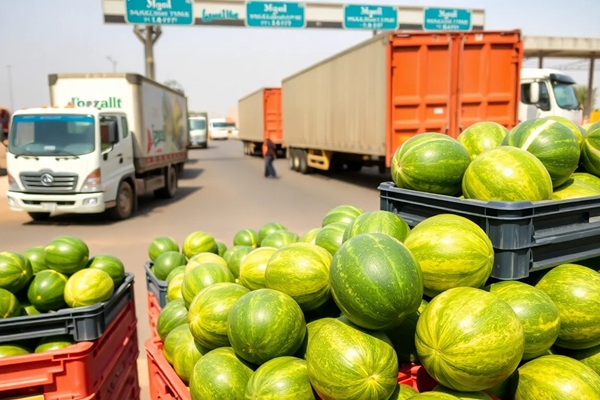
Mauritanian watermelon exporters are reporting mounting pressure on shipments routed through Morocco, citing high entry costs of up to MAD 90,000 (US$9,000) per 24-ton consignment.
While Moroccan industry sources confirm that tariff structures have not changed compared to previous years, exporters argue that the combined burden of customs duties and associated fees is weighing on margins during a sensitive seasonal window.
The issue comes as Mauritania’s production expands rapidly and regional demand fluctuates around Ramadan.
💰 Cost Breakdown per 24-Ton Shipment
| Cost Component | Approximate Value |
| Total entry costs | MAD 90,000 (US$9,000) |
| Customs duties portion | MAD 50,000 (US$5,000) |
| Other associated fees | ~MAD 40,000 (US$4,000) |
Moroccan sources emphasize that the US$9,000 figure reflects total export-related costs, not solely customs duties.
Officials also note that tariff rates remain unchanged from previous years.
📉 Seasonal Timing and Market Impact
Ramadan fell at the end of February, ahead of Mauritania’s production peak.
According to Mauritanian stakeholders:
- Early-season supply shortages pushed prices up to MAD 10 per kilogram domestically.
- Limited volumes entering Morocco are mainly sold through large retail chains.
- Retail prices in Morocco can reach MAD 15 per kilogram.
Most Mauritanian watermelon volumes are traditionally exported to Europe, with Morocco functioning primarily as a transit route rather than a core consumption market.
🌱 Rapid Expansion of Mauritanian Production
Over the past five years:
- Cultivated area increased from 200 hectares to 3,000 hectares.
The Mauritanian domestic market remains small relative to total output, increasing reliance on export channels.
Export dynamics typically follow a two-phase pattern:
- First harvest → export markets (Europe and regional).
- Second harvest → domestic market at lower price levels.
🚛 Logistics and Market Diversion
Due to:
- High European export logistics costs
- Administrative complexity
- Increased production volumes
A portion of Mauritanian watermelon output is diverted to Morocco, the geographically closest outlet.
However, current entry costs are narrowing profitability for exporters.
🧭 Industry Perspective
Moroccan investors active in Mauritania’s watermelon sector acknowledge that:
- Entry cost reductions cannot be introduced mid-season.
- Adjustments would require pre-season bilateral arrangements.
Lower access costs, they argue, could:
- Reduce Moroccan consumer prices.
- Improve exporter margins.
- Strengthen cross-border agricultural integration.
📊 CMB Market Interpretation
The situation reflects structural rather than temporary friction.
Key dynamics:
- Tariff structure unchanged, but production expansion amplifies cost sensitivity.
- Morocco acts more as a transit corridor than a primary destination.
- Ramadan timing temporarily tightened supply.
- Scale expansion in Mauritania increases dependence on efficient trade corridors.
Short-Term Risk:
Margin compression for exporters.
Medium-Term Risk:
Potential overreliance on Morocco as overflow market.
Structural Outlook:
Production growth outpacing logistical optimization.
📌 Strategic Considerations
For Mauritanian exporters:
- Diversify European logistics channels.
- Explore cost-sharing mechanisms with investors.
- Advocate for pre-season bilateral tariff discussions.
For Moroccan authorities:
- Evaluate regional integration benefits.
- Assess consumer price impact versus revenue from duties.
🏁 Conclusion
Mauritania’s rapidly expanding watermelon sector is encountering cost friction at the Moroccan entry point, with total shipment-related fees reaching approximately US$9,000 per 24-ton load.
Although tariff rates have not changed, growing production volumes and seasonal timing are intensifying sensitivity to trade costs.
Future competitiveness will depend on logistical optimization and potential pre-season policy coordination between the two markets.