
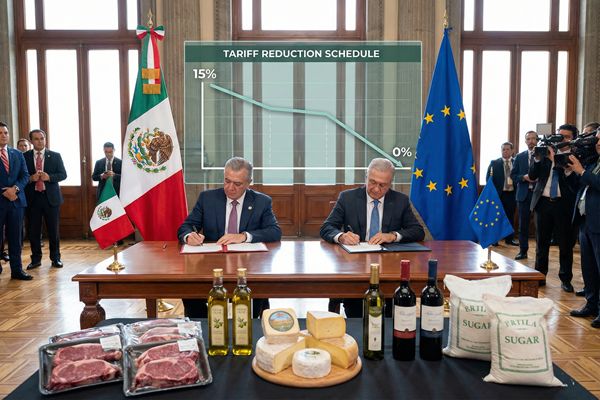
Mexico and EU Prepare to Sign Expanded Trade Pact in 2026
Mexico and the European Union are expected to sign their long-awaited Modernized Global Agreement (MGA) in 2026, significantly expanding agricultural market access and updating trade rules between the two partners
The agreement builds on the 2000 Economic Partnership framework and introduces broader tariff elimination, improved customs procedures, and new rules governing geographical indications (GIs).
Although negotiations concluded in January 2025, final ratification is still pending in both Mexico and the EU.
📊 Current Agricultural Trade Snapshot
The EU is Mexico’s second-largest trading partner and investor.
In 2024:
-
EU agricultural exports to Mexico: USD 4.8 billion
-
Mexico agricultural exports to the EU: USD 1.4 billion
EU’s Top Agricultural Exports to Mexico (2024)
-
Mixtures of odoriferous substances for food/drink industries: USD 1.86 billion
-
Vegetable seeds for sowing: USD 230 million
-
Food preparations: USD 176 million
-
Extra virgin olive oil: USD 164 million
-
Wine: USD 149 million
-
Dairy products: USD 132 million
Mexico’s Top Agricultural Exports to the EU (2024)
-
Spirituous beverages: USD 185 million
-
Beer made from malt: USD 129 million
-
Coffee (not roasted): USD 106 million
-
Frozen orange juice: USD 90 million
-
Cocoa butter/fat/oil: USD 81 million
The new agreement is expected to expand this trade relationship further.
Immediate Tariff Eliminations
The MGA removes tariffs on a wide range of agricultural goods.
Mexican Products Entering the EU with Immediate Tariff Removal
-
Dairy products (milk, cream, yogurt, whey, butter, cheese)
-
Fresh and frozen vegetables
-
Citrus fruits and table grapes
-
Wheat, maize, rice for sowing
-
Olive oil
-
Processed foods, chocolate, pasta
-
Fruit and vegetable juices
-
Wine and vinegar
EU Products Entering Mexico with Immediate Tariff Removal
-
Bovine and poultry offal
-
Duck and goose meat
-
Certain cereals and flours
-
Cocoa products
-
Pasta and prepared foods
-
Milk protein preparations
This broad elimination significantly reduces bilateral agricultural trade barriers.
Tariff Rate Quotas (TRQs): Sensitive Products
For sensitive items, both parties agreed to tariff-rate quotas (TRQs).
EU Products to Mexico
| Product | 0% Tariff Quota | Years to Full Duty-Free |
|---|---|---|
| Beef | 30,000 MT | 7 |
| Swine loins | 10,000 MT | 1 |
| Chicken legs/thighs | 20,000 MT | 5 |
| Milk powder | 50,000 MT | 5 |
| Other cheese | 20,000 MT | 5 |
| Fresh peaches | 2,500 MT | 10 |
Mexican Products to EU
| Product | 0% Tariff Quota | Years to Full Duty-Free |
|---|---|---|
| Pork hams | 10,000 MT | 1 |
| Poultry | 6,667 MT | 3 |
| Honey | 35,000 MT | 1 |
| Tuna preparations | 16,500 MT | 1 |
| Sugar for refining | 30,000 MT | 1 |
| Ethanol | 12,500 MT | 5 |
Some Mexican beef and bovine offal exports will receive a 7.5% tariff-rate quota before eventual liberalization.
These quotas aim to balance liberalization with domestic producer sensitivities.
Customs and Trade Facilitation Improvements
The agreement introduces modern trade facilitation measures, including:
-
Advance rulings on tariff classification and origin
-
Pre-arrival processing
-
Risk-based inspections
-
Single-window electronic systems
-
Expedited clearance for perishable goods
For agricultural exporters, particularly fresh produce, dairy, and meat, these measures could reduce spoilage risks and logistics costs.
Geographical Indications (GI) Protections
One of the most significant structural changes involves intellectual property protection.
-
Mexico will protect 336 EU geographical indications, including wines, spirits, cheeses, and cured meats.
-
The EU will recognize 26 Mexican GIs, including 20 agricultural products and 6 spirits.
The agreement prohibits the use of qualifiers like “style,” “type,” or “imitation” alongside protected GI names.
However, some transitional exceptions apply. For example:
-
Mexican producers may continue using “Mexican Manchego” for domestic cheese, provided origin is clearly stated.
-
Certain prior users may phase out names over defined transition periods (e.g., “feta” allowed for up to eight years with origin labeling).
Strategic Implications
The agreement strengthens:
-
EU dairy and meat access to Mexico
-
Mexican pork, tuna, honey, sugar, and ethanol access to the EU
-
Trade facilitation systems for perishable agricultural goods
-
Intellectual property protections aligned with EU standards
It also deepens integration in digital trade, investment, and strategic raw materials cooperation.
🔎 CMB Outlook
The Mexico–EU Modernized Global Agreement represents one of the most significant bilateral agricultural trade updates in Latin America in recent years.
For the EU, expanded dairy, beef, and processed food access enhances competitiveness in Mexico’s growing consumer market.
For Mexico, improved access for pork, honey, sugar, and ethanol strengthens diversification beyond North American markets.
However, the agreement also intensifies competition for domestic producers on both sides.
Once ratified and fully implemented, agricultural trade volumes between Mexico and the EU are expected to increase meaningfully over the next five years.
Continued monitoring of Senate ratification timelines and EU member-state approvals will determine the precise entry-into-force schedule.