
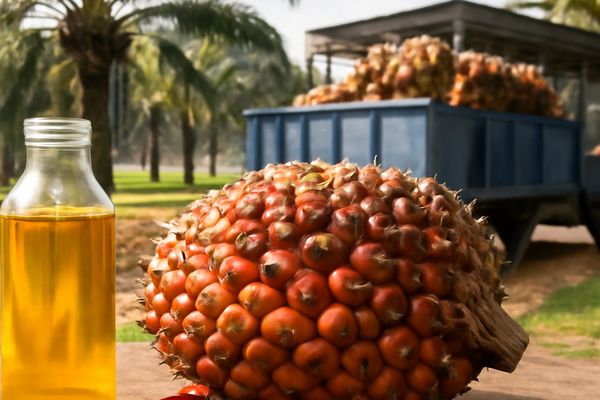
Over the past decade, palm oil has transformed from a niche diversification option into a strategic crop for both producers and policymakers, and nowhere is this more visible than in India’s Telangana state. Local prices have surged by roughly 80% in ten years – from about ₹12,000 per tonne to ₹21,546 per tonne – as the state government actively nudges farmers away from water‑guzzling paddy and towards oil palm plantations. This policy shift is backed not just by price incentives but also by heavy investment in processing: a new ₹300‑crore oil palm mill at Narmetta in Siddipet, with an expandable capacity from 30 tonnes per hour to 120 TPH, and plans for a ₹40‑crore refinery and value‑addition under the Vijaya Hyderabad Edible Oils brand. At the same time, Telangana is aiming for a ten‑fold expansion of oil palm area from 0.1 million to 1 million hectares, signalling a structural re‑orientation of regional agriculture towards the edible oil complex.
These regional developments dovetail with a global palm oil market that remains volatile but fundamentally tight. Malaysian Derivatives Exchange (MDEX) futures around mid‑March 2026 show front‑month contracts in the MYR 4,500/t region, with the forward curve only gradually easing towards MYR 4,250/t by late 2027, indicating that the market still prices in a premium for nearby supply and ongoing weather and policy risks. In Southeast Asia, heavy monsoon rains and recent flooding in parts of Malaysia have disrupted output even as USDA and industry data point to modest production growth in 2024/25 and 2025/26. Indonesia and Malaysia continue to dominate world supply, while India, China and the EU anchor import demand. Against this backdrop, Telangana’s domestic price strength and ambitious acreage plans reflect a broader narrative: structural efforts by import‑dependent countries to localise part of their edible oil supply, even as they remain price‑takers on a globally traded commodity. The following report situates Telangana’s palm oil dynamics within global price trends, supply–demand fundamentals, weather risks and a short‑term trading and price outlook.
📈 Prices & Market Sentiment
1. Telangana price dynamics and policy signal
- Decade‑long price rally: In Telangana, palm oil prices increased by about 80% over the last ten years, from roughly ₹12,000/t to ₹21,546/t, with the state now even lobbying for an official support level of ₹25,000/t to further incentivise farmers to switch from paddy. This embeds a clear policy‑driven floor under local farmgate prices.
- Structural shift from paddy: Government concerns about paddy procurement challenges and vulnerability to pests, wild animal damage and disease are motivating a move into oil palm as a more stable cash crop. The price push to ₹25,000/t is framed explicitly as a tool to accelerate this shift.
2. MDEX futures structure (converted to EUR)
The latest MDEX crude palm oil (CPO) futures strip (13 March 2026) shows a relatively firm but gently backwardated curve. Using an approximate FX rate of 5.0 MYR/EUR for illustration, MYR prices are converted to EUR as follows:
| Contract (MDEX) | Close (MYR/t) | Close (EUR/t, approx.) | Daily Change (%) | Market Sentiment |
|---|---|---|---|---|
| Apr 2026 | 4,539 | ≈ 908 EUR/t | +0.62% | Firm/Bullish |
| May 2026 | 4,572 | ≈ 914 EUR/t | +0.68% | Firm |
| Jun 2026 | 4,572 | ≈ 914 EUR/t | +0.79% | Firm |
| Jul 2026 | 4,554 | ≈ 911 EUR/t | +0.88% | Firm |
| Aug 2026 | 4,523 | ≈ 905 EUR/t | +0.95% | Supported |
| Sep 2026 | 4,480 | ≈ 896 EUR/t | +0.65% | Supported |
| Nov 2026 | 4,440 | ≈ 888 EUR/t | +0.95% | Neutral/Firm |
| Mar 2027 | 4,380 | ≈ 876 EUR/t | +1.00% | Neutral |
| Jul 2027 | 4,327 | ≈ 865 EUR/t | +0.97% | Slightly Softer |
| Nov 2027 | 4,292 | ≈ 858 EUR/t | +0.98% | Slightly Softer |
| Jan 2028+ | 4,250 | ≈ 850 EUR/t | 0.00% | Flat/Illiquid |
- The curve shows a moderate backwardation from roughly 910–915 EUR/t in Q2 2026 towards 850 EUR/t for very long‑dated contracts, reflecting expectations of gradual supply improvement but no return to the much lower price regime of early 2020s.
- Daily gains of 0.6%–1% across much of the strip indicate a short‑term bullish impulse, consistent with recent reports of Malaysian production disruptions due to flooding.
🌍 Supply & Demand
1. Telangana’s expansion and India’s structural demand
- Area growth: Telangana currently cultivates about 100,000 hectares of oil palm and targets a ten‑fold increase to 1 million hectares over the coming years. This would make it one of India’s leading oil palm states, materially lifting domestic FFB and oil output in the medium to long term.
- Processing capacity build‑out: The new Narmetta plant starts at 30 TPH but is designed to scale up to 120 TPH, tied to the Vijaya Hyderabad Edible Oils brand. Co‑investment in a ₹40‑crore refinery is meant to lock in local value‑addition rather than shipping crude oil out of state.
- Domestic import substitution goal: India remains the world’s largest palm oil importer, taking more than 8–9 million tonnes annually. USDA data shows Indian palm oil imports in the 9–10 Mt range in recent years, accounting for over 25% of global trade. Telangana’s expansion is therefore best read as a partial import‑substitution strategy in one of India’s more water‑stressed regions.
2. Global production and trade balance
| Country / Region | 2024/25 Production (Mt) | Share of World Production (%) | Notes |
|---|---|---|---|
| Indonesia | ≈ 46.0 | ≈ 58% | Largest producer; modest 3–4% y/y growth expected into 2026. |
| Malaysia | ≈ 19.4–19.7 | ≈ 24–25% | Rebounding from earlier labour/weather constraints; area around 5.6–6.0 Mha. |
| Thailand | ≈ 3.3 | ≈ 4% | Steady growth from smallholder sector. |
| Colombia | ≈ 1.9 | ≈ 2% | Leading Latin American exporter. |
| Others | ≈ 6.7 | ≈ 9% | Including Nigeria, PNG, Central Africa etc. |
World palm oil production in 2024/25 is estimated near 79–80 Mt, up roughly 4% year‑on‑year, but consumption in food and biofuel is rising in parallel, keeping global stocks relatively tight by historical standards.
3. Import demand hotspots
- India: Expected to import around 9.0–9.9 Mt of palm oil in 2024/25, driven by population growth, urbanisation and cost‑competitiveness versus soft oils.
- China: Roughly 5.9 Mt of palm oil imports, focused on food and industrial uses, with some sensitivity to domestic crush margins for soybean oil.
- EU: Palm oil imports (~3.8–4.0 Mt) have declined over time due to sustainability and biofuel policy constraints, but remain important for food and oleochemical sectors.
📊 Fundamentals & Key Market Drivers
1. Policy and domestic support in Telangana
- Direct price support: The Telangana Agriculture Minister has publicly urged the Union government to lift oil palm prices to ₹25,000/t. This proposed policy would substantially enhance farm economics and could accelerate the planned expansion from 0.1 to 1 million hectares.
- Value‑chain integration: The co‑location of a large mill, a coming refinery and branding under an established edible oil label (Vijaya Hyderabad) reduces marketing risk for farmers by ensuring a stable offtake channel.
- Risk profile versus paddy: Compared with paddy, oil palm is seen as less exposed to procurement bottlenecks, pest and disease incidence and wild animal damage, addressing major farmer complaints while better aligning with groundwater constraints.
2. Global stocks and inventory trends
- Malaysia: MPOB data and recent analysis suggest Malaysian palm oil stocks around or slightly above 2.0 Mt at mid‑2025, the highest in roughly 18 months, before floods hit Sabah and caused a steep monthly output drop in early 2026.
- Indonesia: Production growth of 3–4% y/y in 2026 is anticipated, sustaining export capacity even as domestic biodiesel mandates absorb a rising share of supply.
- Global balance: USDA/Oil World projections show global production rising only modestly (~0.5%–4% depending on year) against firm demand, implying that stocks‑to‑use ratios remain historically moderate and leave limited buffer for weather shocks.
3. Biodiesel & energy linkages
- Indonesia biodiesel trajectory: Implementation of higher biodiesel blending (towards B45–B50) has been gradual, with potential delays beyond 2026. Even as full B50 is pushed out, current blends already anchor a structurally larger domestic demand base for CPO.
- Crude oil price shock: Early March 2026 saw one of the strongest weekly rallies in crude oil in decades, with Brent reportedly spiking above US$100/bbl amid conflict‑driven disruptions around the Strait of Hormuz. Elevated energy prices support palm‑based biodiesel economics and, by extension, palm oil prices.
4. Competing vegetable oils
- Soft oil competition: Soyoil and sunflower oil remain key competitors; strong US biodiesel demand is set to consume more than half of US soyoil output by 2026, constraining global export availability and indirectly supporting palm oil.
- Price spreads: Palm oil maintains a meaningful discount to most soft oils on a landed‑EU or landed‑India basis, preserving its role as a baseline ingredient in blends and refining margins.
🌦️ Weather Outlook & Yield Risks
1. Southeast Asia: heavy rains, floods and heat
- Malaysia: The northeast monsoon is projected to continue into March 2026, with the meteorological service warning of flood risks near rivers and low‑lying areas. Reports from early March indicate severe flooding in Sabah leading to the steepest monthly decline in Malaysian palm oil output in over a year. Short‑term, this is supportive for prices as fresh fruit bunch deliveries are disrupted.
- Indonesia: Jakarta and much of Indonesia are experiencing above‑normal rainfall, with March averages around 245 mm and expectations for an earlier, harsher dry season later in 2026. This pattern—wet now, potentially drier later—creates a two‑stage risk: logistics disruptions in the near term and possible yield stress if drought materialises in H2 2026.
- Heat stress: Anecdotal and model‑based evidence points to an unusually hot early 2026 across Malaysia and parts of Southeast Asia, raising evapotranspiration and potential pollination stress where soil moisture is inadequate.
2. Implications for Telangana & India
- Water balance: Oil palm is a high‑water‑use perennial; Telangana’s shift away from paddy is motivated by groundwater concerns, but sustainable palm expansion will still require careful irrigation planning. Higher local processed capacity (Narmetta plant) reduces the need to truck FFB long distances, limiting post‑harvest losses even under heat stress.
- Yield lag in new plantings: With area targeted to rise from 0.1 to 1.0 million hectares, a large share of Telangana’s plantations will be immature for several years. The significant price gains of the last decade and policy push to ₹25,000/t therefore reflect expectations of future, not yet realised, supply growth—keeping India reliant on imports in the interim.
📌 Global Production & Stocks Comparison
| Marketing Year 2024/25 | Production (Mt) | Ending Stocks (Mt) | Stocks/Use (%) | Comment |
|---|---|---|---|---|
| World | ≈ 79.8–80.4 | ≈ 17–18 | Low‑mid teens | Structurally tighter than pre‑COVID average. |
| Indonesia | ≈ 46.0 | ≈ 4–5 | Moderate | Significant biodiesel absorption limits exportable surplus growth. |
| Malaysia | ≈ 19.4 | ≈ 2.0 | ≳ 10% | Stocks recently at 18‑month highs but vulnerable to flood‑driven dips. |
| India (balance, not production) | n/a | <2 | Short pipeline | Heavily import‑dependent; domestic schemes like Telangana’s aim to change this over a decade. |
💹 Trading Outlook & Recommendations
1. Strategic view (6–12 months)
- Bias: Mildly bullish / high floor. With MDEX front months near 900–915 EUR/t and global stocks only moderately comfortable, downside appears limited unless there is a major demand shock or exceptional production surge.
- Risks skewed to upside: Flood‑related production losses in Malaysia, possible drought in Indonesia later in 2026, and sustained high crude oil prices (via biodiesel) all point to supportive fundamentals.
- Countervailing forces: Rising Malaysian stocks once floods recede, any delay or scaling‑down of Indonesian biodiesel targets, and macro‑driven demand softness (e.g., weaker China, currency‑hit importers).
2. Tactical guidance by participant
- Producers (Malaysia, Indonesia, Telangana processors):
- Use current price strength to layer forward sales in Q2–Q3 2026 around 895–920 EUR/t equivalent, focusing on near‑to‑mid curve (Apr–Sep 2026).
- Maintain some unhedged volume to capture upside from possible further supply disruptions or energy price spikes.
- Indian refiners & importers:
- Stagger purchases rather than front‑loading, given backwardation and some probability of stock rebuilding once Malaysian floods ease.
- Secure coverage for key festival and high‑consumption periods, but retain flexibility to switch ratios between palm and soft oils depending on spreads.
- Telangana farmers:
- For existing plantations, current local price levels (≈₹21,546/t with potential policy lift towards ₹25,000/t) are attractive; consider locking into long‑term supply contracts with the new Narmetta plant/refinery where viable.
- New entrants should carefully assess water availability and financing, but the combination of government backing, processing capacity and robust global price levels supports oil palm as a viable long‑term crop.
- Speculative traders:
- Momentum currently favours moderate length; pullbacks towards ~870–880 EUR/t on front months could offer buying opportunities, with stops below ~840 EUR/t.
- Watch crude oil and Indonesian biodiesel policy headlines as key catalysts for sharp price moves.
📆 3‑Day Regional Price Forecast (EUR/t, Approx.)
Assuming stable FX (~5.0 MYR/EUR) and no major policy shocks over the next three trading days (from 16 March 2026):
| Market / Contract | Current Level (EUR/t) | Day 1 | Day 2 | Day 3 | Short‑Term Trend |
|---|---|---|---|---|---|
| MDEX CPO Front Month | ≈ 910 | 905–920 | 900–920 | 895–920 | Sideways to slightly firm; flood risk priced in but not fully. |
| MDEX 3‑Month Forward | ≈ 905 | 900–910 | 895–910 | 890–910 | Mild backwardation persists; range‑bound. |
| Indicative CIF India (telescoped from MDEX) | ≈ 950 | 945–960 | 940–960 | 935–960 | Firm landed prices; freight and risk premiums elevated. |
- Upside triggers: Further reports of flood damage in Malaysia, stronger crude oil rally, or export restrictions from key suppliers.
- Downside triggers: Rapid normalisation of Malaysian output post‑floods, evidence of weaker import demand from India/China, or a sharp correction in energy and broader commodities.
Overall, the palm oil market enters late Q1 2026 with a supportive price structure, weather‑related supply risks and strong policy backing in new growth regions such as Telangana. While short‑term volatility is high, the broader balance of risks argues for a relatively elevated price floor, underpinned by tight global fundamentals and expanding downstream demand in food and biofuels.