
Qatar LNG Production Halt Sends European Gas Prices Soaring
CMB News | Energy Markets | March 2026
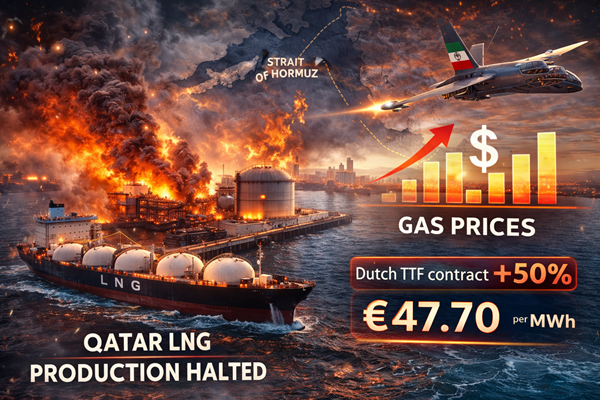
Global gas markets were thrown into turmoil after Iranian drone attacks targeted two major liquefied natural gas (LNG) facilities in Qatar, forcing a temporary halt in production and triggering a sharp spike in European gas prices.
Qatar, one of the world’s largest LNG exporters, confirmed that operations at the Ras Laffan industrial complex — the largest LNG export facility globally — have been suspended. Production has also reportedly stopped at the Mesaieed facility south of Doha.
According to Qatar’s Ministry of Defense, both sites were targeted by Iranian drones. In one incident, a water tank was reportedly hit. No casualties were reported.
European Gas Prices Jump Over 50%
The immediate market reaction was dramatic.
The Dutch TTF gas contract, Europe’s benchmark, surged more than 50% intraday, briefly reaching an annual high of €47.70 per megawatt hour.
QatarEnergy is responsible for roughly 20% of global LNG supply, making any disruption highly significant for international markets.
A Citi analyst estimated that a prolonged shutdown of Qatari LNG production could push European gas prices toward €100 per megawatt hour. Conversely, a credible and rapid de-escalation could see prices fall back toward pre-conflict levels just as quickly.
Why Europe Is Affected — Even Without Direct Qatari Supply
Qatar primarily supplies LNG to Asian markets. Germany, for example, does not import LNG directly from Qatar.
However, global LNG operates as a competitive, interconnected market. Any supply interruption increases competition for alternative cargoes — particularly from the United States and other exporters — driving up prices worldwide.
The situation echoes dynamics seen in 2022 following Russia’s invasion of Ukraine, when global bidding competition sharply lifted European gas prices.
Strait of Hormuz: The Strategic Risk
Beyond the direct attacks on LNG facilities, markets remain focused on the Strait of Hormuz.
The narrow waterway, controlled in part by Iran, connects the Persian Gulf to global shipping lanes and accounts for roughly 20% of daily global oil and LNG flows.
Even without a formal closure, any operational disruption to shipping routes significantly increases perceived supply risk — and markets price that risk immediately.
Germany: Supply Secure, Prices Under Pressure
The German government emphasized that physical supply remains secure.
“Delivery sources are diversified. There is no reason for concern,” government spokesperson Stefan Kornelius said.
Germany sources approximately:
-
44% of its natural gas via pipeline from Norway
-
Additional LNG imports through terminals in Germany, the Netherlands and Belgium — primarily from the United States
Nevertheless, officials acknowledged that a de facto restriction of shipping through Hormuz has major price implications.
U.S. gas prices also reacted, rising by more than 7%.
Economic Implications
German Economy Minister Katherina Reiche confirmed that crisis response mechanisms have been reactivated. Rising energy costs could place additional strain on the economy, though no immediate market intervention is planned.
“We intervene only when absolutely unavoidable,” she said.
Market Outlook: Volatility Ahead
The next decisive factor will be the duration of the production halt and the broader trajectory of the regional conflict.
If Qatari LNG output resumes quickly and shipping lanes stabilize, the current risk premium could unwind rapidly.
If disruptions persist, however, energy markets may face renewed structural tightness — with significant inflationary implications for Europe and beyond.
For now, gas markets are trading geopolitical risk rather than confirmed physical shortages.
And that risk has returned to center stage.
Source: ntv.de