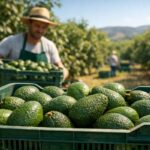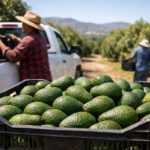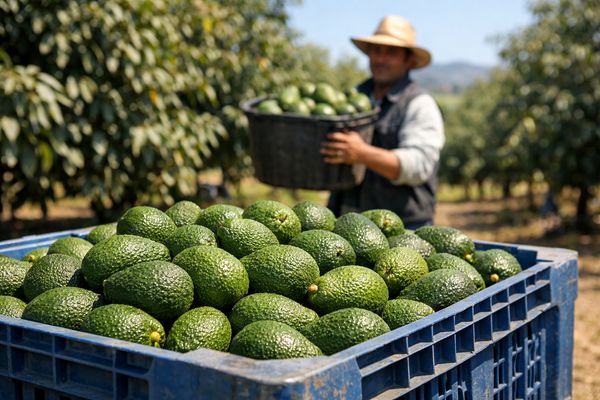
Record-high Mexican avocado exports in 2026 are driving volumes to unprecedented levels and pushing prices down across key markets, even as US demand remains robust. A partial price recovery is expected later in the season, but much depends on supply discipline and the success of Mexico’s diversification into Europe, Asia and Brazil.
Mexican growers and packers are navigating a classic high-volume, low-price cycle. Weekly shipments to the United States now routinely match what used to be peak-season highs, squeezing grower margins despite healthy offtake. At the same time, tight logistical focus on the US is limiting Mexico’s ability to cushion price pressure via alternative outlets, though structural advantages in year-round production and strong brand recognition continue to underpin demand.
📈 Prices & Current Market Situation
Mexican avocado shipments to the US reached 127,000 tonnes during the Super Bowl week, an all-time record for a single week, and weekly volumes in early May are still running at around 105,000–110,000 tonnes. This surge in supply has depressed market prices, with industry representatives openly characterising 2026 as a commercially difficult year for growers and exporters, even if exact average price levels were not disclosed. Fresh industry commentary confirms that more volume and lower prices are the defining features of the current season, as export records are broken while returns per unit fall.
In Europe, wholesale avocado prices have trended lower from late 2025 peaks and moved into a more competitive range during Q1–Q2 2026, helped by abundant availability from Mexico and other origins. Benchmarks for European wholesale markets currently cluster in the equivalent of roughly EUR 2.30–3.20 per kg, down from last year’s seasonal highs, though local variances remain significant by market and size category.
🌍 Supply & Demand Dynamics
Mexico is the world’s dominant avocado exporter and the backbone of US supply, delivering fruit year-round from four main commercial varieties. Its expanding production base has allowed export volumes to grow steadily, and for the current crop cycle exports to the US alone are on course to reach or exceed 1.2 million tonnes. This reflects not only rising production but also sustained demand growth, as avocados have shifted from an occasional guacamole ingredient to a staple across breakfast, lunch and dinner in the US diet.
On the demand side, weekly US imports in the 105,000–110,000 tonne range during an ordinary spring week — without the boost of major sporting events — highlight strong underlying consumption. However, demand growth has not kept pace with the latest supply surge, creating an imbalance that pushes average returns down. Other origins such as Peru and Colombia remain largely complementary, filling seasonal windows rather than displacing Mexican product, which reinforces Mexico’s central role but also concentrates market risk when its own volumes overshoot demand.
📊 Fundamentals, Trade Flows & Weather
The United States remains by far the main outlet for Mexican avocados, and price signals from this market set benchmarks globally. APEAM has identified Europe, Asia and Brazil as priority diversification targets to reduce dependence on a single destination, but shipments to these regions still account for a small share of total exports. As a result, when US prices weaken, the impact is quickly transmitted into European import costs and, ultimately, retail prices, particularly via Dutch redistribution hubs serving the wider EU market.
Recent weeks have also been marked by intense heat across large parts of Mexico, including Michoacán, where temperatures have reached 40–45°C during the early May heatwave. While mature avocado orchards are relatively resilient in the short term, sustained high temperatures can stress trees, increase irrigation needs and affect fruit sizing and quality later in the season. For now, the dominant fundamental driver remains surplus volume rather than weather-related shortages, but persistent heat will be closely watched for any signal of yield impact that could tighten supply towards the end of the crop cycle.
📆 Outlook & Price Implications
In the near term (next 30–90 days), Mexican export volumes are likely to remain elevated as the current crop cycle continues, keeping downward pressure on prices despite some expected seasonal demand support from events such as Cinco de Mayo and the US summer grilling season. APEAM anticipates some reduction in supply later in the season, which should help trigger a partial price recovery, but the timing and magnitude of this adjustment remain uncertain and will depend on growers’ willingness to slow harvests and on any weather-related production effects.
Over the medium term (6–12 months), the key variable will be how quickly Mexico can diversify exports beyond the United States. If meaningful volumes are redirected toward Europe, Asia and Brazil, US price pressure could ease somewhat, but such diversification typically requires several seasons of commercial investment, marketing and regulatory alignment. Meanwhile, competing origins like Peru and Colombia will face a challenging environment: if Mexican prices stay low, their room to secure premium slots in the US market could narrow, pushing them to rely more heavily on Europe and emerging markets, where they will still need to compete against Mexican fruit entering via alternative trade routes.
💼 Trading & Procurement Recommendations
- US buyers: Use the current high-volume, low-price window to secure forward cover at competitive EUR-equivalent levels, but maintain flexibility in contracts to benefit if prices soften further before the expected seasonal tightening.
- European importers: Monitor Mexican price signals closely and lock in volumes opportunistically; weak US prices are likely to feed into European offers, especially ex-Dutch hubs, but basis and logistics costs may move quickly once any supply tightening emerges.
- Growers in competing origins: Stress-test margins against a scenario of sustained low Mexican prices and consider shifting marketing focus toward differentiated niches (organic, ripeness programs, origin branding) rather than competing head-on on price in the US.
- Retailers: Consider promotional activity during the current low-price phase to stimulate additional consumer demand and build loyalty, while being prepared to taper deep discounts if and when late-season price recovery starts to materialise.
📍 3-Day Directional Price Indication (EUR)
| Market | Product | Today–3 Day View (Direction) | Indicative Wholesale Range (EUR/kg) |
|---|---|---|---|
| US import (CIF, Mexico origin) | Hass, 4kg carton (EUR-converted) | Sideways to slightly lower on heavy arrivals | ~2.20–2.80 |
| Northwest Europe (ex-warehouse) | Hass, mixed origin | Mostly sideways, soft undertone | ~2.30–3.10 |
| Southern Europe (import hubs) | Hass, mixed origin | Stable to marginally softer amid good availability | ~2.40–3.20 |
Price levels are indicative ranges converted into EUR from recent wholesale assessments and should be used as directional guidance rather than firm quotes.