
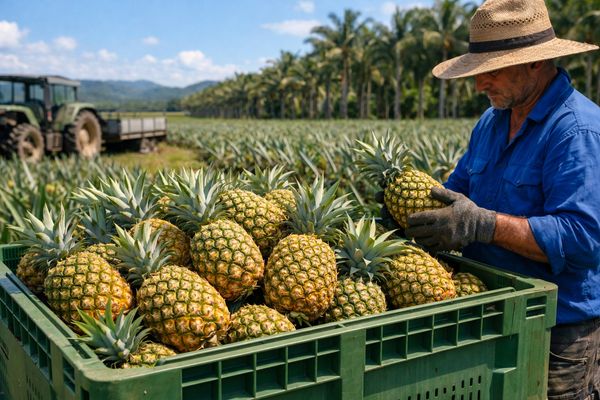
Queensland’s pineapple sector is testing a new nitrogen strategy that halves fertiliser use while maintaining or lifting yields, easing cost pressure just as global urea prices stay historically high. Early adoption of Lono in Wamuran’s sandy soils points to a structural improvement in nitrogen-use efficiency that could stabilise supply and margins for Australian pineapple producers.
Pineapple production in southeast Queensland has long been exposed to volatile nitrogen costs, leaching-prone sandy soils and tightening expectations on water quality in reef catchments. The recent on-farm trials with Lono show that growers can reduce pre-plant nitrogen from around 200 kg to the equivalent of just 1.5 kg of nitrogen via amine-based formulations, with heavier plants, stronger roots and improved packout performance. This shift comes at a time when global nitrogen markets remain elevated after a multi-year price shock, making input savings highly market-relevant.
Exclusive Offers on CMBroker

Pineapple dried
FOB 6.75 €/kg
(from VN)

Pineapple dried
normal sugar, 5-7 mm
FCA 4.00 €/kg
(from NL)

Pineapple dried
normal sugar, 8-10 mm
FCA 3.90 €/kg
(from NL)
📈 Prices & Margin Signals
On the product side, dried pineapple offers show a broadly stable picture in early May. Vietnamese dried pineapple (FOB Hanoi) is indicated around EUR 6.75/kg, unchanged over the last three weekly updates. Thai dried pineapple (normal sugar, 5–7 mm and 8–10 mm, FCA Dordrecht) is quoted at roughly EUR 4.00/kg and EUR 3.90/kg respectively, also flat since mid-April. This suggests no immediate upstream price squeeze from raw fruit costs in export-oriented dried segments.
By contrast, nitrogen fertiliser markets remain elevated, even if some benchmarks have softened from recent peaks. A combination of war-related trade disruptions and high global energy prices has pushed international urea indicators to levels not seen since the 2022 energy crisis, with global indices up by around 12% in Q1 2026. Recent spot data show urea values oscillating in the USD 640–870/ton range across key hubs after a sharp spike in April, translating into persistently high nitrogen costs for Queensland growers despite short-term pullbacks.
🌍 Supply, Demand & Production Dynamics
Queensland pineapple production is concentrated on sandy coastal soils around Wamuran and similar districts north of Brisbane. These soils are highly vulnerable to nutrient leaching, so growers have traditionally relied on relatively heavy nitrogen programs to protect yields, especially in seasons with roughly one metre of in-crop rainfall. Under such conditions, conventional urea and nitrate fertilisers are prone to leach beyond the root zone, raising both cost and environmental risks.
The Lono trials, conducted with Queensland’s Department of Agriculture and Fisheries and industry bodies, deliberately targeted these challenging conditions. With approximately one metre of rainfall during the trial period, the tests replicated a worst-case leaching scenario. Despite this, crops receiving Lono at roughly half the usual nitrogen rate produced heavier plants, stronger root systems and better fruit quality metrics (size, brix and overall packhouse grades) than conventional programs.
This evidence suggests that, at least in Wamuran-type systems, pineapple output can be maintained or improved with substantially lower applied nitrogen. In market terms, that reduces the input-cost sensitivity of Queensland supply to global nitrogen price spikes. If replicated at scale, this could help smooth production volumes over coming seasons, even if fertiliser affordability deteriorates further.
📊 Fertiliser Economics & Environmental Drivers
Lono’s key feature is its delivery of nitrogen in amine (NH2) form, stabilised to resist rapid microbial conversion and leaching. Whereas urea and other conventional sources primarily stimulate vegetative growth, amine nitrogen is positioned to support fruit development directly, improving the share of marketable fruit per hectare. ProdOz reports that 5 litres of Lono contain the nitrogen equivalent of about 1.5 kg of conventional nitrogen, yet growers in the trials replaced around 200 kg of pre-plant nitrogen with this much smaller dose while still achieving superior outcomes.
With global nitrogen benchmarks elevated and volatile across major export hubs, the capacity to cut nitrogen rates by 50% or more without yield loss is economically significant. It provides a buffer against further price spikes or supply dislocations and directly lowers per-hectare cost of production for Queensland pineapple farms. At the same time, lower nitrogen loading into groundwater and runoff addresses regulatory and social pressures linked to Great Barrier Reef and Moreton Bay water quality, potentially reducing future compliance costs for growers.
🔄 Market Reactions & Strategic Positioning
Commercial adoption is already underway among major Queensland producers such as Polsoni Pines, Pace Farming and Sandy Creek Pineapples. Grower motivation remains primarily economic: lower fertiliser bills and more consistent packhouse returns. However, the fact that these gains align with government objectives around reef protection and nutrient management adds institutional support and reduces reputational risk for the industry.
From a downstream market perspective, buyers of fresh and processed pineapple from Queensland gain improved supply reliability. If a critical mass of growers switches to higher-efficiency nitrogen systems, the region becomes less exposed to global fertiliser shocks that could otherwise constrain application rates and yields. This is particularly relevant as global fertiliser indices remain high and policymakers warn of potential food security impacts if farmers are forced to cut usage. Over time, improved nitrogen efficiency could support more stable export programs, especially into European markets for processed pineapple and juice concentrates.
🌦️ Weather & Production Risk Outlook
In the near term, Wamuran and surrounding coastal districts remain exposed to typical subtropical variability: episodic heavy rainfall events interspersed with drier periods. In seasons matching the recent trial’s approximately one metre of rainfall, the advantage of amine-based, leach-resistant fertilisers becomes more pronounced, as conventional nitrogen losses are highest under such wet conditions.
If the coming months bring above-average rainfall, growers reliant on traditional urea programs may face both higher input losses and stricter scrutiny over runoff, whereas early Lono adopters could maintain more stable nitrogen availability in the root zone. Conversely, in slightly drier seasons, the economic case remains supported by reduced fertiliser volumes and the hedge against still-elevated global nitrogen prices, even if leaching risks are somewhat lower.
📆 Market & Trading Outlook
Looking ahead 6–12 months, Lono adoption in Queensland pineapples is likely to expand as commercial results are shared within the grower community and as global fertiliser markets stay tight and expensive relative to pre-2021 norms. Input-cost relief at the farm level should help keep regional supply steady, limiting upward pressure on export prices for both fresh and processed pineapple originating from Queensland.
Over the medium term, further upside depends on ProdOz’s ability to scale Lono production and extend trials into other reef-catchment crops. Demonstrable reductions in nitrogen runoff could encourage regulatory endorsement or preferential treatment for low-leaching fertilisers, accelerating uptake. For international buyers, this would translate into a more resilient and environmentally compliant supply base, a growing consideration in European and premium retail channels.
📌 Trading Recommendations
- Growers in Queensland: Consider staged Lono adoption (e.g., side-by-side blocks) to validate local responses, particularly on sandy or leach-prone soils, while current nitrogen prices remain elevated.
- Buyers of dried and processed pineapple: Use the current stability in EUR-denominated dried pineapple offers as an opportunity to extend coverage modestly, anticipating that lower input-cost sensitivity in Queensland will support consistent volumes.
- Input suppliers and traders: Monitor regulatory discussions on reef-related nutrient management; any move towards incentivising leach-resistant nitrogen products could structurally reduce urea demand in coastal horticulture systems.
📍 3-Day Directional Price Indication (EUR)
| Product | Origin / Location | Current Indication (EUR/kg) | 3-Day View |
|---|---|---|---|
| Dried pineapple (generic) | VN FOB / TH FCA NL | 3.90–6.75 | Stable; no major fresh supply shock expected from Queensland in the very short term |
| Nitrogen fertiliser (urea, reference) | Global benchmarks | ~EUR 0.60–0.80/kg nutrient (implied) | Volatile but sideways bias; recent spike easing slightly but prices remain historically high |
Related posts:
 Dried Pineapple Prices Hold Steady as Thai Heat Meets Vietnam Premium
 Costa Rican Pineapple Oversupply Looms as Costs and Currency Squeeze Margins
 Bangladesh Mango Boom Meets a Freight-Cost Wall
 Dried Pineapple Prices Hold Steady as Thai Heat Meets Viet Supply Resilience
 Logistics Squeeze Keeps Pineapple Prices Firm Despite Moving Volumes