
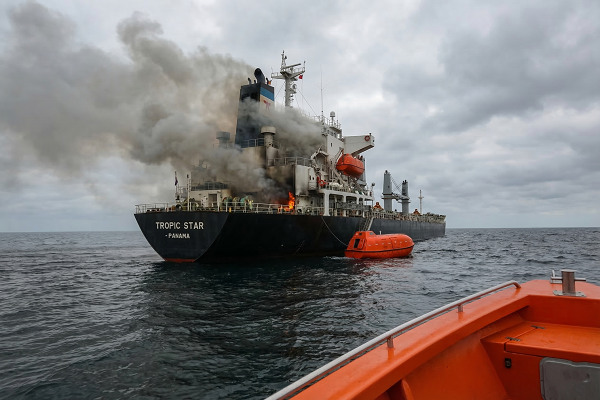
At least six merchant vessels were attacked in the Gulf and the Strait of Hormuz, marking a sharp escalation in maritime risks as the conflict between Iran and U.S.-Israeli forces intensifies. The incidents highlight how commercial shipping has increasingly become a frontline target in the regional conflict, disrupting global energy and trade routes.
According to port officials and maritime security firms, explosive-laden Iranian boats attacked two fuel tankers in Iraqi territorial waters, causing fires on board and killing one crew member.
The vessels involved were the Marshall Islands-flagged tanker Safesea Vishnu and the Malta-flagged tanker Zefyros, both carrying fuel cargo loaded in Iraq.
The attacks took place during ship-to-ship loading operations within Iraqi waters, according to Iraq’s State Organization for Marketing of Oil (SOMO).
Iraqi Oil Ports Halt Operations
Following the attacks, Iraq suspended operations at its oil export terminals, although commercial ports in the country continue to function.
Rescue teams responded quickly after the incident. Officials said 25 crew members were rescued from the burning vessels.
However, one foreign crew member was confirmed dead after being recovered from the water, while search teams continue looking for additional missing sailors.
The fires on both ships were still burning hours after the attacks, according to Iraqi port authorities.
Additional Ships Damaged in Gulf Waters
Several other vessels were also hit by projectiles in nearby waters, highlighting the widening maritime threat.
A Thailand-flagged bulk carrier, Mayuree Naree, was struck by two projectiles while sailing through the Strait of Hormuz, causing a fire in the engine room.
The ship’s operator said three crew members were missing and believed to be trapped in the engine room, while the remaining 20 crew members were safely evacuated to Oman.
Images released by the Royal Thai Navy showed thick black smoke pouring from the vessel.
A Japan-flagged container ship, ONE Majesty, also sustained minor damage after being hit by an unidentified projectile while anchored in the Gulf near the United Arab Emirates.
The vessel’s owner, Mitsui O.S.K. Lines, confirmed that the damage occurred above the waterline and that the ship remains operational with all crew safe.
Another vessel, the Marshall Islands-flagged bulk carrier Star Gwyneth, was also hit by a projectile northwest of Dubai, damaging the hull but causing no injuries.
Later, the United Kingdom Maritime Trade Operations (UKMTO) reported that a separate container ship experienced a small fire after being struck by a projectile north of Jebel Ali port in the UAE.
Iran Warns Ships May Be Targeted
Iran’s Islamic Revolutionary Guard Corps (IRGC) has repeatedly warned that ships transiting the Strait of Hormuz could be targeted if attacks against Iran continue.
The strategic waterway carries about 20% of the world’s oil shipments, making it one of the most important global energy chokepoints.
Since U.S. and Israeli forces began strikes on Iran on February 28, shipping activity in the Gulf has slowed dramatically and insurance costs for vessels operating in the region have surged.
Iranian officials have warned that if the war escalates further, they may block oil exports from the Middle East entirely.
Shipping Industry Faces Growing Risks
The escalating attacks have left the global shipping industry on edge.
Many shipping companies have diverted vessels away from the Strait of Hormuz, while others have suspended routes entirely due to security concerns.
Industry sources say that U.S. naval escorts have not yet been deployed regularly, despite requests from shipping companies, as the risk of attacks remains high.
However, U.S. President Donald Trump has said that the United States is prepared to provide naval protection for commercial vessels if needed.
With at least 16 ships struck in the region since the conflict began, analysts warn that merchant vessels are increasingly caught in the crossfire of geopolitical tensions.
The attacks have intensified fears of major disruptions to global energy and trade flows, particularly as oil prices surge and shipping traffic through the Strait of Hormuz approaches a near standstill.