
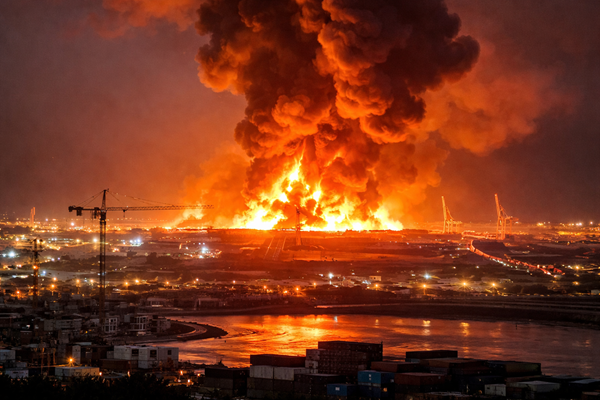
Middle East Escalation Sparks Energy Market Shock
Crude oil prices surged 5–8% over the weekend after large-scale military strikes involving Israel, the United States, and Iran escalated tensions across the Gulf region.
The confrontation triggered temporary disruption concerns in the Strait of Hormuz, a critical maritime chokepoint through which approximately 20% of global crude oil supply flows.
Markets reacted immediately to the risk of supply losses estimated at 8–10 million barrels per day, including roughly 2 million barrels per day of Iranian exports.
Analysts indicate crude oil prices could test the USD 80–90 per barrel range if instability persists.
Strait of Hormuz Closure Announcement Creates Shipping Panic
Iranian naval authorities initially announced the closure of the Strait of Hormuz, halting civilian vessel passage.
Following reported attacks on vessels near the Strait of Oman, nearly 150 ships anchored in the region, awaiting further clarity.
However, Iran’s Foreign Ministry later clarified that the country “did not and does not intend to close the Strait,” signaling potential de-escalation.
Even temporary disruption at Hormuz significantly raises freight costs, particularly for shipments destined for Asia, increasing energy and commodity import costs for major consumers such as China and India.
Immediate Market Reaction: Commodities Rally
Weekend trading in energy and safe-haven assets showed sharp gains:
-
🛢️ Crude oil: +5–8%
-
⛽ Natural gas: Higher
-
🏅 Gold and silver: Strong gains
Equity markets remain closed, but volatility expectations are rising sharply.
Higher oil prices directly impact:
-
Freight and shipping costs
-
Fertilizer production expenses
-
Agricultural input prices
-
Consumer inflation globally
OPEC+ Response: Limited Production Increase
In response to market instability, OPEC+ agreed to increase production by 206,000 barrels per day starting in April.
However, this increase represents less than 0.2% of global demand, offering limited immediate relief to markets.
The scale of supply risk at Hormuz far outweighs the incremental OPEC+ adjustment.
Impact on Russia and Sanctions Enforcement
Rising oil prices could marginally benefit Russian crude revenues. However:
-
Increased monitoring of the so-called “shadow fleet” continues
-
Maritime enforcement actions have intensified in Europe
-
Freight costs are rising, limiting upside gains
Energy geopolitics are now closely linked to sanctions enforcement and shipping insurance costs.
Diplomatic Signals Emerge
Reports indicate Iran has invited negotiations with the United States, raising the possibility of short-term diplomatic engagement.
Market participants are watching closely for:
-
Formal de-escalation statements
-
Naval reopening assurances
-
Coordinated diplomatic intervention
A rapid diplomatic resolution could trigger an equally sharp pullback in oil prices.
Agricultural & Commodity Market Implications
For global agri-markets, the crisis introduces several risks:
1️⃣ Higher fuel and fertilizer costs
2️⃣ Increased shipping premiums for grain exports
3️⃣ Inflationary pressure in import-dependent economies
4️⃣ Currency volatility in emerging markets
Grain exporters in the Black Sea and Gulf regions could face logistical disruptions if instability spreads.
🔎 CMB Outlook
The Strait of Hormuz remains the single most sensitive energy chokepoint globally.
Short-term:
Headline-driven volatility will dominate oil and commodity markets.
Medium-term scenarios:
Scenario A – Rapid De-escalation
Oil retreats below USD 80/barrel. Freight stabilizes. Commodity inflation moderates.
Scenario B – Sustained Maritime Risk
Oil sustains USD 85–90 range. Shipping costs rise structurally. Agricultural input inflation intensifies.
Given the economic stakes for major powers, markets are currently pricing heightened tension but not a prolonged closure.
The next 72 hours will be decisive for energy markets.