
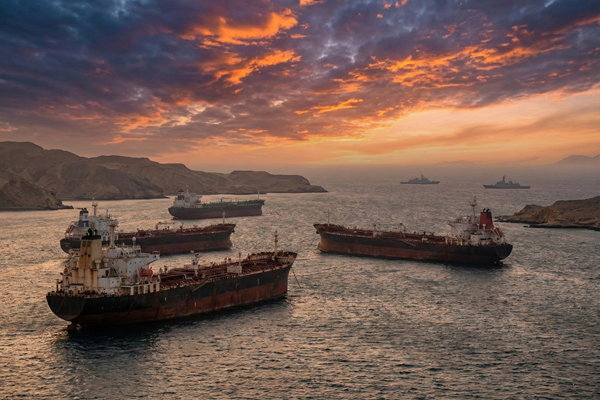
Global oil markets showed signs of stabilization after U.S. President Donald Trump announced plans to insure and escort commercial ships passing through the Strait of Hormuz, easing fears of a prolonged disruption to energy supplies.
The move comes as U.S. and Israeli forces continue coordinated strikes on Iranian targets for the fourth consecutive day, targeting military infrastructure and leadership structures.
Despite earlier threats from Tehran to close the strategic waterway, analysts now believe Iran lacks the military capability to fully block the Strait of Hormuz, although isolated attacks on ships remain possible.
U.S. Offers Insurance and Naval Escort for Tankers
In response to rising maritime risks, President Trump directed the U.S. International Development Finance Corporation (DFC) to provide risk insurance and financial guarantees for all maritime trade transiting the Persian Gulf.
In addition, the U.S. Navy has declared its readiness to escort oil tankers through the Strait of Hormuz, aiming to ensure uninterrupted global energy supplies.
The announcement reassured markets that shipping routes through the strait could remain operational despite ongoing tensions.
Oil Prices Stabilize After Sharp Weekly Rise
Prior to the announcement, oil prices had surged amid fears that the waterway could be blocked.
-
May Brent crude futures rose 4.5% to $81.5 per barrel
-
Weekly gains reached approximately 15%
However, prices eased slightly toward the end of the trading session as markets reacted positively to the U.S. security guarantees.
Traders are increasingly optimistic that traffic through the strait will continue without major disruption.
China Calls for De-escalation
China, one of the largest importers of Middle Eastern energy, has urged all parties to avoid escalating the conflict.
Chinese Foreign Ministry spokesperson Mao Ning called for restraint and protection of maritime trade routes.
“China calls on all parties to immediately cease military operations, avoid escalating tensions, and ensure the safety of shipping in the Strait of Hormuz,” she said.
Iran previously exported around 2 million barrels of oil per day, with China purchasing about 90% of those shipments. Iranian crude accounted for roughly 13% of China’s seaborne oil imports, making stability in the Persian Gulf critical for Beijing.
Qatar Halts LNG Production After Drone Attack
Meanwhile, regional energy markets face additional uncertainty after Qatar suspended liquefied natural gas production and exports following Iranian drone attacks on an energy facility.
Qatar plays a crucial role in global energy markets:
-
Supplies about 20% of the world’s LNG
-
Second-largest LNG exporter after the United States
Asian buyers represent 82% of QatarEnergy’s customer base, meaning disruptions could have significant effects on both Asian and European energy markets.
Attacks on Russian LNG Tanker Add to Market Volatility
Further tensions emerged after unidentified drones struck the Russian LNG tanker Arctic Metagaz off the coast of Libya.
The vessel is reportedly part of Russia’s “shadow fleet” used to transport sanctioned energy supplies.
The attack, combined with earlier strikes near the Russian Black Sea port of Novorossiysk, suggests Moscow may struggle to capitalize on rising global energy prices.
Global Markets React to Energy Uncertainty
Financial markets have responded cautiously to the geopolitical developments.
While oil prices surged, global stock markets declined amid concerns over supply disruptions and reduced trading activity.
Asian markets have been particularly affected due to their heavy dependence on Middle Eastern energy supplies.
Regional market declines include:
-
Asian equity markets down between 2% and 4%
-
South Korea’s stock market falling more than 7%, marking its third-largest drop this century
Analysts expect increased diplomatic pressure on Iran, including from China and other energy-importing countries, to accelerate negotiations and reduce the risk of further disruptions to global energy supplies.