
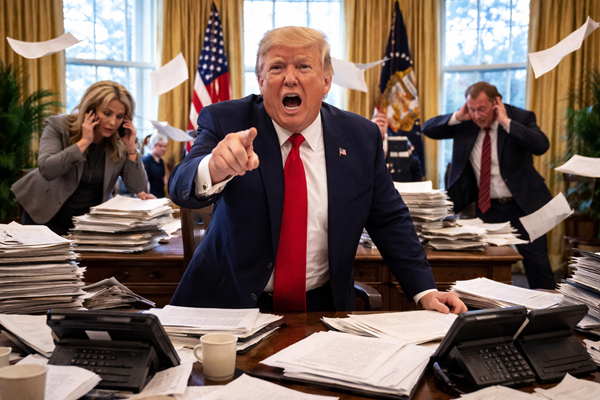
🇺🇸 Trump Threatens “More Powerful and Unpleasant” Tariffs After Court Setback
CMB News | Global Trade & Policy | February 2026
U.S. President Donald Trump has signaled a renewed escalation in trade tensions, stating that a recent Supreme Court ruling against his broad global tariff measures has unintentionally given him “far more power and strength.”
In a post on his platform Truth Social, Trump suggested that alternative trade measures could be deployed “in much more powerful and unpleasant ways.” He also indicated that he could use unspecified “licenses” to impose “absolutely terrible things” on other countries — without clarifying what legal mechanisms he was referring to.
⚖️ Background: Supreme Court Ruling
Last week, the U.S. Supreme Court ruled that the emergency powers law cited by Trump did not authorize the president to impose sweeping global tariffs. The Court determined that tariff authority rests with Congress.
Following the ruling:
-
U.S. Customs temporarily halted collection of the contested tariffs.
-
Trump announced new tariff measures under a different statutory framework.
-
Proposed new rates range between 10% and 15%, potentially layered on top of existing duties.
🌍 Market Implications
Trump’s latest remarks inject further uncertainty into global trade relations, particularly with:
-
The European Union
-
China
-
Major industrial exporters
The possibility of new tariff instruments — potentially outside traditional emergency powers — raises questions about:
-
Legal durability
-
WTO compatibility
-
Retaliation risk
-
Supply chain stability
🔎 CMB Assessment
While the Supreme Court ruling appeared to constrain executive tariff authority, Trump’s comments suggest a strategy shift rather than a retreat.
Key risks include:
-
Escalation through alternative legal tools
-
Increased unpredictability in U.S. trade policy
-
Higher volatility in trade-sensitive sectors (automotive, machinery, chemicals)
At this stage, markets remain in a wait-and-see mode, but rhetoric signaling “more powerful” trade measures may increase risk premiums in transatlantic and Asia–U.S. trade flows.
Bottom line:
The legal setback has not softened the administration’s trade stance. Instead, it may be catalyzing a search for new mechanisms to exert tariff leverage — prolonging global trade uncertainty.