
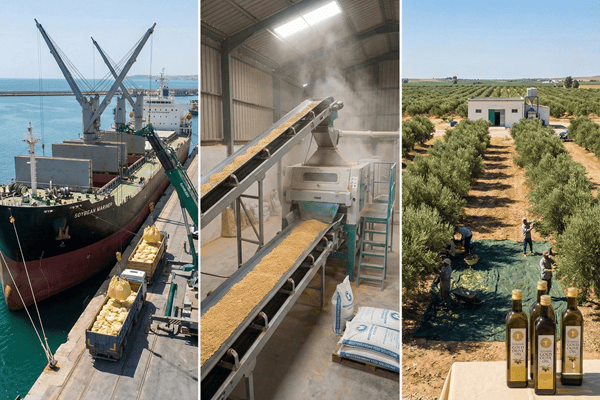
Tunisia Relies Fully on Soybean Imports
Tunisia does not produce soybeans domestically and depends entirely on imports to supply its crushing industry and feed sector.
For MY 2026/27, soybean imports are forecast to reach 595,000 metric tons, rising from 580,000 MT in MY 2025/26 and 507,000 MT in MY 2024/25.
The increase reflects stronger demand for animal feed linked to growth in the food service sector and rising tourism activity.
In MY 2024/25, Tunisia sourced its soybeans mainly from:
-
Brazil: 60%
-
United States: 36%
-
Ukraine: 4%.
Importers typically purchase based on price and availability, although crushers report strong satisfaction with U.S. soybean quality and remain willing to pay premiums when needed.
Soybean Crushing Expands with Feed Industry Growth
Tunisia has one major soybean crushing facility, which supplies meal and oil to domestic markets.
Crushing is forecast to increase gradually:
-
447,000 MT in MY 2024/25
-
475,000 MT in MY 2025/26
-
495,000 MT in MY 2026/27.
The growth reflects expanding demand from the poultry, dairy, and livestock sectors.
Feed millers are also increasingly using soybeans to produce full-fat soybean and express soybean meal for direct feed applications, supported by investments in new soybean pressing units.
Industry sources report that Tunisia’s soybean sector typically maintains about 30 days of processing stocks, equivalent to roughly 45,000 MT.
Soybean Meal Consumption Continues to Rise
Soybean meal remains a critical feed ingredient for Tunisia’s livestock sector.
For MY 2026/27, soybean meal consumption is forecast to reach 540,000 MT, up from 517,000 MT in MY 2025/26.
Approximately 70% of soybean meal consumption is directed to the poultry and egg industries, which remain the largest feed users in the country.
Soybean meal imports are also expected to increase slightly to 165,000 MT in MY 2026/27 to meet growing feed demand.
Olive Oil Production Expected to Drop in 2026/27
Tunisia’s olive oil sector follows an alternating high- and low-yield production cycle.
Production is estimated at 470,000 MT in MY 2025/26, reflecting a strong harvest year.
However, output is forecast to decline sharply to 250,000 MT in MY 2026/27, aligning with the typical lower-yield year in the production cycle.
As a result, olive oil exports are expected to fall significantly:
-
400,000 MT in MY 2025/26
-
240,000 MT in MY 2026/27.
The European Union and the United States remain Tunisia’s primary export destinations, accounting for 60% and 28% of exports respectively.
Vegetable Oil Market Driven by Imports
Soybean oil is Tunisia’s largest imported vegetable oil, followed by palm, corn, and sunflower oils.
For MY 2026/27, soybean oil production is forecast to increase to 90,000 MT, supported by higher soybean crushing volumes.
Palm oil imports are forecast at 63,000 MT, while soybean oil imports are expected to reach 50,000 MT.
Vegetable oil prices are partially subsidized by the government to maintain affordability for consumers.
Government Strategy Focuses on Expanding Olive Production
Tunisia continues to prioritize olive oil production as a key agricultural export industry.
Government targets include:
-
Increasing annual olive oil production to 300,000 MT by 2035
-
Replacing aging olive trees and expanding new plantations
-
Increasing irrigated olive area to stabilize production during drought years.
These measures aim to reduce production volatility and strengthen export revenues.
🔎 CMB Outlook
Tunisia’s oilseed market remains heavily dependent on imports due to the absence of domestic soybean production.
Key market trends include:
-
Rising soybean imports driven by feed demand
-
Gradual expansion in crushing capacity
-
Continued growth in poultry and livestock sectors
At the same time, Tunisia’s olive oil industry remains highly cyclical, with exports fluctuating depending on annual harvest conditions.
In the medium term, the country’s oilseed trade will remain closely linked to feed demand, tourism growth, and olive production cycles.