
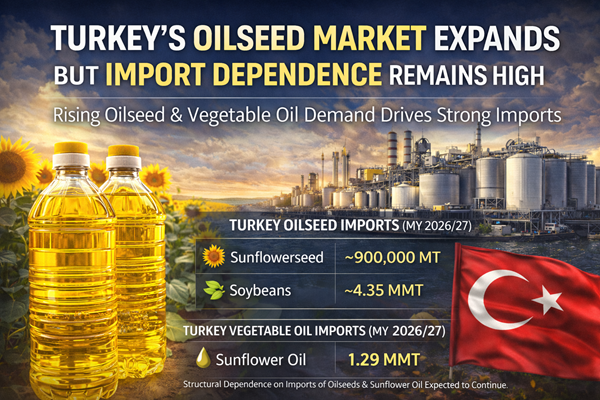
Turkey’s Oilseed Market Expands but Import Dependence Remains High
CMB News | Oilseeds & Vegetable Oils | March 2026
Turkey’s oilseed sector is expected to expand moderately in the coming marketing year, supported by improved weather conditions and rising feed demand from the livestock and poultry sectors. However, despite the projected increase in domestic production, the country will remain heavily dependent on imports of oilseeds and vegetable oils to satisfy domestic consumption and export demand.
The latest USDA Foreign Agricultural Service report from Ankara highlights that Turkey’s oilseed production will rise slightly in the 2026/27 marketing year, while consumption and imports continue to grow in response to expanding feed and food demand.
Oilseed Production Expected to Increase
Turkey’s oilseed production – mainly sunflowerseed, soybeans, and cottonseed – is forecast to reach nearly 2.6 million metric tons (MMT) in MY 2026/27, driven primarily by increased sunflower production.
Turkey Oilseed Production Outlook
| Crop | MY 2026/27 Production |
|---|---|
| Sunflowerseed | ~1.55 MMT |
| Soybeans | ~160,000 MT |
| Cottonseed | ~900,000 MT |
The expansion is supported by improved rainfall conditions after two years of drought, although irrigation constraints remain a risk in several regions.
Sunflowerseed Remains the Dominant Oilseed
Sunflowerseed remains Turkey’s most important oilseed crop.
Sunflowerseed Supply (MY 2026/27)
| Indicator | Volume |
|---|---|
| Production | ~1.55 MMT |
| Imports | ~900,000 MT |
| Crush | ~2.15 MMT |
| Domestic consumption | ~2.35 MMT |
Farmers are expected to expand sunflower acreage to around 760,000 hectares, particularly in regions facing water shortages where drought-resistant crops are preferred.
Soybean Imports Reach Record Levels
Turkey’s domestic soybean production remains relatively small compared with consumption.
Turkey Soybean Market (MY 2026/27)
| Indicator | Volume |
|---|---|
| Production | 160,000 MT |
| Imports | ~4.35 MMT |
| Crush | ~3.1 MMT |
| Domestic consumption | ~4.35 MMT |
Imports are expected to hit a record level, reflecting strong demand for soybean meal used in poultry and aquaculture feed.
Major suppliers include:
- United States
- Ukraine
- Brazil
Feed Demand Drives Oilseed Meal Consumption
Turkey’s rapidly expanding feed sector continues to push demand for oilseed meals.
Compound Feed Production in Turkey
| Year | Production |
|---|---|
| 2023 | 27.9 MMT |
| 2024 | 29.3 MMT |
| 2025 | 30.7 MMT |
The growth is mainly linked to expanding poultry and livestock production. For example, chicken meat production increased 11% in 2025 to 2.8 MMT.
Vegetable Oil Consumption Dominated by Sunflower Oil
Sunflower oil remains the most widely consumed edible oil in Turkey.
Vegetable Oil Consumption (Human Use)
| Oil Type | MY 2026/27 |
|---|---|
| Sunflower oil | 1.12 MMT |
| Olive oil | 320,000 MT |
| Cottonseed oil | 117,000 MT |
| Soybean oil | ~2,000 MT |
| Total | 1.56 MMT |
Soybean oil consumption remains extremely low because Turkish biosafety regulations restrict the use of genetically engineered soybean oil in food products.
Sunflower Oil Imports Continue to Rise
Turkey remains heavily reliant on imported sunflower oil and seeds, particularly from the Black Sea region.
Sunflower Oil Market (MY 2026/27)
| Indicator | Volume |
|---|---|
| Production | 936,000 MT |
| Imports | 1.29 MMT |
| Exports | 1.07 MMT |
| Domestic consumption | 1.16 MMT |
Imports during the current season have been dominated by suppliers from:
- Russia
- Ukraine
Russia alone accounted for more than 300,000 MT of imports during the first months of the marketing year.
Olive Oil Production Set to Rebound
Turkey’s olive oil production is forecast to increase sharply in MY 2026/27 due to the natural cyclical yield pattern.
Olive Oil Market Outlook
| Indicator | Volume |
|---|---|
| Production | 400,000 MT |
| Domestic consumption | 320,000 MT |
| Exports | 90,000 MT |
However, prices remain significantly higher than sunflower oil, limiting consumption among lower-income households.
Strategic Outlook
Turkey is investing heavily in expanding its oilseed crushing and vegetable oil refining capacity. Total crushing capacity is estimated at around 9 MMT, while refining capacity is approximately 4.5 MMT.
Despite these investments, structural import dependence is likely to persist. Limited domestic oilseed production combined with strong demand from the food and feed sectors means that Turkey will continue to rely heavily on global suppliers.
Government policy will therefore remain focused on stabilising domestic prices through tariff adjustments and strategic imports, particularly for sunflower seeds and crude sunflower oil.
Source: USDA