
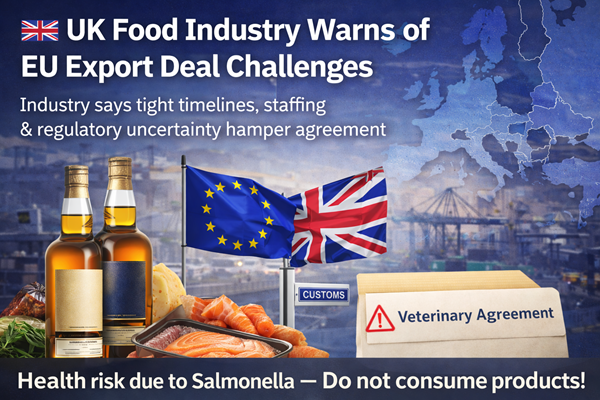


🇬🇧 UK Food Industry Warns Over EU “Veterinary Agreement” Implementation Risks
CMB News | Trade & Policy | February 2026
The UK food and drink industry has warned that the government may struggle to deliver its planned “veterinary agreement” with the EU, citing delays, staff shortages and insufficient business engagement.
The agreement — expected by the end of 2026 — aims to reduce post-Brexit red tape on food and drink exports by aligning the UK more closely with the EU’s Sanitary and Phytosanitary (SPS) rules governing plant and animal products.
⚠️ Industry Concerns: Tight Timelines & Limited Preparation
Karen Betts, CEO of the Food and Drink Federation (FDF), said implementation timelines are already “very tight”.
Key issues raised:
-
The UK is attempting in two years what Switzerland took four to five years to implement.
-
Delays after the May 2025 Windsor summit, when the UK committed to SPS realignment.
-
Lack of early, structured engagement between government departments and industry.
-
Ongoing staffing and budget constraints within Whitehall.
Although Betts acknowledged improvements under the current Defra leadership, she stressed that significant “catch-up” is required if an SPS agreement is to be operational by mid-2027.
🏭 Operational Impact: Packaging, Ingredients & Supply Chains
The core anxiety for food manufacturers lies in regulatory uncertainty:
Companies are already producing goods that will reach shelves in 12–18 months. Without clarity on:
-
Implementation dates
-
Transition periods
-
Regulatory scope
-
EU compliance requirements
…firms risk producing goods that may later fail to comply with EU standards.
Potential friction points include:
-
Ingredient sourcing (e.g., pesticides, fungicides compliance)
-
Flour standards
-
Packaging adjustments to meet EU recycling rules
-
Labelling and certification updates
This affects not only exporters, but all UK food producers, since domestic standards would realign with EU SPS rules.
📊 Economic Stakes
The UK government estimates that the agreement could:
-
Increase UK GDP by £5.1bn annually in the medium term
-
Reduce border checks and administrative costs
-
Improve market access for exports such as Scottish whisky and processed foods
However, the FDF and parliamentary committees argue that without:
-
A 24-month transition period
-
Adequate administrative capacity
-
Clear regulatory roadmaps
…the deal could impose short-term financial strain on food manufacturers and farmers.
🧑⚖️ Political Context: Brexit Reset Under Pressure
Prime Minister Keir Starmer’s government has committed to a pragmatic “reset” with the EU. Delivering tangible trade benefits is politically important.
But five years after leaving the single market, regulatory reintegration presents practical challenges:
-
Need for expanded Defra and Food Standards Agency capacity
-
Continuous monitoring and alignment with evolving EU SPS rules
-
Long-term regulatory dependency considerations
🔎 CMB Outlook
The proposed veterinary agreement is economically rational for UK food exporters. However:
-
Implementation risk is high.
-
Regulatory alignment is complex and resource-intensive.
-
Transitional clarity is essential to prevent supply chain disruption.
Key watchpoints:
-
Confirmation of transition periods
-
Defra staffing allocations
-
Formal EU–UK negotiation timelines
-
Industry compliance guidance rollout
If executed efficiently, the agreement could materially improve UK agri-food trade flows with the EU. If mismanaged, it risks creating new uncertainty in an already fragile post-Brexit trade environme