
You may be thinking about dusting off the combine to prepare for harvest, but your end users are already thinking about your fully grown crop.
“It may have been a slow start to this planting season, but I’m already excited to see where this crop will go,” says Doug Winter, Illinois soybean grower and soy checkoff farmer-leader. “I’m proud that soybean growers like myself provide a gold standard ingredient for end users domestically and internationally.”
U.S. soybeans, compared to soybeans of other origins, bring a lot of value to the table for end users, which brings returns to yours. Because of that, your soy checkoff continuously invests in research to keep U.S. soybean meal top of mind for end users.
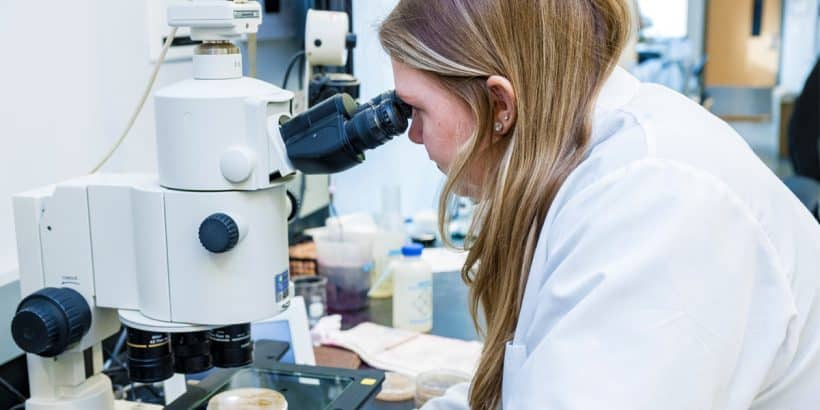
So, what is most important for end users? One word: protein. That hasn’t escaped the eyes, or microscopes, of the researchers focused on soybeans.
“Soybeans are a wonderful producer of protein and have set the gold standard for animal feed. But just because it’s the gold standard doesn’t mean that it couldn’t be tailored further,” says Doug Allen, USDA research scientist and principal investigator at the Donald Danforth Plant Science Center in St. Louis, Missouri.
Protein starts in the seed. So that’s where scientists start their journey to a better and better bean.
IN THE SEED
To increase the value of soybean meal, many researchers start by looking inside the bean.
“We study the metabolism of soybeans that have been augmented through breeding, gene editing or transgenic approaches,” says Allen.
Other researchers take a single bean and begin seed selections and variety trials — all with the goal of shuttling resources into the right amino acid balance to affect the protein quantity and quality.
“Different research strategies are equally valid and complementary. We need sustained research efforts to improve soybean yield and composition and to make crops more resilient to changing climates,” says Allen.
IN THE SOIL
While what’s inside the bean plays a critical role in its value, how it’s grown also has an impact.
“The capacity of soybeans to take up and use the nitrogen through partnering with microbes ultimately contributes to the high protein content in seeds,” says Allen.
Allen works with the Subterranean Influences on Nitrogen and Carbon Center at the Danforth Plant Science Center. SINC is dedicated to developing technology that will reduce the amount of chemical nitrogen fertilizer used in agriculture without sacrificing crop yield.
“Coming from the farm, I can appreciate that farmers are business-oriented and want to maximize the return per acre while also being good stewards. That could mean having a cover crop to help rebuild soil and replenish nutrients, or better leveraging the microbiome for plant productivity and to save on fertilizer inputs and associated costs,” says Allen.
Nitrogen fixation is critical to soybean growth and success. Their root systems are set up to fix nitrogen. Fungi like rhizobium and mycorrhizae increase the surface area of roots, allowing the roots to pull more nutrients from the soil into the plant. Kind of like adding an antenna to your TV.
“Within SINC and at the Center, there is strong interest and expertise in understanding the beneficial interactions between microbes and plants, the often overlooked role of roots, their structure, organization and metabolism, and the genetics of crops that enable the productive interactions,” says Allen. “I think there’s a lot of unexplored opportunity here for agricultural advances.”
ON THE FARM
While science works to increase protein for end users, your checkoff knows that yield for soybean farmers can’t fall by the wayside.
“End users need protein from our soybeans, and soybean growers need yield from our crop,” says Winter. “We’re committed to keeping both of those top of mind when directing checkoff investments.”
As soybeans across the country grow each day, their importance to the world, to you and to your checkoff does not go unnoticed.
“Soybean meal research will ultimately add value to the U.S. soybean,” adds Allen. “Adding value to agriculture means adding value to the family farm and local economies, but also responsibly contributing to more sustainable agriculture for generations to come.”