
🔵 Executive Summary
A recent US Supreme Court ruling invalidating the use of emergency tariff powers has significantly weakened Washington’s negotiating leverage over China ahead of a planned leaders’ meeting in Beijing at the end of March.
By striking down the mechanism that allowed rapid and broad tariff escalation, the Court has reduced the United States’ ability to apply immediate trade pressure. China now faces a baseline global tariff of approximately 15%, far below the peak levels of up to 145% imposed last year.
The decision carries notable implications for global agricultural markets, particularly soybeans.
⚖️ Legal Shift Redefines Trade Leverage
The Court’s ruling eliminated a tool that had enabled:
-
Rapid tariff increases
-
Broad-based trade actions
-
Executive-driven negotiation pressure
Without emergency tariff authority, US trade actions must now rely on:
-
More limited statutory mechanisms
-
Sector-specific procedures
-
Congressional-backed frameworks
This reduces tactical flexibility in high-level trade negotiations.
🌱 Soybeans: The “Negotiation Card” Returns
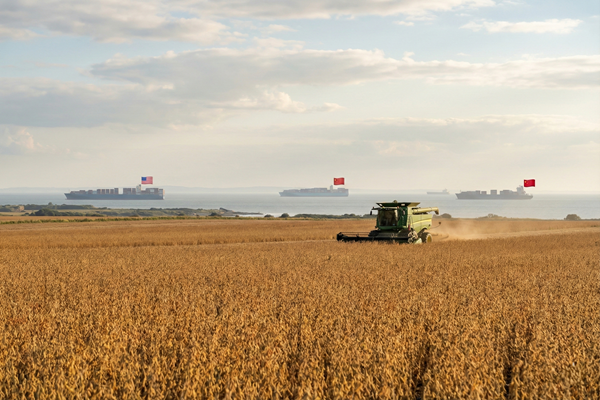
Agricultural trade — especially soybeans — was one of the primary arenas of tariff pressure.
Previously:
-
Tariffs were used to encourage larger Chinese purchases of US soybeans.
-
Trade policy uncertainty influenced planting decisions and pricing expectations.
With emergency tariffs removed:
-
China regains greater discretion over procurement volumes.
-
The so-called “soybean card” becomes a more flexible diplomatic instrument for Beijing.
-
Supplier diversification strategies may intensify.
China remains the world’s largest soybean importer, making its purchasing decisions critical to global price formation.
🌍 Global Market Implications
Reduced tariff pressure may result in:
-
More diversified sourcing between the US, Brazil, and other exporters
-
Increased competition among soybean suppliers
-
Greater price sensitivity to commercial rather than political signals
The ruling also affects other sectors:
-
Energy exports
-
Industrial goods
-
Technology-linked trade
Without broad tariff threats, Washington may find it more challenging to extract large-scale purchase commitments.
🧭 CMB Market Interpretation
The Court’s decision represents a structural shift in US trade strategy toward China.
Key Observations:
-
Executive-led tariff escalation is now legally constrained.
-
China enters negotiations with improved bargaining strength.
-
Soybean markets may see reduced political volatility but sustained competition.
-
Alternative US trade tools still exist, maintaining baseline uncertainty.
Short-Term Outlook:
Improved sentiment stability in agricultural markets.
Medium-Term Outlook:
Competition between US and Brazilian soybean exports likely intensifies.
Strategic Impact:
Negotiation leverage shifts modestly toward Beijing.
📊 Risk Assessment
| Factor | Risk Level |
|---|---|
| Tariff Shock Risk | Lower |
| US–China Trade Tension Persistence | Moderate |
| Soybean Price Volatility | Moderate |
| Supplier Diversification Pressure | High |
| Alternative Tariff Tools Risk | Moderate |
📌 Why This Matters Now
-
Leaders’ meeting scheduled for late March.
-
China’s soybean procurement decisions influence global trade flows.
-
US exporters may face intensified competition.
-
Legal constraints reshape future US trade strategy.
The ruling reduces immediate tariff escalation risk but does not eliminate broader trade friction.
🏁 Conclusion
The US Supreme Court’s decision to invalidate emergency tariff powers has materially weakened Washington’s leverage in trade negotiations with China.
For agricultural markets — particularly soybeans — the shift could reduce politically driven volatility while increasing competitive pressure among exporters.
Although alternative tariff tools remain available, the ruling marks a significant recalibration in the balance of trade power between the two largest global economies.