
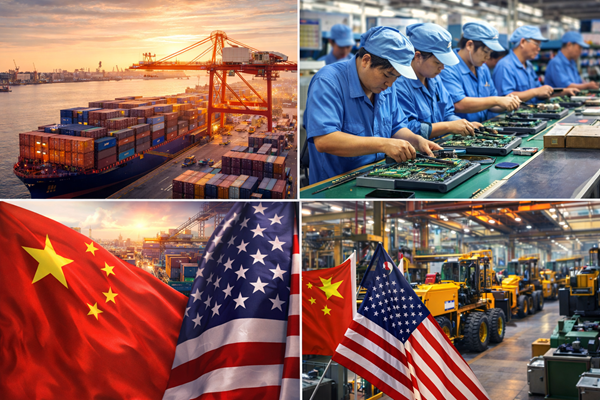
US Tariff Relief Sparks Export Rush — but Uncertainty Still Clouds China–US Trade
CMB News | Global Trade | March 11, 2026
A temporary reduction in U.S. tariffs on Chinese goods is triggering a rush among some Chinese exporters to accelerate shipments to the United States. At the same time, many companies remain cautious, warning that long-term uncertainty in China–U.S. trade relations continues to weigh heavily on investment decisions.
The shift follows a ruling by the U.S. Supreme Court, which limited President Donald Trump’s ability to impose tariffs unilaterally. As a result, the effective U.S. tariff burden on Chinese products has temporarily declined, offering exporters a short window to increase shipments before potential policy changes later in the year.
U.S. Tariffs on Chinese Goods Fall Significantly
According to calculations by Capital Economics, the weighted average U.S. tariff rate on Chinese goods has fallen from 32.4% to approximately 22.3% following the court ruling and the introduction of a temporary global tariff structure.
Average U.S. Tariff Rates
| Period | Average Tariff Rate |
|---|---|
| Before ruling | 32.4% |
| After ruling | 22.3% |
| Temporary global tariff floor | 10% |
President Trump has indicated that the global tariff could increase by another five percentage points, which could narrow the current opportunity for exporters.
Chinese Exporters React Differently
Export companies in China’s major manufacturing hubs such as Shenzhen are responding in different ways to the temporary tariff relief.
Some manufacturers are attempting to front-load shipments, rushing products to the U.S. market before the policy environment changes again. One equipment manufacturer, for example, is reportedly sending technicians to the United States to accelerate the installation of machinery for a food processing plant expansion.
However, other executives remain skeptical.
Many companies fear that tariffs could be reinstated quickly through alternative legal mechanisms or sector-specific trade measures.
One executive involved in overseas industrial projects noted that the uncertainty surrounding China–U.S. relations continues to create “psychological pressure” for exporters and investors.
Short-Term Boost for China’s Export Momentum
Despite the caution among many companies, analysts believe the tariff reduction could temporarily support China’s export growth.
Deepali Bhargava, Asia-Pacific head of research at ING, said the new tariff environment could provide upside potential for Chinese exports in the near term.
Chinese manufacturers may try to ship goods more quickly to lock in the lower tariff exposure while it lasts.
This dynamic could help support China’s economic growth this year, with forecasts suggesting GDP expansion of around 4.5% to 5%.
China Continues Diversifying Export Markets
Even with improved access to the U.S. market, Chinese exporters are continuing to expand into alternative markets.
In 2025, China recorded a record trade surplus of $1.2 trillion, driven in part by strong exports to emerging markets.
Growth in Chinese Exports by Region (2025)
| Region | Export Growth |
|---|---|
| Africa | +25.8% |
| Latin America | +7.4% |
| Southeast Asia | +13.4% |
| European Union | +8.4% |
Shipments to the United States, however, declined by 20%, although the U.S. remains one of China’s most important export destinations.
Industrial Overcapacity Intensifies Competition
Another structural challenge for Chinese exporters is the country’s large industrial capacity.
As companies push into new markets, they often find themselves competing not only with local manufacturers but also with other Chinese firms.
This creates strong price competition across many sectors.
A senior executive from a consumer goods manufacturer in eastern China described the situation bluntly:
“Most of our competitors are Chinese companies. The pressure has not decreased for anyone.”
Outlook
The temporary tariff reduction offers Chinese exporters a short-term opportunity to increase shipments to the United States. However, the broader trade relationship between the two countries remains fragile.
Many companies are therefore continuing to diversify their export strategies, expanding sales in emerging markets across Africa, Southeast Asia, and Latin America while reducing long-term dependence on the U.S. market.
Unless a broader trade agreement is reached, volatility in tariff policy and global trade relations is likely to remain a defining feature of China–U.S. economic relations in the coming years.
Source: Reuters