
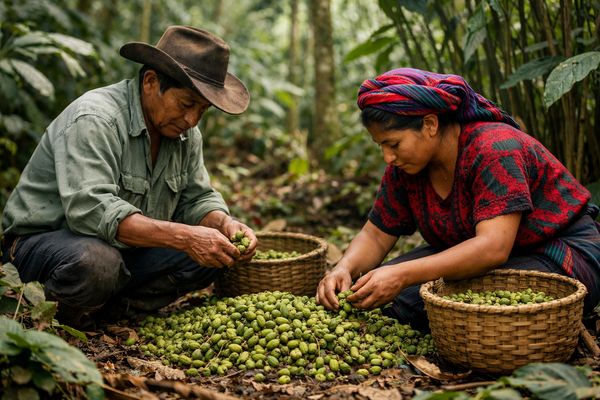
Large cardamom prices are edging higher as weather‑related crop damage in Nepal and India’s Northeast combines with tighter holding by stockists, keeping nearby supply thin while demand holds steady. The market is likely to remain in a firm band over the coming weeks, with upside risk if adverse weather persists or damage estimates deepen.
Large cardamom, the smoky, high‑altitude Himalayan variety, is seeing renewed support after unseasonal rain and hail damaged standing crops in key belts of Nepal and India’s Sikkim–Darjeeling region. At the same time, March‑end business closures and strategic stockist behavior have restricted physical availability just as food‑service demand builds into India’s summer wedding season. For European and Middle Eastern buyers, this translates into a cautiously firm near‑term outlook and reduced incentive to run short inventories.
Exclusive Offers on CMBroker

Cardamom whole
green,7.5-8 mm
FOB 18.10 €/kg
(from IN)

Cardamom whole
green 6.0-6.5 mm
99%
FOB 16.35 €/kg
(from IN)

Cardamom whole
green, 8 mm
FOB 24.35 €/kg
(from IN)
📈 Prices & Spreads
During the week under review, large cardamom prices rose by about USD 0.22/kg, to roughly USD 18.01–18.12/kg. Using an indicative 0.93 FX factor, this corresponds to approximately EUR 16.75–16.85/kg at origin for Himalayan large cardamom.
In parallel, latest FOB New Delhi offers for Indian green cardamom (small cardamom, different product segment but an important price reference) show a mild upward bias since mid‑March, reinforcing the picture of a generally supported cardamom complex. Converted to EUR, current indicative green cardamom and powder offers are broadly in the mid‑ to high‑teens and low‑twenties per kilogram.
| Product (India FOB New Delhi) | Specification | Latest Price (EUR/kg) | WoW Change (EUR/kg) |
|---|---|---|---|
| Cardamom whole (green) | Organic 6.0–6.5 mm | ≈ EUR 15.20 | +≈ EUR 0.05 |
| Cardamom whole (green) | Conventional 7.5 mm | ≈ EUR 21.80 | +≈ EUR 0.05 |
| Cardamom powder | Organic | ≈ EUR 22.60 | +≈ EUR 0.05 |
Note: EUR prices are approximate conversions from listed USD or local currency values using an indicative rate and rounded for clarity.
🌍 Supply & Demand Drivers
On the supply side, unseasonal rainfall and hail across Nepal and India’s northeastern producing belts have damaged standing large cardamom crops and raised concerns about both yield and quality. Fresh heavy‑rain warnings and travel disruptions reported across Sikkim in early April confirm that weather in the Himalayan spice belt remains unstable, sustaining worries about further field and post‑harvest losses.
Stockists have reacted by tightening their grip on available inventory rather than selling into uncertainty. Because large cardamom production is geographically concentrated and stocks are held by a relatively small number of wholesalers, coordinated holding back quickly shrinks market float and amplifies even modest buyer enquiries into price moves. Inflows into key consuming markets have also been curtailed by March‑end business closures, adding a seasonal layer of short‑term tightness.
On the demand side, Indian restaurant and catering demand is building ahead of the summer wedding and festive calendar, where large cardamom is a staple in rice and meat dishes and demand tends to be relatively inelastic. Export demand from Europe and parts of Asia is described as steady rather than exuberant, but against tightened nearby supply this is sufficient to keep the market bid.
📊 Fundamentals & Weather Outlook
Fundamentally, the current move looks like a weather‑and‑stock driven firming phase rather than a full‑scale rally. The reported crop damage is credible but not yet fully quantified; field assessments have yet to confirm large, structural production losses. As a result, the market is pricing in risk premium for quality and availability without breaking decisively into a new, higher trading regime.
Short‑term weather risk remains skewed to the downside for production. Forecasts for the first half of April indicate continued instability in the eastern Himalayan region, with heavy rainfall, landslide risk and localized hail still possible in parts of Sikkim and neighboring hill regions. This environment supports the narrative of potential further damage to late‑stage crops and logistics disruptions, which in turn discourages aggressive selling by producers and stockists.
Broader spice‑sector signals from India also point to weather‑related support across high‑value spices, with markets such as cassia and mace showing mild upside bias on emerging weather volatility and freight concerns. While these are different products, they help sustain a generally firm tone in the premium spice complex, indirectly underpinning large and green cardamom pricing.
📆 Short‑Term Market Outlook
Over the next two to four weeks, the most likely scenario is a continuation of the present price band for large cardamom with a clear upside bias. Further reports of crop damage or prolonged heavy rains in Nepal and the Indian Himalayan region could trigger incremental gains as risk premia expand and stockists feel vindicated in holding back supply.
A more pronounced, sustained rally beyond current levels would probably require confirmation of significant production losses or a sharper‑than‑expected acceleration in export demand. Conversely, if weather stabilizes and field surveys show only modest yield impacts, some of the current weather premium could erode, particularly after the peak of the domestic wedding season when Indian food‑service demand normalizes.
💡 Trading & Procurement Recommendations
- Importers (EU / Middle East): Avoid running excessively short; cover at least 4–6 weeks of requirements at current levels, given upside weather risk and tight nearby stocks.
- Indian buyers (food service & packers): Use any brief dips from current levels to secure coverage through the core wedding and festive period rather than waiting for confirmation of crop size.
- Producers & stockists: A measured holding strategy remains justified while damage assessments are incomplete, but consider scaling out of stocks on further sharp spikes to lock in margins before fundamentals are fully known.
- Risk management: Where available, use regional cardamom futures or cross‑hedging via correlated spice contracts to protect against weather‑driven volatility.
📍 3‑Day Indicative Directional Outlook (EUR)
- Large cardamom, Himalayan origin (farm‑gate equivalent): ≈ EUR 16.7–16.9/kg, stable to slightly firmer over the next 3 days on ongoing weather concerns and tight local stocks.
- Green cardamom FOB New Delhi (whole, mid‑grades): Mid‑ to high‑teens EUR/kg, bias mildly upward in line with broader spice‑sector weather risk and firm food‑service demand.
- Cardamom powder FOB New Delhi: Low‑ to mid‑twenties EUR/kg, likely to track whole‑pod sentiment with limited downside in the very near term.
Related posts:
 Large cardamom firms as India’s marriage season kicks off
 Indian Cardamom Firms on Tight Supply and Pre-Monsoon Rains in Kerala
 Nepal Large Cardamom Exports Surge to Record, Prices Stay Firm
 Nigella seeds correct lower as Indian stockists turn sellers
 Large Cardamom Capped by Tight Nepal Supply and Heavy Stock Overhang
 Nigella Market Softens as Delhi Stockists Sell Into Weak Demand
 Cumin market cools as Indian buyers step back and stockists sell into weakness
 Indian Chilli Prices Hold Firm at Peak Arrivals as Cyclone Losses Tighten Supply