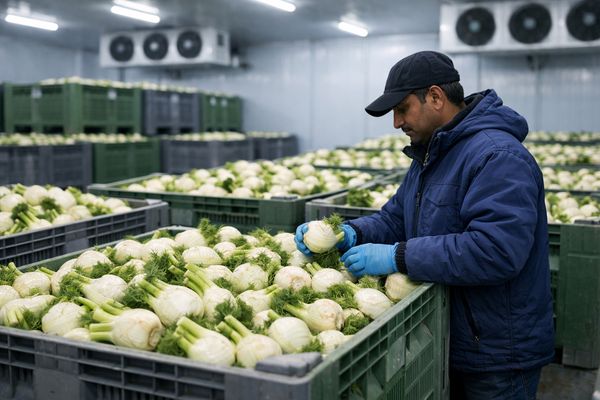
Indian fennel has entered a clear recovery phase, with spot prices in Delhi surging alongside cumin and turmeric as consumer and institutional buying returns and export logistics begin to normalise. The short‑term balance of risks points moderately to the upside, especially for premium export grades sensitive to renewed demand from Europe and the Middle East.
The latest session in Delhi’s wholesale spice trade saw fennel advance sharply, driven less by any visible surge in arrivals and more by a demand-led squeeze as sellers stayed cautious and buyers re‑entered after weeks of geopolitical uncertainty. With India firmly positioned as the global reference market and a two‑week ceasefire in the Strait of Hormuz starting to ease freight disruptions, European and North American buyers face rising replacement costs for high-quality Indian fennel and should consider accelerating coverage before new-crop flows fully stabilise the market.
Exclusive Offers on CMBroker

Fennel seeds
grade - A
99%
FOB 1.16 €/kg
(from IN)

Fennel seeds
grade - A
98%
FOB 0.91 €/kg
(from IN)

Fennel seeds
99%
FOB 1.05 €/kg
(from IN)
📈 Prices & Market Tone
At Delhi’s wholesale market, fennel traded around USD 158.82–294.12 per 100 kg, reflecting a wide spread between run-of-crop material and premium double‑cleaned lots aimed at exporters and pharma buyers. Using an indicative rate of 1 USD ≈ 0.92 EUR, this implies roughly EUR 146–271 per 100 kg (EUR 1.46–2.71/kg) on a spot basis.
Export offers from New Delhi for conventional fennel seeds (FOB) are broadly aligned with this structure: recent quotations cluster around EUR 0.84–1.07/kg for non‑organic seeds, while organic powder and whole fennel command significant premiums near EUR 1.98–2.05/kg FOB. The stability of these FOB quotes over recent weeks, despite the spot rally, suggests exporters are absorbing part of the domestic move for now, but this buffer is unlikely to persist if local strength continues.
| Product | Location/Term | Price (EUR/kg) | Comment |
|---|---|---|---|
| Fennel seeds, standard (run-of-crop) | Delhi spot | ≈ 1.46 | Lower end of wholesale range |
| Fennel seeds, premium double‑cleaned | Delhi spot | ≈ 2.71 | Export & pharma focused grades |
| Fennel seeds 98–99% purity | New Delhi FOB | 0.84–1.07 | Conventional export offers |
| Fennel organic powder | New Delhi FOB | ≈ 1.98–2.05 | Value‑added segment |
| Fennel whole organic | New Delhi FOB | ≈ 2.03–2.09 | Premium niche, soft downtrend recently |
🌍 Supply, Demand & Geopolitics
The current fennel rally is part of a broader rebound across India’s spice complex, with cumin and turmeric also firming as domestic retail and institutional demand normalises. Fennel is benefiting from a particularly favourable demand mix: steady offtake from Ayurvedic and digestive‑health applications provides a structural floor, while culinary and food‑service demand adds cyclical upside as sentiment improves after recent uncertainty around the Middle East conflict.
On the supply side, detailed arrival numbers from Unjha in Gujarat—the key reference market for global fennel—have not been reported for the latest session, reinforcing the sense that the immediate move is driven more by a demand shock than a sudden shortage. Still, restrained selling in producing regions is amplifying price gains, as farmers and traders hold back in anticipation of better levels and await clearer signals on the timing and scale of new crop arrivals.
Externally, the reopening of the Strait of Hormuz under a two‑week ceasefire has begun to ease freight and insurance pressures, although logistics experts expect full normalisation of shipping costs and vessel positioning to take 1–3 months. For fennel exports, this means a gradual improvement in transit reliability and potentially softer freight into Europe and the Middle East just as buyers re‑enter the market, reinforcing India’s role as the price‑setting origin.
📊 Structural Fundamentals
India remains the dominant global producer and exporter of fennel, with Unjha prices effectively setting the reference for European and North American buyers. The dual‑use nature of fennel—serving both culinary channels and medicinal/digestive health industries—reduces its vulnerability to sharp price corrections compared with single‑use spices. When consumer sentiment weakens, pharma and wellness demand tends to remain stable, and when sentiment improves, fennel often leads the recovery.
European herbal tea blenders, digestive supplement manufacturers and natural food brands maintain a strong preference for premium Lucknow and Gujarat fennel, particularly double‑cleaned and organic formats. This structural import dependence, combined with India’s outsized share of global supply, leaves European buyers exposed to swings in Indian domestic pricing and export parity, especially during periods of freight disruption or geopolitical tension.
In the near term, the main fundamental swing factor is the pace and quality of new‑crop arrivals in Gujarat. An earlier‑than‑expected, sizeable inflow of fresh fennel could cap the rally and restore a wider spread between standard and premium grades. Conversely, if arrivals remain staggered or quality is mixed while export channels reopen and pharma demand stays firm, the current upward price bias could extend through the next 2–4 weeks.
🌦️ Weather & Crop Outlook (Key Growing Areas)
Weather across India’s north‑western belt has recently been broadly supportive for late‑season fieldwork and logistics, with no acute reports of disruptive rainfall or temperature extremes over the last few days in mainstream agri coverage. Fertiliser supply concerns linked to earlier Middle East tensions have eased somewhat with the ceasefire, though input costs and freight remain elevated compared with pre‑conflict norms, which could still influence planting decisions and cost structures in the upcoming cycle.
For fennel, most of the immediate 2–4 week price drivers are demand and logistics related rather than strictly weather‑driven. As such, short‑term weather risk to standing crops appears limited for now, while macro‑geopolitical and freight dynamics continue to play a larger role in export parity and buyer sentiment.
📆 2–4 Week Price Outlook & Trading Ideas
Baseline expectations point to a continuation of the recent upward drift in Indian fennel, assuming domestic demand remains active and growers’ selling stays measured until new-crop flows are fully established. The key downside risk is a sharper‑than‑expected jump in arrivals at Unjha, which could quickly restore liquidity and cap further gains, especially for mid‑grade material.
🧭 Strategic Pointers for Market Participants
- European and Middle Eastern buyers: Consider advancing purchases of premium double‑cleaned and organic fennel for Q2–Q3 coverage while FOB levels still lag the full domestic rally. Prioritise origin‑near contracts before freight costs fully re‑price to the post‑ceasefire environment.
- Indian exporters: Use the current demand rebound to selectively raise offer levels for higher‑grade fennel, especially to herbal, pharma and natural food clients, while maintaining competitive pricing on standard grades to defend market share.
- Industrial users (pharma/digestive health): Lock in at least partial forward cover over the next 2–3 months to protect margins against further upside in seed costs; consider diversifying between whole and processed formats to optimise input pricing.
- Producers and stockists in Gujarat: Maintain disciplined selling into strength but monitor new‑crop arrival pace closely; a sudden increase in volumes could flatten the curve and argue for accelerating sales of lower‑quality stocks.
📉 3‑Day Directional Outlook (EUR Basis)
- Delhi spot fennel (standard grades): Mildly bullish bias; prices likely to hold near the upper half of the recent EUR 1.40–1.60/kg band for run-of-crop material as active demand meets cautious selling.
- Premium double‑cleaned fennel (export‑oriented): Bullish; potential to test slightly above the current implied EUR 2.70/kg area on firm export enquiries and limited top‑quality availability.
- FOB New Delhi export offers (conventional seeds): Steady to slightly firmer; current EUR 0.84–1.07/kg range may edge higher if domestic spot strength persists and freight normalisation gathers pace.