
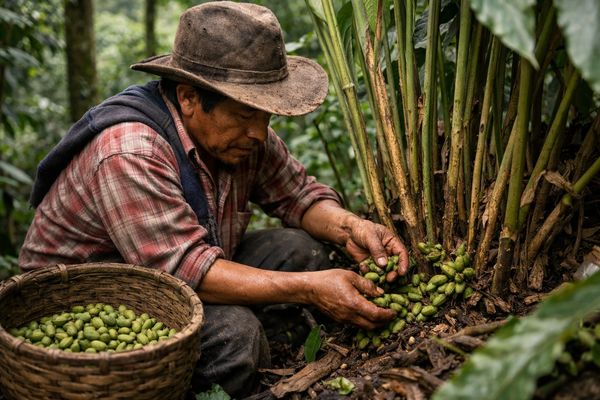
Large cardamom posted a sharp, weather‑driven spike before giving back part of the gains as Indian wholesale demand hesitated, leaving prices elevated but no longer in full rally mode. Tight Himalayan supply and stockist hoarding remain supportive, yet weak end‑week offtake signals a near‑term consolidation within a defined range.
Large cardamom – the bold, smoky variety from Sikkim and Nepal – saw a choppy week in Delhi, with prices first surging on reports of crop damage and restricted selling before softening as consumer and institutional buyers stepped back. The structural story is still bullish: harvest losses in Nepal and India’s northeast constrain supply, while demand from South Asian, Middle Eastern and niche European users stays resilient. However, the latest pullback, combined with easing wholesale activity across the spice complex, argues for more sideways, volatile trade rather than an immediate renewed spike.
Exclusive Offers on CMBroker

Cardamom powder
FOB 24.00 €/kg
(from IN)

Cardamom whole
green,7.5-8 mm
FOB 17.90 €/kg
(from IN)

Cardamom whole
green 6.0-6.5 mm
99%
FOB 16.10 €/kg
(from IN)
📈 Prices & Volatility
At the start of the week, large cardamom in Delhi wholesale markets jumped to ₹1,680–₹1,690 per kg before slipping by roughly ₹20 to end around ₹1,660–₹1,670 per kg. Converted at ₹93.10 per EUR, this places current wholesale levels at approximately €17.80–€17.95 per kg, close to but just below the weekly peak.
Recent auction data from Sikkim and adjoining markets broadly corroborate this elevated price zone, with large cardamom categories trading in the mid‑₹1,500s to high‑₹1,700s per kg in early April, underscoring a firm but not runaway market.
By contrast, FOB offers for Indian green cardamom from New Delhi (a different product segment) are clustered around €16–€24 per kg depending on size and quality, leaving a pronounced premium for large cardamom relative to standard green grades.
| Product / Market | Price Range (EUR/kg) | Trend vs. Previous Week |
|---|---|---|
| Large cardamom, Delhi wholesale | ≈17.8–18.0 | Spike early, mild correction later |
| Green cardamom whole, 6.0–6.5 mm, FOB New Delhi | 16.1 | Slightly softer (‑0.25 EUR) |
| Green cardamom whole, 7.5–8 mm, FOB New Delhi | 17.9 | Marginally softer (‑0.2 EUR) |
| Green cardamom whole, 8 mm, FOB New Delhi | 24.1 | Marginally softer (‑0.25 EUR) |
| Cardamom powder, FOB New Delhi | 24.0 | Stable to slightly lower |
🌍 Supply & Demand Drivers
Structurally, large cardamom supply is constrained this season. Traders widely acknowledge crop damage in Nepal – the dominant origin – and in India’s Sikkim and northeastern belts, where production is geographically concentrated and highly exposed to adverse weather. When stockists simultaneously hold back inventories on such news, available market supply can tighten abruptly, amplifying price spikes.
On the demand side, large cardamom benefits from steady usage in Indian and regional cuisines (biryani, spiced teas, confectionery) and in Middle Eastern coffee preparations, with European specialty food and flavour segments adding incremental pull. Nonetheless, the late‑week correction in Delhi highlights buyer fatigue at higher levels: institutional users and traders show limited willingness to chase prices, preferring to wait for dips before restocking.
Recent indications from Indian wholesale trade suggest that after early‑April firmness linked to restocking and seasonal consumption, large cardamom demand has entered a softer patch, with kiryana and food‑service buyers largely covered in the near term. This has shifted the immediate focus from weather‑driven scarcity to consumption‑side discipline, reinforcing a rangebound profile despite tight underlying fundamentals.
📊 Fundamentals & Weather Outlook
Production data and field reports confirm that both Nepali and Indian origins have suffered crop losses, implying a structural shortfall that will not be resolved quickly. Given the small, high‑altitude footprint of large cardamom cultivation, even moderate weather shocks translate into disproportionate swings in tradable volumes and, by extension, prices.
In the core Himalayan growing zones of Sikkim and eastern Nepal, recent weather has been seasonally mixed but without a fresh, clearly defined new shock in the past few days, so the market is trading more on the established damage narrative than on new crop news.
With inventories in the trade already partially adjusted to earlier supply concerns, the key question for the next 2–4 weeks is whether end‑user and export demand will re‑accelerate into the tighter crop backdrop or continue to ration at current high prices. The base case is consolidation: the market is expected to oscillate in roughly the ₹1,620–₹1,720 per kg band (about €17.40–€18.47 per kg) over the next fortnight, with dips finding support from structural tightness and rallies capped by price‑sensitive buyers.
📌 Trading Outlook & Strategy
- Buyers (food industry, blenders, roasters): Use current pullbacks towards the lower half of the projected ₹1,620–₹1,720 (≈€17.4–€18.5) range to secure medium‑term cover, especially for large cardamom‑heavy blends and product launches. Avoid chasing spikes driven purely by stockist hoarding.
- Exporters & traders: Maintain flexible pricing clauses with clients in the Middle East and Europe, reflecting likely short‑term volatility. Stagger sales rather than front‑loading commitments, as renewed demand or fresh weather issues in the Himalayas could quickly re‑tighten values.
- Producers & stockists: Given the structural supply constraint, a gradual selling strategy is advisable, but the recent demand‑led correction warns against overly aggressive holding. Consider scaling out of stocks on moves to the upper end of the projected range.
- Risk management: For users exposed to both large and green cardamom, monitor the premium between the two segments. If the spread widens further, some product reformulation or partial substitution into green cardamom where feasible could cap input cost pressure.
📆 3‑Day Price Indication (Directional)
- Delhi wholesale (large cardamom): Mildly softer to sideways, with trade likely around the mid‑₹1,600s per kg (≈€17.7–€18.0), barring any abrupt demand surge.
- Indian FOB green cardamom (New Delhi offers): Slight downside bias or flat, after modest easing over recent weeks, as export and domestic demand remain steady but unspectacular.
- Himalayan origin auctions (Sikkim/Nepal, indicative): Sideways within a firm band, reflecting already‑priced‑in crop losses and cautious buying interest.
Related posts:
 Large Cardamom Eases from Recent Highs as Seasonal Demand Softens
 India’s Natural Peppermint Oil Supply Squeezed as Uttar Pradesh Farmers Exit Mentha – Menthol Complex Braces for Tightness
 Large Cardamom Softens as Seasonal Demand Lulls, Rangebound Trade Ahead
 Tight Large Cardamom Supply Keeps Prices Firm as Export Demand Stays Strong
 Large Cardamom Firms as Weather Damage and Stockists Tighten Supply
 Large cardamom firms as India’s marriage season kicks off
 Nepal Large Cardamom Exports Surge to Record, Prices Stay Firm