
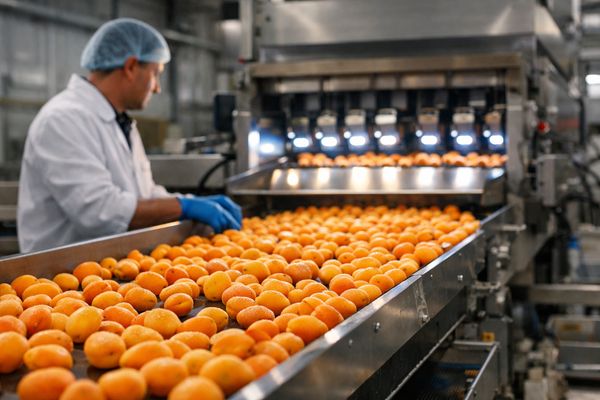
Prices for Turkish dried apricots are broadly stable to slightly firmer, with no major weather or supply shocks in Malatya so far and export demand remaining solid.
With Malatya orchards now in full bloom under mild and mostly dry spring weather, the market is in a waiting mode: current-crop stocks are adequate and well sold, while buyers are monitoring flowering and fruit set for any hint of 2026/27 crop size. Turkey keeps its dominant position in world dried apricot exports and continues to benefit from structurally strong demand in Europe and the Middle East, but buyers resist higher offers after the steep increases of recent seasons. For now, price action is driven more by inventory management and logistics than by fundamentals shocks.
Exclusive Offers on CMBroker

Apricots dried
no:8, TR-1123
99,97%
FCA 5.15 €/kg
(from PL)

Apricots dried
Cubes, no - 8
FCA 5.57 €/kg
(from NL)
Apricots dried
Cubes, no - 5
FCA 6.05 €/kg
(from NL)
📈 Prices & Spreads
FOB Malatya prices for conventional whole unsulphured dried apricots are currently around EUR 7.8–8.7/kg for sizes 5–1, with organic lots near EUR 9.3–10.35/kg. Export-oriented sulphured product (2,000 ppm) trades slightly lower, near EUR 6.3–8.7/kg FOB depending on size, leaving a stable quality and colour premium for unsulphured fruit. At destination, Turkish-origin cubes in the Netherlands are quoted roughly between EUR 5.6 and 6.5/kg FCA Dordrecht for standard sizes, while a lower-grade 8–10 mm cube line is around EUR 3.35/kg. FCA Lodz for a TR-1123 no. 8 specification sits near EUR 5.15/kg, unchanged over the past week, confirming a generally sideways short-term trend.
🌍 Supply, Demand & Trade Flows
Turkey remains by far the leading global dried apricot exporter, accounting for the bulk of world trade volumes according to recent Ministry of Trade and industry statistics, with Europe, the USA and the Middle East as key outlets. Export volumes have generally risen in recent years, with Malatya Commodity Exchange data showing Turkish dried apricot exports around 77,000 tons in the latest calendar year, up from about 70,000 tons a year earlier, and export revenue near EUR 370–380 million equivalent. Demand in the EU and Gulf states remains firm, supported by the wider growth trend in dried and freeze-dried fruit consumption in the Middle East region.
On the supply side, structural tightness persists following previous seasons marked by frost and weather volatility in eastern Turkey, which constrained available export-quality volumes and pushed up prices. While other origins (e.g. Central Asia) have increased shipments, they have not fully offset reduced Turkish output and the quality advantage of Malatya fruit. Current-crop stocks in Turkey are reported moderate rather than burdensome, encouraging exporters to defend price levels but limiting their ability to raise offers aggressively as buyers resist further increases after a strong rally in 2024–Q1 2026.
🌦️ Weather and New-Crop Outlook (TR – Malatya)
Apricot orchards in Malatya, Turkey’s main production region, entered full bloom around 1 April 2026, with imagery confirming widespread flowering across the province. For the next three days (14–16 April), Malatya is forecast to see partly sunny to mostly sunny conditions, with daytime highs around 16–20°C and nighttime lows in the 3–8°C range, staying above critical frost thresholds. These mild, dry conditions are favourable for pollination and early fruit set and, crucially, avoid the severe sub-zero episodes that have damaged apricot crops in previous years.
While it is still too early to speak definitively about 2026/27 production, the absence of recent frost events during peak bloom reduces immediate downside risk to the new crop. Market participants will now focus on weather through late April and early May, when late frosts or hail could still impact yield potential. In the meantime, the weather picture helps cap upside price risk, with supply fears much less acute than in seasons marked by heavy freeze damage.
📊 Fundamentals Snapshot
| Segment | Current Situation (EUR/kg) | Trend vs. Recent Weeks |
|---|---|---|
| TR whole, unsulphured, conv. (FOB Malatya) | ≈ 7.8–8.7 | Sideways, after Q1 firming |
| TR whole, unsulphured, organic (FOB) | ≈ 9.3–10.35 | Stable premium |
| TR whole, sulphured 2000 ppm (FOB) | ≈ 6.3–8.7 | Sideways |
| TR cubes std sizes (FCA NL) | ≈ 5.6–6.5 | Flat to marginally higher vs. late March |
| TR cubes 8–10 mm (FCA NL) | ≈ 3.35 | Stable |
| TR no. 8 spec (FCA PL) | ≈ 5.15 | Stable week-on-week |
Fundamentals across the Turkish dried fruit complex (hazelnuts, figs, dried apricots) continue to be influenced by strong export programs and limited stock rebuilding after recent weather-affected seasons. In dried apricots specifically, the combination of moderate inventories, sustained export demand and a less threatening 2026 spring so far creates a relatively balanced picture: not enough oversupply to pressure prices sharply lower, but also not enough shortage to justify a new price spike at current levels.
📆 Short-Term Price Outlook & Trading Strategy
Over the next few weeks, price direction will hinge on two factors: (1) any surprise cold snaps in eastern Turkey during late bloom/early fruit set, and (2) the pace of export sales as Ramadan-related demand and European retail programs are covered. With weather forecasts currently benign and buyers generally well covered for nearby needs, short-term trade is expected to remain orderly, with occasional firm offers on high-quality unsulphured sizes and organic lots where availability is thinner.
🎯 Trading recommendations (1–4 week horizon)
- European buyers: Use current sideways pricing to extend coverage modestly into Q3 2026 for key unsulphured sizes, especially if you rely heavily on Malatya origin and cannot easily substitute other suppliers.
- Importers in CEE and Benelux: Consider opportunistic purchases of cubes and industrial grades while FCA prices in NL and PL remain flat; spreads to whole fruit are reasonable, and any later crop scare could tighten these segments quickly.
- Turkish packers/exporters: Maintain a disciplined offer strategy; with no immediate crop damage and solid demand, aggressive discounting appears unnecessary, but be prepared for some buyer resistance if offers move significantly above current ranges.
📍 3-Day Directional Outlook (Region TR)
- FOB Malatya/Ankara – whole unsulphured & sulphured: Stable over the next 3 days; benign weather and balanced nearby demand imply sideways pricing in EUR terms.
- FCA NL (Dordrecht) – cubes & industrial grades: Stable to slightly firm as logistics and packaging costs remain elevated but no major shift in Turkish origin replacement yet.
- FCA PL (Lodz) – no. 8 TR-1123: Stable; limited spot liquidity but no evidence of price pressure either side at current EUR 5.1–5.2/kg levels.
Related posts:
 Turkish Dried Apricots: Stable to Firm Prices as Frost Risk Fades
 Chinese Dried Apple Cubes Edge Higher on Firm Demand and Stable Logistics
 Turkish Dried Fig FOB Prices Hold Firm as Export Pace Normalises
 Stable Dried Apple Prices in Europe as Turkish Weather Stays Seasonally Mild
 Dried Apricot Prices Steady to Firm as Turkish New Crop Approaches
 Turkish Dried Apricots Hold Firm as Bloom Advances and Stocks Remain Tight
 Dried Apple Prices Hold Steady as Tight Turkish Crop Supports Market